Little disappointed in sharpness of GEC knives. Need help.

Joined
Oct 31, 2013
Messages
315
I was pleased with the #77 barlows I received from Mike. Those GEC knives were nice an sharp, and the overall quality was what you would expect from a GEC knife. However the #15 knives, in both Charlies barlows, and the boys knives have been a little dull. Well made...yes. Sharp....no.

I really don't want to buy an expensive sharpening system to bring these knives up to standard, so what are some of you doing to sharpen knives that have come from the factory somewhat dull?

Any suggestions for me?
 
Last edited:
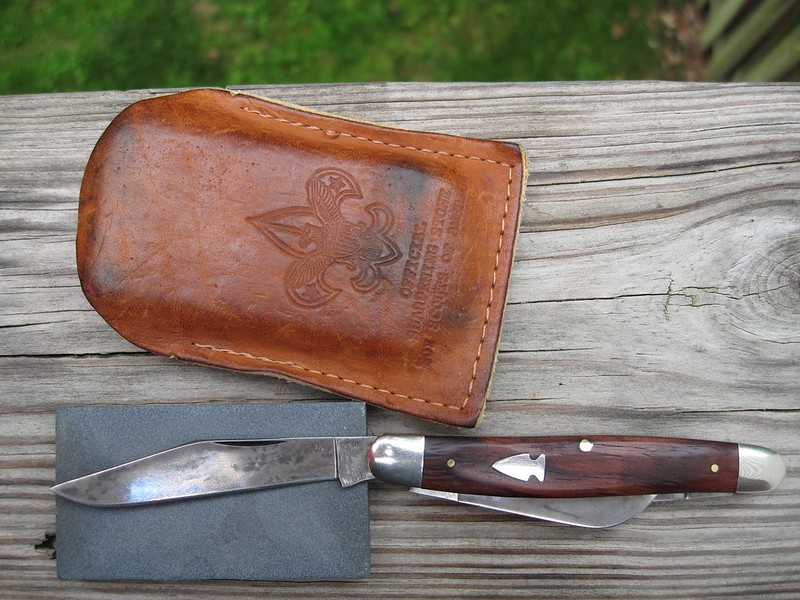
You can get a Norton economy stone from Home Depot for a little more than the price of a fast food lunch. It'll put a nice edge on a traditional pocket knife with a little practice. Strop on the back of an old leather belt and you'll be good to.:thumb up:
14211539277_6e5e6c318e_c.jpg


Or get a coffee mug with nice unglazed ring on the bottom and use that. Ceramic puts a very nice razor edge on knives.
10117187934_a1b70bcc95_c.jpg
 
Short of sending it back in to be sharpened, you really should have a means of maintaining your blade edge. You don't need to spend a lot either. A Lansky system will do just fine for short money.
 
I think sharpness from the factory has always been GEC's weak point.

Thankfully their 1095 is easy to sharpen. I recommend the TriAngle Sharpmaker (although some might consider that expensive). It really shines with small knives, which can be difficult (for me) to sharpen on traditional stones.

I generally just use mine for honing and touch-ups but the steel in question should get sharp pretty easily on it.

Are we allowed to talk about the sharpmaker in this subforum?
 
Of the 100 plus knives purchased from the distributors of GEC, (3) of them were sharp! The others were about as sharp as a butter knife. They do know how to make sharp knives as I have witnessed this in their Northwoods line.

Yes, great quality, poor edges for sure.

TD
 
I like "crock sticks" (aluminum oxide). They wash with water and scouring powder and last decades. One with an 8" rod can do everything up to large Chef's knives. 9 on the mohs scale (diamond at 10).
 
Welcome to the love-hate relationship of GEC knives. I learned how to sharpen knives on this forum and can get a good edge on a 1095 carbon GEC blade.

If you are just collecting the knife, don't worry about it put it in a showcase or keep it in its box or sheath and then pull it out and look at it once in a while.

If you plan to use your GEC or any 1095 carbon blade...not only will you have to initially profile and sharpen the blade but you'll have to sharpen it or touch it up on a strop on a regular basis. My main cary right now is a 64 Babylon Hill. I use it a lot and strop it every night. And put it on a stone every few days.

I use a combination of a belt attachment for my Worksharp to profile and put on the initial edge and then a couple of stones and leather strop to finish.

For me it's part of the love affair with these knives and their patina laden carbon blades.

Not sure this will turn out but here's my #64.

ImageUploadedByTapatalk1427416507.456120.jpg
ImageUploadedByTapatalk1427416582.959470.jpg

Here's an I unsharpened #92--typically very thin to almost no edge.

ImageUploadedByTapatalk1427416683.515985.jpg

Hope that helps. I know others will jump in.

Mike
 
Last edited:
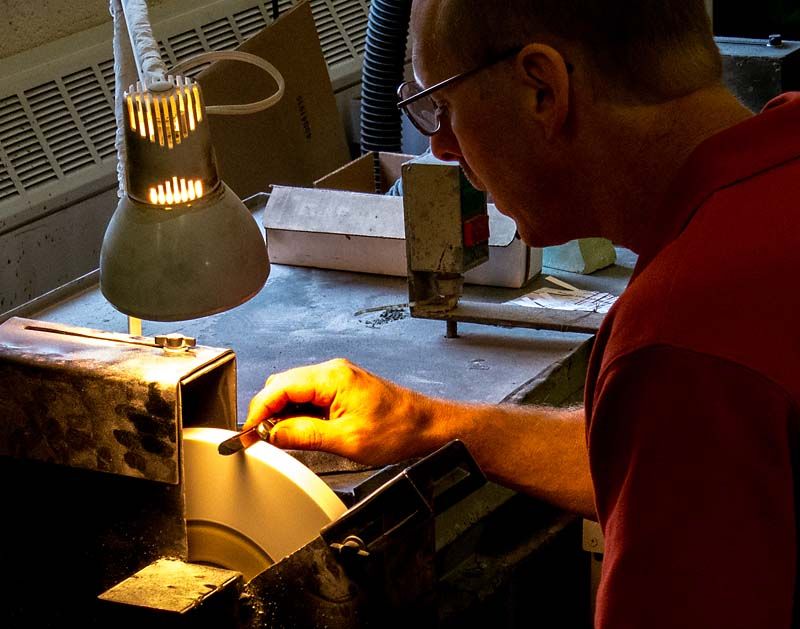
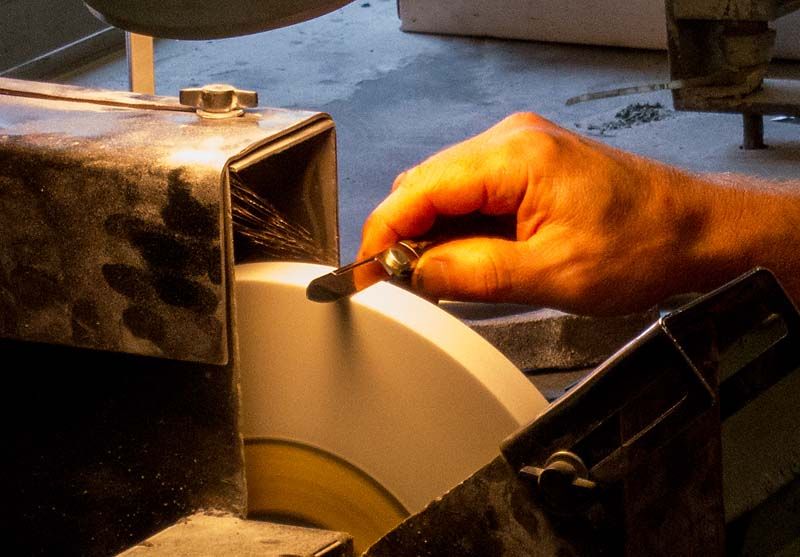
Being a visitor there at GEC during one of their open house weekends, I saw the owner, Bill, sharpen his son's knife on a grinding stone during a tour that the son was giving;

IMG_1684.jpg~original


IMG_1685.jpg~original


Now, I'm not saying that Bill's the only one that can sharpen a knife there, but it may be something that they aren't trying to attain in a production run, similar with Case sometimes I think to, as I have a Case Seahorse that was pretty bad shape sharpness wise or even just bevel grind wise, while I have a fancier Seahorse that was made for the Case Collector's Club and more attention was given to that knife as you can see from how the edges were applied.

As the folks have already mentioned, it's something that needs to be learned since even a sharp knife on arrival, if used, will need some TLC down the line eventually. From Jack's coffee cup to regular stones, you don't have to put out a lot of money, just some patience and time and you can get your blades sharp. I used that coffee cup sharpening at work one time when I didn't have my stones with me and the guy was surprised that I was able to put his edge back on ;)

G2
 
To THIN the edge grind, a SiC stone such as the Norton Economy stone Carl mentioned, from Home Depot, or a coarse/fine diamond hone will do it the fastest. I really like a Fine DMT hone for thinning edges on traditional knives in 1095, CV and 420HC, and I routinely use pocket-sized versions of them for it; works very quick with a back/forth or circular scrubbing motion. The 'fine' side of the SiC stone is almost as good for that. Pretty much any of the other options mentioned, like a Sharpmaker or well-chosen strop & compound, will easily handle the upkeep from there (the diamond & SiC stones will handle that too, depending on how you like your edges finished).


David
 
Last edited:
When I was a visitor at the factory a woman was sharpening hot oil cleaning/lubeing and performing QC. Like the picture above, she had a white stone and a finer aqua green stone. She passed each blade through and she did cut paper with each one before putting it back in those wooden trays you see on the website. Now the paper wasn't Natchez type, but she was cutting paper. That's what I witnessed on a non-entry house day. Like right off the street - here we are.
 
Learn to sharpen your knives, folks, and you will never fret over a dull factory edge again! ;):thumbup:

Just a bit of practice makes perfect!

I like a nice set of DMT diamond bench stones. A bit pricey, but they can't be beat if you are using your knives a lot and want to put on a nice edge in not a lot of time. They even work great on the modern high-carbide stainless steels.
 
Learn to sharpen your knives, folks, and you will never fret over a dull factory edge again! ;):thumbup:

Just a bit of practice makes perfect!

I like a nice set of DMT diamond bench stones. A bit pricey, but they can't be beat if you are using your knives a lot and want to put on a nice edge in not a lot of time. They even work great on the modern high-carbide stainless steels.
:thumbup:
 
I learned freehand at a young age on an Arkansas stone and continued that way along with a strop up till a dozen years ago.

Now I use an assortment of belts and finish off on fine rods. Always love sharpening freehand though as it's a Zen like thang:cool::thumbup:
 
Most of my GECs have been passably sharp to be honest. Not quite as sharp as I like them, but usable out of the tube for general purposes.
 
Learn to sharpen your knives, folks, and you will never fret over a dull factory edge again! ;):thumbup:

Just a bit of practice makes perfect!

I like a nice set of DMT diamond bench stones. A bit pricey, but they can't be beat if you are using your knives a lot and want to put on a nice edge in not a lot of time. They even work great on the modern high-carbide stainless steels.

I believe if I had the right tools I could sharpen and even re-profile just fine, with a little bit of practice of course. But every time I say I'm going to buy sharpening equipment I buy a knife lol
 
Pretty easy to use sandpaper on those sheepfoot blades too. Depending how dull they are, a few strokes each side with 400 grit, followed by 600 grit, strop and good to go. Lots of information in the maintenance section on this forum.
 
To me, sharpening is an absolutely essential skill. It makes no more sense to me to own a knife and not make an effort to learn to sharpen, than to buy a gun and not buy ammo and learn to shoot.

It does take a bit of effort, and a little bit of investment, and some practice, but pretty much anyone can learn to do it if they want to.

I teach courses on how to do this, and have done so for many years. I have yet to encounter anyone from about the age of 9 and up who cannot learn to do this.

Here is a bit on how to sharpen a knife. Read this over a few times before you actually try to do it, and then be careful to follow instructions in detail. Hopefully this will all help!

When you sharpen, lay the knife on the stone at about a 10 degree angle.
Use a fair amount of pressure as you rub the blade on the stone and try to
maintain that angle as closely as you can. Keep working on that side of the
blade until you raise a burr on the other side of the edge. This burr, or
wire edge, must be evident for the entire length of the edge. Do not turn
the knife over until you have raised this burr. Do not quit too soon. If
you don't get this burr or wire edge, you will have no hope at all of
getting the knife really sharp. Once you have raised the wire edge, then
turn the knife over and do the same on the other side, until again you have
raised the wire edge the other way.

Now turn the knife to the first side again, and with fairly light pressure
give it 5 - 10 strokes, turn it over, give it 5 - 10, and repeat the
procedure until you do not detect wire edge on either side. It is essential
that you maintain the 10 degree angle throughout this entire procedure.

Now you need a strop, which is just any old piece of leather glued to a flat
stick and dressed with a good stropping compound. Again maintaining the 10
degree angle, and with QUITE A BIT OF PRESSURE, pull the blade (that is with
the edge trailing) along the strop. Be very careful to maintain the 10
degree angle throughout the entire stroke DO NOT ROLL THE KNIFE UP AT THE
END OF THE STROKE, and do not run off the end of the strop. Do not flip the
knife over at the end of each stroke and come back the other way on the
other side of the knife. If you do, you will be anticipating the flip and
almost certainly roll the knife up and as a result rub your edge off! Just
give it about 50 good strokes on one side and then do 50 on the other side,
and you should be able to shave with the knife, and more importantly, make
good feather sticks and whittle all kinds of neat stuff. When you lose the edge a
bit through normal whittlin', just give it a few strokes on the strop and
the edge will come right back. I usually strop my knife on about 30 - 50
occasions before going back to the stone. When you find that the edge only
lasts for a few minutes before you need to strop again, then it is time to
freshen up the edge on the stone. Remember to use fairly heavy pressure on
the strop. Don't use red jeweller's rouge. Use white or green,zam or
yellowstone or better yet - time for a commercial - Rick's White Lightnin'. It is not necessary to put the White Lightnin’ or whatever other strop dressing that you are using, on the strop each time you use it. One application is sufficient to do 50 – 100 blades.


There are dozens of youtube videos on sharpening too - some better than others

 
I have returned many an edge using the car window. Simply roll it down halfway and use the edge of it, like you would ceramic sticks or a whetstone. It will clean up a dull edge and get you back to sharp.
 
I agree with the comments that learning how to sharpen a knife is a critical skill that all knife owners should learn, and that investing in some decent knife sharpening tools should come shortly after purchase of the first few knives. However, I am also of the opinion that a new knife should come so sharp that the typical knife owner would be hard-pressed to match the factory edge.

Though not a traditional brand, Kershaw has always astonished me with how sharp their knives are out of the box. I have had several of those that I didn't try to touch up for fear of making the edge worse than the factory. I have had a few (very few) Case knives that hit that same mark. A recent purchase of a plain old Case Sod Buster Jr in black handles and as-ground stainless blade was one of those "shaving sharp out of the box" experiences.

Though most Case knives (especially stainless steel models) have a rather coarse grind with a significant wire edge out of the box. Once the wire edge is stopped off, they have sharp but toothy edges that are mostly ready for work.

Back to the GECs, my only issue with them is that the final bevel is almost microscopic, even on the sharp ones. That FFG goes all the way to the edge most times. Takes a bit of work to take the shoulder off that factory bevel and get a thinner cutting edge.
 
I have found most (if not all) of my GEC's to have an out of the box (tube!) edge that is a bit too obtuse for my taste, but it hasn't, and will never, deter me from buying more! I still think they are the best value for quality production traditionals on the market today. Sure, the folks at Great Eastern have the capability, equipment, and knowledge to put a razor polished edge on every knife that leaves the factory, BUT that costs time, and time is money, and that would add to the cost of the finished product.

Besides, refining the factory edge on my new GECs has kind of become a ritual for me that sort of makes the knife "mine." I just go free hand on my set of DMT diamond stones, working my way up the grits, then finishing up on a strop.
 
Back
Top