
-
The BladeForums.com 2024 Traditional Knife is available! Price is $250 ea (shipped within CONUS).
Order here: https://www.bladeforums.com/help/2024-traditional/
You are using an out of date browser. It may not display this or other websites correctly.
You should upgrade or use an alternative browser.
You should upgrade or use an alternative browser.
Lockbacks and Slipjoints - Which is more traditional??
- Thread starter richstag
- Start date


- Joined
- Jul 25, 2010
- Messages
- 7,432
Imo (!!) - I let me educate me a very better way - Slipjoints come from friction folders. They were know from the medival times. A slipjoint is a friction folder with an added backspring and some pins.
To build a lockback, you need a backspring and a notch on the tang / root of the blade (as we call it in Germany) getting the blade fixacted. The backspring needs to be flexible to let the notch on the tang get in there. This means more mechanic.
Slippies are more traditional imo.
Kind regards
Andi
To build a lockback, you need a backspring and a notch on the tang / root of the blade (as we call it in Germany) getting the blade fixacted. The backspring needs to be flexible to let the notch on the tang get in there. This means more mechanic.
Slippies are more traditional imo.
Kind regards
Andi

- Joined
- May 7, 2011
- Messages
- 3,426
Slipjoints, by a mile.
But then...friction folders, by an extra mile
Fausto

But then...friction folders, by an extra mile
Fausto

- Joined
- Dec 19, 2006
- Messages
- 8,210
I think which was first and which is more traditional are separate questions. In my opinion, this Walden Knife Co (1870-1923) lockback is no less traditional than this Remington UMC (1924-1933) slipjoint.


- Joined
- Mar 10, 2011
- Messages
- 7,893
I have perhaps an odd take on this, as in my mind a lock back is just a slightly refined slip joint...both have cut tangs to accommodate a spring, or in the case of the lock back a lockbar...both employ a spring...both are held open by a mechanical means...both employ a pin in the middle to allow flex, or pivot action of the locking mechanism ( slip joints are held open by spring tension) ...mechanically their actions really aren't much different from one another.

- Joined
- Sep 15, 2002
- Messages
- 10,317
Imo (!!) - I let me educate me a very better way - Slipjoints come from friction folders. They were know from the medival times. A slipjoint is a friction folder with an added backspring and some pins.
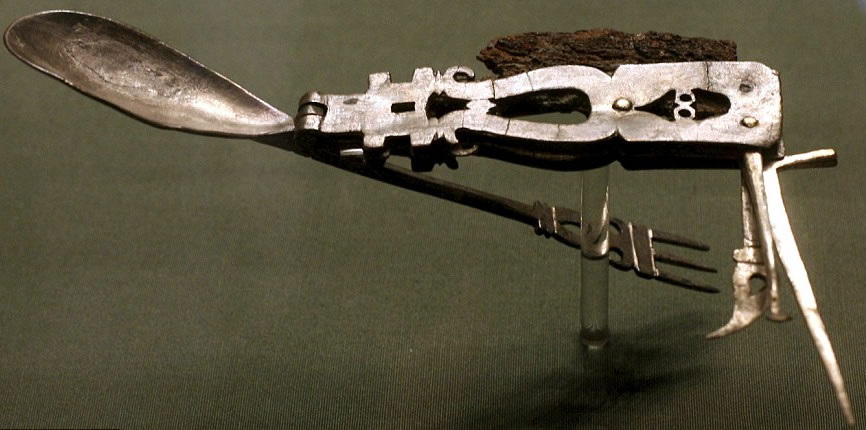
Actually, from even longer ago than that. They were used from the beginning of the Iron Age, at least 2,500 years ago.
Romans even had their versions of "multitools" or SAK.
- Joined
- Jul 25, 2010
- Messages
- 7,432
I´ve already seen this pic. But it seemed, that it was not very cummon in that times - not many were found. But the regular friction folder was used during medival times already by farmers and craftman. For sure, the great eastern cultures (china, japan) might have another history in this kind of knives.
Kind regards
Andi
Kind regards
Andi
- Joined
- Dec 19, 2006
- Messages
- 8,210
Actually, from even longer ago than that. They were used from the beginning of the Iron Age, at least 2,500 years ago.
Romans even had their versions of "multitools" or SAK.
I think it's very likely that the source is inaccurate. Here are BRL's remarks:
I would really like to know how the museum dated this thing to Roman times.
Maybe it was listed under "Romany" on ebay? Or "Rum"?
Several of the commentors to the Guardian story mentioned the eating fork as a clue the thing is relatively recent.
They were talking about post 7th century, which made me chuckle.
Post 17th is more like it.
I wonder if they noticed that little stamp that says MADE IN OCCUPIED ILLYRIA.
BRL...
- Joined
- Dec 19, 2006
- Messages
- 8,210
"Traditional" is a relative term. 100 years from now an axis lock or Spydie hole might be traditional for most folks. 
- Joined
- Sep 15, 2002
- Messages
- 10,317
I´ve already seen this pic. But it seemed, that it was not very cummon in that times - not many were found. But the regular friction folder was used during medival times already by farmers and craftman. For sure, the great eastern cultures (china, japan) might have another history in this kind of knives.
Kind regards
Andi
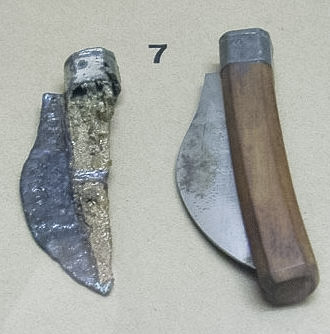
I agree that that "SAK" knife is an abnormality and not a "commoner's knife (whatever the date of manufacture), but the fact still is that folding knives have been around since the Iron Age. Commoners have been using them "off and on" since their introduction.
Here's what an early folder (clasp knife) looked like, alongside a modern reproduction.

black mamba
Gold Member
- Joined
- Oct 21, 2009
- Messages
- 23,691
I had my slipjoint boyscout knife a few years before my lockback Silver Knight, so slipjoints are more traditional. 

- Joined
- Apr 12, 2009
- Messages
- 13,529
"Traditional" is a relative term. 100 years from now an axis lock or Spydie hole might be traditional for most folks.
I think for some, it already is. 'Traditional' is completely subjective to the individual and what they've come to know in their own history. I'm certain there are some members here, younger than a certain age, who've never seen or handled anything without a stud or hole in the blade, a liner or frame lock, and black synthetic handles. Makes me feel old, knowing some people can't even conceive of a time before cell phones, digital cameras, remote controls for TVs, or microwave ovens.

- Joined
- Apr 12, 2009
- Messages
- 13,529
David, your not old, your lucky.
No doubt, in many regards. :thumbup:
My tired eyes, thinning hair and aching back might have something else to say about that, though.