What are the knives you have either from the factory or something you've had reground with the lowest angle edges? Usually 30 degrees inclusive is on the low end for production stuff, but how low to you guys go for your slicers and light EDC knives?

-
The BladeForums.com 2024 Traditional Knife is available! Price is $250 ea (shipped within CONUS).
Order here: https://www.bladeforums.com/help/2024-traditional/
You are using an out of date browser. It may not display this or other websites correctly.
You should upgrade or use an alternative browser.
You should upgrade or use an alternative browser.
Lowest angle edges you have
- Thread starter Brutus013
- Start date

- Joined
- Jun 26, 2009
- Messages
- 1,000
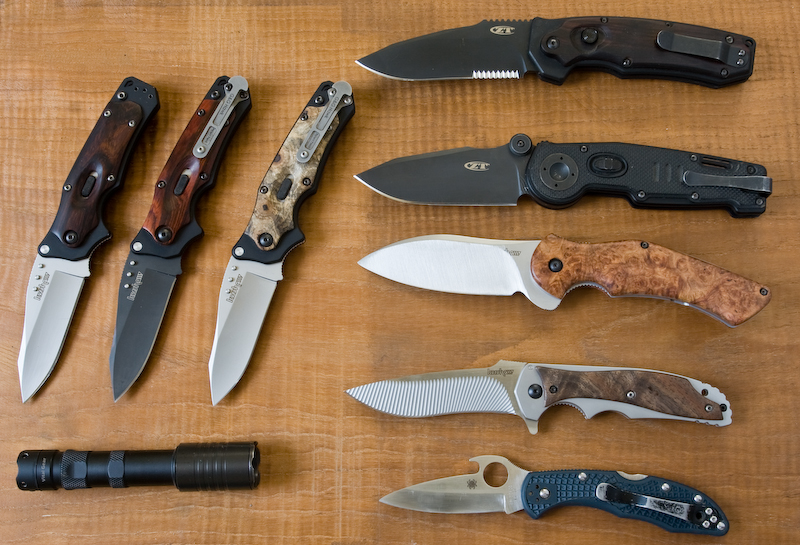
I reground the JYD2 in this pic. The edge bevel is about 20-degrees inclusive. The grind behind the edge bevel is just over .010" thick.
Needless to say, it's not a hard use blade. It's amazing for food prep and other light duties. I don't let friends use it. Even if they don't cut themselves, they'll probably destroy the edge.
Needless to say, it's not a hard use blade. It's amazing for food prep and other light duties. I don't let friends use it. Even if they don't cut themselves, they'll probably destroy the edge.


- Joined
- Oct 2, 2006
- Messages
- 1,746
I use 8° per side for my EDC and kitchen knives, the edges hold up just fine. As long as you don't chop or pry with it, you can even cut hard objects. For heavier tasks I use a different knife which is 15° per side. When using premium steels, I don't see any reason to go thicker. Even my axe (5160 spring steel) is no thicker than 15° per side. My butcher knife that cuts through bone on a regular basis, is 10° per side with a somewhat convex edge.
- Joined
- Jul 11, 2007
- Messages
- 43
Wow. I'm gonna do that to all my knives!
I use 8° per side for my EDC and kitchen knives, the edges hold up just fine. As long as you don't chop or pry with it, you can even cut hard objects. For heavier tasks I use a different knife which is 15° per side. When using premium steels, I don't see any reason to go thicker. Even my axe (5160 spring steel) is no thicker than 15° per side. My butcher knife that cuts through bone on a regular basis, is 10° per side with a somewhat convex edge.
- Joined
- Oct 2, 2006
- Messages
- 1,746
Wow. I'm gonna do that to all my knives!
Yeah they cut exceptionally well. Even a "duller" edge on an acute blade cuts better than a less dull edge on a broader edge. What I mean is, less sharpening =)
Just make sure that your steel can handle it. Mine are in premium steels at high hardness, for example M2 at hrc 63-64, 1095 and A2 at 61, S30V at 60-61. I've had some brittle 154CM blades that chip at pretty much any angle, but my Paul Bos ht'ed version of the same steel can take pretty acute angles, even though at hrc 61 it's actually harder than the brittle blades.
Knives for tougher tasks, I still start at some really acute angle, BUT I give it a microbevel at a less steep angle. Maybe add another microbevel for a true convex edge. This is what I did for my axe and butcher knife.

- Joined
- Apr 21, 2006
- Messages
- 5,611
I've brought some down to around 15 to 17 degrees inclusive. Mostly carbon steel in light use folders, though I have brought BG42 down that low before. It chipped a bit, but did better than many would think. Typically I leave it a bit coarse and not too fine a finish, not usually over 2,000 grit.
I will eventually take some CPM M4 down that low for test purposes. When I have time and energy.
I guess that only makes me a half a$$ed darksider.
I have to admit I'm not at the skill level of Gunmike, and knifenut 1013. I see Knifenut's edges and it gives me a goal to eventually shoot for. Recall this is after I've got 30 some years of freehand sharpening too. I'm not bad, he's just that good! Joe
I will eventually take some CPM M4 down that low for test purposes. When I have time and energy.
I guess that only makes me a half a$$ed darksider.
I have to admit I'm not at the skill level of Gunmike, and knifenut 1013. I see Knifenut's edges and it gives me a goal to eventually shoot for. Recall this is after I've got 30 some years of freehand sharpening too. I'm not bad, he's just that good! Joe

Jason B.
Knifemaker / Craftsman / Service Provider
- Joined
- Jun 13, 2007
- Messages
- 11,196
I've brought some down to around 15 to 17 degrees inclusive. Mostly carbon steel in light use folders, though I have brought BG42 down that low before. It chipped a bit, but did better than many would think. Typically I leave it a bit coarse and not too fine a finish, not usually over 2,000 grit.
I will eventually take some CPM M4 down that low for test purposes. When I have time and energy.
I guess that only makes me a half a$$ed darksider.
I have to admit I'm not at the skill level of Gunmike, and knifenut 1013. I see Knifenut's edges and it gives me a goal to eventually shoot for. Recall this is after I've got 30 some years of freehand sharpening too. I'm not bad, he's just that good! Joe
Thanks Joe means a lot, still waitin to see some steel from ya.
When I see people talk of having a knife with a bevel of 8 or less degrees and saying that it holds up just find to hard use, I'm sorry but I must call BS on this. For example I sharpened my M4 mule team to around 10 degrees per side and while making wood curels I noticed microchipping in the edge. Same thing happened with my S90V mule team until I applied a 15 degree microbevel, I did the same with the M4 mule and the difference is night and day with edge retention. You can take almost any steel to a low angle but a microbevel or slight convexing will be needed.
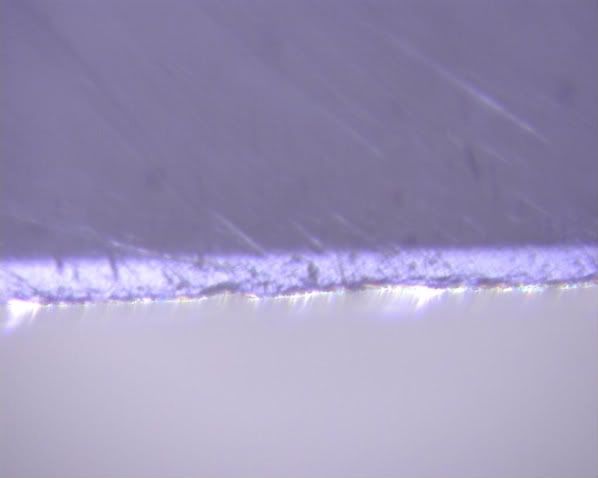
This is my S90V mule team after extreme cutting abuse. 10-12 deg edge with a about 15 deg microbevel. I cut 3/4 manila rope, cardboard, drywall and a small piece of carpet, the edge would not even come close to shaving but would still keep cutting rope and slicing computer paper. When I did this test before with no microbevel the edge was at the same level of dullness by the end of the rope cutting and the edge damage was 10x. Stright bevel sharpening seems to have a cut off point around 10 degrees with almost every steel but like everything I guess it all depends on what you are cutting and how long you want your edge to last.
Pic's at 400x
Remember this microbevel is so small you cannot see it with the naked eye.

- Joined
- Oct 2, 2006
- Messages
- 1,746
knifenut1013, if you need a microscope to notice the edge microchipping, I doubt most people would notice it. Yes you will get microchipping from time to time but they are very small and it's not a big deal on the cutting performance and easy to fix up.
Actually for the stuff I cut, I very rarely get microchipping at all with 8 degrees per side. Mostly to cut soft objects but even when I de-barked tough tree trunks I didn't notice any chipping. I didn't examine it under my microscope, just visual inspection. You can call BS but this has been my experience for the past 4 years.
Actually for the stuff I cut, I very rarely get microchipping at all with 8 degrees per side. Mostly to cut soft objects but even when I de-barked tough tree trunks I didn't notice any chipping. I didn't examine it under my microscope, just visual inspection. You can call BS but this has been my experience for the past 4 years.
Jason B.
Knifemaker / Craftsman / Service Provider
- Joined
- Jun 13, 2007
- Messages
- 11,196
knifenut1013, if you need a microscope to notice the edge microchipping, I doubt most people would notice it. Yes you will get microchipping from time to time but they are very small and it's not a big deal on the cutting performance and easy to fix up.
Actually for the stuff I cut, I very rarely get microchipping at all with 8 degrees per side. Mostly to cut soft objects but even when I de-barked tough tree trunks I didn't notice any chipping. I didn't examine it under my microscope, just visual inspection. You can call BS but this has been my experience for the past 4 years.
The whole point is that your edge is not performing as well as the steel could if better edge geometry was used. Though you may not mind the damage that occurres its still damage that could have been prevented and is taking away from the usable life of the edge.
- Joined
- Apr 21, 2006
- Messages
- 5,611
Thanks Joe means a lot, still waitin to see some steel from ya.
I'm going to take you up on that in the future. I'll wait until I get the right knife that doesn't need major rebevelling, and one that I'll be using. It might be M4 after seeing how yours came out. Most likely a carbon/alloy steel in any event, with a good carbide structure.
One day I want a Millie class folder in a good carbon steel ( super blue?/ high speed steel M4/M2, Maybe even o-1 or A2, or W2 ). It's my dream. It'll come your way.
 Joe
Joe- Joined
- Aug 15, 2007
- Messages
- 363
Edge geometry is only one part of the triumvirate....you need quality steel and heat treat to complete the package.
I have been able to shave with an axe, but have never tried splitting kindling with a single digit grind kitchen knife.
I have been able to shave with an axe, but have never tried splitting kindling with a single digit grind kitchen knife.
How do different steels react to the low angle edges, let's say 10 degrees per side? Are carbon steels like 1095 going to perform better than some of the new high end stainless steels like S30V as far as edge retention and chipping resistance goes?
My lowest right now is a Food Network kitchen knife at 12 degrees per side. My M2 Puukko was lower at about 10 per side, convex, but I resharpened it on the Sharpmaker at 20 per side for comparison to some other knives. EDC knives rarely go below 15 per side, as I tend to use them for whatever comes along, such as scraping caulk.

- Joined
- Dec 9, 2005
- Messages
- 2,402
My Takeda Gyuto was 4.5 degrees perside from the Maker, and I sharpened it at 4 per side. It cut with serious authority due to the extreme thinness of the blade and geometry, but large chips wait slightly sideways hits on the cutting board made me change my mind to microbevelling at 10-15 per side, and it holds up better. When you cut right with that knife in the kitchen the super acute edge is amazing, but that ultra thin edge at ultra acute angles just isn't forgiving at all of a bad cut. My Caly Jr ZDP is 5 per side on the backbevel, but over 10 per side on the microbevel (my Caly 3 ZDP was 9.5 per side from the factory). It does fine for the light duty stuff I use it for, as it's .005" reground edge (high hollow grind now) limits any tough cutting you might do anyway. On the rest of my stuff I have most of my backbevels under 10 per side, but now I am pretty much going between 10-20 per side on the microbevel (usually 15-20 per side but thinner on lighter duty, very high quality steel knives). If I am going to cut up carpet and drywall you can bet even on my ZDP the microbevel will be 15 per side, where it might have been 10-12 per side (like on my Caly 3 and Stretch 2) if I was only cutting up cardboard, clamshells, and other stuff that doesn't really tax the edge too bad (though cardboard does dull knives pretty quick). This is just my experience, and I haven't looked at the edges under 400X to check the damage. I used to just use a standard 15 per side microbevel, and might keep that as my minimum microbevel due to not really noticing a loss of cutting ability compared to more acute microbevels and the added strength you get from it. On lesser steels or harder cutting tasks sometimes 20 per side is appropriate, and again you really don't notice much if any difference in cutting ability as long as you son't let the microbevel get too thick. I think I was getting into a personal bragging rights game by going to super acute microbevels for a while, but now find myself going 15 per side almost exclusively again. I still firmly believe in thin backbevels, however, and either microbevels (my method) or convexing (other's use it a lot) to get the very edge a bit less acute to add the strength you need for it to hold up under use.
Mike
Mike


- Joined
- Oct 24, 2005
- Messages
- 1,836
Yes, most of my knives are sharpened to 20° per side, too. I find that is plenty sharp enough for just about anything I need to do. The only exception I make is a couple of my multi-blade slippies, where I sometimes sharpen one of the smaller blades to 15° for fine work.I find that I do mostly utility cutting that quickly deforms a thin edge. Therefore, I mostly keep my using blades thick at 20°per side. When I do manila rope cutting tests, I use 15° per side.
- Joined
- Jan 24, 2005
- Messages
- 2,792
i try to keep mine around 180 degrees inclusive.
lmao!