
- Joined
- Dec 30, 2009
- Messages
- 353
Like saying "old villagers blacksmith knife".
I think this could be interesting for someone...
The maasepän puukko is the simpliest and oldest style of puukko and has parallel equivalents in Sweden and Norway too. They have their origin in early Middle Age as all around belt knives of the free men. In higher classes knives were obviously more refined (metal bolsters, pattern welded blade, engraved handle, metal decoration/retentions on the sheath) but we are now talking of the original humble man knife.
All pics of knife and sheath making by Ilkka Seikku.
The making process, in this case, tries to be the closest possible to how it was done in the old days.
Let's start with the block of wood and the blade, which tang has a sharp point. The wood is rawly carved with axe.

Then is drilled a hole in the wood and it's enlarged with a hot iron rod.

The blade is sticked in and the wood is then beated on a large log to "nail" the tang well into the wood. If the operation is done properly the blade will stay in place without any glue or wedges against the tang.
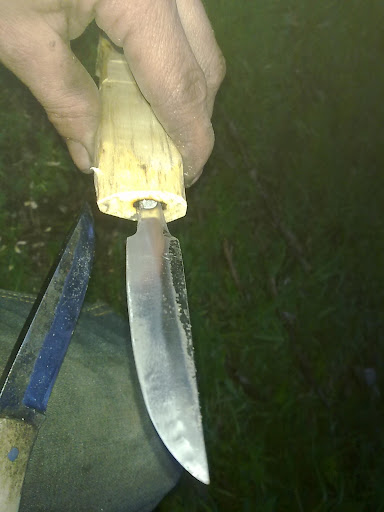


The handle is then carved and sanded with #120 paper.


Finally the handle is treated with pine tar. Ilkka makes his own tar in the old way.


Sheath could be the usual backsewed leather one

or made out of folded birch bark stripes.


To conclude, a few other examples of the style.
Markku Vilppola

from left to right, Esa Laaksonen, Kay Vikström, Antti Mäkinen

Pasi Hurttila

Hope you liked it.
I think this could be interesting for someone...
The maasepän puukko is the simpliest and oldest style of puukko and has parallel equivalents in Sweden and Norway too. They have their origin in early Middle Age as all around belt knives of the free men. In higher classes knives were obviously more refined (metal bolsters, pattern welded blade, engraved handle, metal decoration/retentions on the sheath) but we are now talking of the original humble man knife.
All pics of knife and sheath making by Ilkka Seikku.
The making process, in this case, tries to be the closest possible to how it was done in the old days.
Let's start with the block of wood and the blade, which tang has a sharp point. The wood is rawly carved with axe.
Then is drilled a hole in the wood and it's enlarged with a hot iron rod.
The blade is sticked in and the wood is then beated on a large log to "nail" the tang well into the wood. If the operation is done properly the blade will stay in place without any glue or wedges against the tang.
The handle is then carved and sanded with #120 paper.
Finally the handle is treated with pine tar. Ilkka makes his own tar in the old way.
Sheath could be the usual backsewed leather one
or made out of folded birch bark stripes.
To conclude, a few other examples of the style.
Markku Vilppola

from left to right, Esa Laaksonen, Kay Vikström, Antti Mäkinen

Pasi Hurttila

Hope you liked it.


