- Joined
- Jun 4, 2002
- Messages
- 3,930
Whenever I'm not making stuff, or out doing stuff, I love to read and research subjects that interest me. Studying pre-revolutionary war colonial America is a subject I find fascinating, and in the course of some study on the subject, came across the following gem.
Spanish colonial infantry in Florida, Louisiana, and California, during the 18th century certainly had axes available, but seldom carried or used them. Instead, they had a strong preference for the machete de cinta as an all purpose tool and weapon, substituting for a hanger (short sword) or espada ancha ("hunting" sword). That didn't really surprise me, what did surprise me was how robust these machetes were in comparison to contemporary versions. A good average blade length would have been around 22", obviously some were much shorter and some were longer. Blade width would be between 2 1/2 to 3 inches, but check this out, blade thickness at spine ran around 1/4" to 3/8".
For those of you who have owned or handled the HI Tarwar, imagine one shortened a bit, and fitted with a simple, but sturdy, Chiruwa style handle of riveted wooden slabs. Holy cow indeed.
I'd love to see an HI version, but until such time as that I do know where to get my hands on a fairly authentic piece, thick spined, hand forged, and fitted with not wood, but horn handle scales. There's a guy who turns up at the monthly gun show down in Austin with just such blades, hand forged down in old Mexico by two brothers that are third generation blacksmiths.
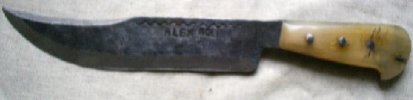
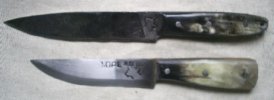
Think I'm pulling y'all's leg? Here's a bowie forged by Alex Molina (the other brother is named Guadalupe). It's every bit as rustic and rugged as it looks. The blade, 9" long by 1 1/2" wide, starts out at 1/4" thick, and has a full length distal taper (read that, this thing is well balanced and "quick"). You can't hold this one in your hand and not feel just a bit bloodthirsty, can't wait to field test one of their machetes.

The bowie knife has often been mentioned as the "American khukuri equivalent", but perhaps the machete deserves a closer look. I'm thinking a machete with a 5/16" spine might just do some pretty freaky stuff. I'll let y'all know.
Sarge
Spanish colonial infantry in Florida, Louisiana, and California, during the 18th century certainly had axes available, but seldom carried or used them. Instead, they had a strong preference for the machete de cinta as an all purpose tool and weapon, substituting for a hanger (short sword) or espada ancha ("hunting" sword). That didn't really surprise me, what did surprise me was how robust these machetes were in comparison to contemporary versions. A good average blade length would have been around 22", obviously some were much shorter and some were longer. Blade width would be between 2 1/2 to 3 inches, but check this out, blade thickness at spine ran around 1/4" to 3/8".
For those of you who have owned or handled the HI Tarwar, imagine one shortened a bit, and fitted with a simple, but sturdy, Chiruwa style handle of riveted wooden slabs. Holy cow indeed.
I'd love to see an HI version, but until such time as that I do know where to get my hands on a fairly authentic piece, thick spined, hand forged, and fitted with not wood, but horn handle scales. There's a guy who turns up at the monthly gun show down in Austin with just such blades, hand forged down in old Mexico by two brothers that are third generation blacksmiths.
Think I'm pulling y'all's leg? Here's a bowie forged by Alex Molina (the other brother is named Guadalupe). It's every bit as rustic and rugged as it looks. The blade, 9" long by 1 1/2" wide, starts out at 1/4" thick, and has a full length distal taper (read that, this thing is well balanced and "quick"). You can't hold this one in your hand and not feel just a bit bloodthirsty, can't wait to field test one of their machetes.
The bowie knife has often been mentioned as the "American khukuri equivalent", but perhaps the machete deserves a closer look. I'm thinking a machete with a 5/16" spine might just do some pretty freaky stuff. I'll let y'all know.
Sarge