-
The BladeForums.com 2024 Traditional Knife is available! Price is $250 ea (shipped within CONUS).
Order here: https://www.bladeforums.com/help/2024-traditional/
You are using an out of date browser. It may not display this or other websites correctly.
You should upgrade or use an alternative browser.
You should upgrade or use an alternative browser.
Materials Used On Stacked Handles??
- Thread starter E.K.Tryon
- Start date

- Joined
- Dec 4, 2001
- Messages
- 3,824
Personaly I like leather and plastic and fiber spacers. I like the look of metal spacers, but with leather it's so much harder than the leather that it tends to "rise" above slightly during polishing, also after time there is a bit of shrinkage to the leather and that leaves the metal spacers just a couple thou. taller than the surounding material. The plastic and fiber spacers have worked a lot better for me as there about the same hardness.


- Joined
- Oct 20, 2008
- Messages
- 5,547
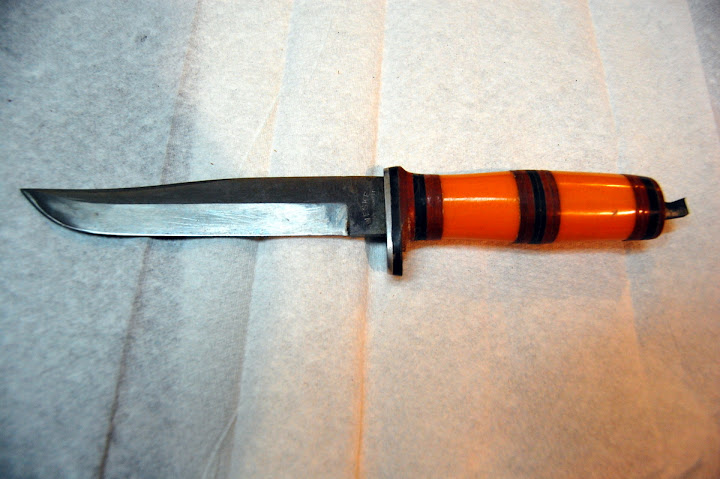
I've seen some cool old stacked grip knives with lucite blocks and colored spacers. Amber also looks good in the mix. So does turquoise or some of the reconstituted gemstones, like malachite.


Stacy E. Apelt - Bladesmith
ilmarinen - MODERATOR
Moderator
Knifemaker / Craftsman / Service Provider
- Joined
- Aug 20, 2004
- Messages
- 38,478
Some ideas:
Birchbark is the champ for Nordic knives; exotic leathers - like an elephant ear, a cut up elephant skin boot, or a pack of sharkskin scraps from Tandy; a pack of veneer wood becomes multi-colored plywood;and heavy canvas squares become 360 degree end grain mycarta (talk about grippy!). I bet Zaph could even make a stacked handle from some of his beef jerky.
Another area is sentimental objects.
I made one out of the Army boots a persons grandfather wore in WW2. Heck , you could even make a stacked wedding knife handle from the tatters of great grandma's wedding dress.
If you can cut it and put a hole in the pieces, you can stack a handle from it. Impregnating the stack with CA is a real good way to make the stack hard and take a good polish. As you shape the handle to its final shape, repeat the CA soak to assure all fibers are sealed, then sand and buff the final surface.
Some tricks to making a stacked handle;
Assembling the stack on a mandrel is often easier than doing it on the knife.
The mandrel can be a 1/2" bolt about 6-8" long, with fender washers and nuts. Grind the bolt flat on two sides to about 1/4" thick, so it simulates the tang. Coat all these with wax, and do the glue up and assembly on the mandrel. After the glue is set, but not fully hardened, remove the end nut, and drive the mandrel out of the stack with a wooden mallet. Clean off any resin with a wire wheel, and apply petroleum jelly or WD-40 to the bolt and re-install it, tightening the nuts down again, and let cure. After rough shaping the handle, install on the knife tang and finish the shaping.This works well for epoxy glue-up handles.
For CA handles, use a 1/4" wooden dowel. Slide all the pieces on the dowel, with any wooden end pieces or other spacers, and a fender washer one the ends. Drill a 3/8" hole through the jaws of a woodworking clamp ( one of those two bolt types) and clamp the stack tight. Apply thin CA and let cure. Repeat until the stack is completely impregnated. Drill out the dowel and shape the assembly on the grinder. You can insert a new dowel ( but don't glue it in) to hold the stack with while shaping. Once the stack is made into a rough handle, install it on the knife tang with plenty of epoxy, and clamp down with the pommel. Shape as desired. This technique will produce a really nice handle in materials you never thought about.
Birchbark is the champ for Nordic knives; exotic leathers - like an elephant ear, a cut up elephant skin boot, or a pack of sharkskin scraps from Tandy; a pack of veneer wood becomes multi-colored plywood;and heavy canvas squares become 360 degree end grain mycarta (talk about grippy!). I bet Zaph could even make a stacked handle from some of his beef jerky.
Another area is sentimental objects.
I made one out of the Army boots a persons grandfather wore in WW2. Heck , you could even make a stacked wedding knife handle from the tatters of great grandma's wedding dress.
If you can cut it and put a hole in the pieces, you can stack a handle from it. Impregnating the stack with CA is a real good way to make the stack hard and take a good polish. As you shape the handle to its final shape, repeat the CA soak to assure all fibers are sealed, then sand and buff the final surface.
Some tricks to making a stacked handle;
Assembling the stack on a mandrel is often easier than doing it on the knife.
The mandrel can be a 1/2" bolt about 6-8" long, with fender washers and nuts. Grind the bolt flat on two sides to about 1/4" thick, so it simulates the tang. Coat all these with wax, and do the glue up and assembly on the mandrel. After the glue is set, but not fully hardened, remove the end nut, and drive the mandrel out of the stack with a wooden mallet. Clean off any resin with a wire wheel, and apply petroleum jelly or WD-40 to the bolt and re-install it, tightening the nuts down again, and let cure. After rough shaping the handle, install on the knife tang and finish the shaping.This works well for epoxy glue-up handles.
For CA handles, use a 1/4" wooden dowel. Slide all the pieces on the dowel, with any wooden end pieces or other spacers, and a fender washer one the ends. Drill a 3/8" hole through the jaws of a woodworking clamp ( one of those two bolt types) and clamp the stack tight. Apply thin CA and let cure. Repeat until the stack is completely impregnated. Drill out the dowel and shape the assembly on the grinder. You can insert a new dowel ( but don't glue it in) to hold the stack with while shaping. Once the stack is made into a rough handle, install it on the knife tang with plenty of epoxy, and clamp down with the pommel. Shape as desired. This technique will produce a really nice handle in materials you never thought about.
Last edited:
- Joined
- Oct 20, 2008
- Messages
- 5,547
Great stuff, Stacy. Kind of makes me want to built something with a stacked handle myself.