
Cliff Stamp
BANNED
- Joined
- Oct 5, 1998
- Messages
- 17,562
Most impact splitting is done by putting the blade in the wood with the tip extended past the wood and hitting the tip while pressing down on the handle to split the wood :
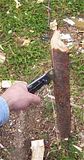
This induces a strong internal torque in the knife which reaches a maximum between the two force points of the knife in the wood and the hand pressing down on the grip. Unfortunately for knives there is usually a large weak point also right inbetween those points. For folding knives it is the pivot and the lock mechanism and for fixed blades it is the tang/blade junction.
Now you can avoid this torque if you don't press down on the handle. However this also means that unless the wood is very easy to split, the impact will just cause the knife to rotate in the wood and will not be effective at splitting. However if you positionthe knife so that the tip just reaches the other side and impact in the choil region then a radically different behavior is induced for the internal torque :
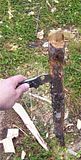
In splitting done in this manner there is rarely any need to provide significant force with the hand, and you are in fact pulling up which stabilizes the lock rather than pressing down trying to collapse it. This allows *much* heavier impacts. In fact as an extreme example, I used the Delica Wave with the choil impact method and the Manix with the tip impact method. Under the same impact energies 16 (2) ft.lbs (calibrated off lead weight drops) I could damage the Manix lock but the Delica/Wave was fine.
The damage to the Manix was only light, the lock bar was raised visibly, and the blade will catch/stick after being opened about 25 degrees, though it can still be rotated out with a bit more force. However the Delica/Wave is actually rock solid, it was not effected at all because even though the impacts are the same, the effect on the internal torque is not. For lock backs it is also difficult to tip split because the off hand tends to depress the lock anyway.
Note for large fixed blades there is another benefit. Many large knives are balanced so that they don't respond well to impacts in the tip and thus they are much more comfortable in hand if you impact near the choil vs the tip. Possom has discussed this in detail in various posts.
In short, reverse the position of the blade to minimize the internal torque in the blade at the lock/tang region. This in many blades will also reduce the vibration impact to the off hand.
-Cliff
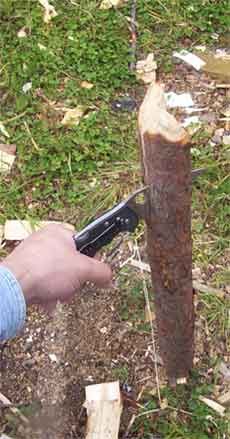
This induces a strong internal torque in the knife which reaches a maximum between the two force points of the knife in the wood and the hand pressing down on the grip. Unfortunately for knives there is usually a large weak point also right inbetween those points. For folding knives it is the pivot and the lock mechanism and for fixed blades it is the tang/blade junction.
Now you can avoid this torque if you don't press down on the handle. However this also means that unless the wood is very easy to split, the impact will just cause the knife to rotate in the wood and will not be effective at splitting. However if you positionthe knife so that the tip just reaches the other side and impact in the choil region then a radically different behavior is induced for the internal torque :

In splitting done in this manner there is rarely any need to provide significant force with the hand, and you are in fact pulling up which stabilizes the lock rather than pressing down trying to collapse it. This allows *much* heavier impacts. In fact as an extreme example, I used the Delica Wave with the choil impact method and the Manix with the tip impact method. Under the same impact energies 16 (2) ft.lbs (calibrated off lead weight drops) I could damage the Manix lock but the Delica/Wave was fine.
The damage to the Manix was only light, the lock bar was raised visibly, and the blade will catch/stick after being opened about 25 degrees, though it can still be rotated out with a bit more force. However the Delica/Wave is actually rock solid, it was not effected at all because even though the impacts are the same, the effect on the internal torque is not. For lock backs it is also difficult to tip split because the off hand tends to depress the lock anyway.
Note for large fixed blades there is another benefit. Many large knives are balanced so that they don't respond well to impacts in the tip and thus they are much more comfortable in hand if you impact near the choil vs the tip. Possom has discussed this in detail in various posts.
In short, reverse the position of the blade to minimize the internal torque in the blade at the lock/tang region. This in many blades will also reduce the vibration impact to the off hand.
-Cliff
