
-
The BladeForums.com 2024 Traditional Knife is available! Price is $250 ea (shipped within CONUS).
Order here: https://www.bladeforums.com/help/2024-traditional/
You are using an out of date browser. It may not display this or other websites correctly.
You should upgrade or use an alternative browser.
You should upgrade or use an alternative browser.
Mirror Finish on D2
- Thread starter TCooper
- Start date

- Joined
- Jun 17, 2001
- Messages
- 5,705
D-2 for the most part won't give you a mirror finish. Cloudy is normally the best you can get. I haven't worked D-2 for a number of years but what I did learn is you need to have it pretty well rubbed out before you heat treat. Abrasive resistent, yes it is.....

- Joined
- Feb 11, 2003
- Messages
- 1,628
TCooper,
I hate to tell you this but you won't get a mirror finish on D-2 or A-2. D-2 always has a "matrix" type look. If you want a mirror finish I would recomend 154 cm from crucible. If what I hear is right it sounds like their will be a CPM 154 in the future. I would recomend a hand rubbed or satin finish on D-2 or A-2.
Tom
I hate to tell you this but you won't get a mirror finish on D-2 or A-2. D-2 always has a "matrix" type look. If you want a mirror finish I would recomend 154 cm from crucible. If what I hear is right it sounds like their will be a CPM 154 in the future. I would recomend a hand rubbed or satin finish on D-2 or A-2.
Tom

- Joined
- Mar 22, 2001
- Messages
- 787
I've been having the same problem with ATS34 lately. The stuff seems to have gotten "grainy". Maybe I'll give 154CM a try.

- Joined
- Jun 25, 2001
- Messages
- 8,474
..A. Brett Schaller said:I've been having the same problem with ATS34 lately. The stuff seems to have gotten "grainy". Maybe I'll give 154CM a try.
ataboy

I have a sword that I have 11 hours in on grinding made of D2
I didn't even try to M/P it, I know better

BUT after foil wraped and H/T'ed
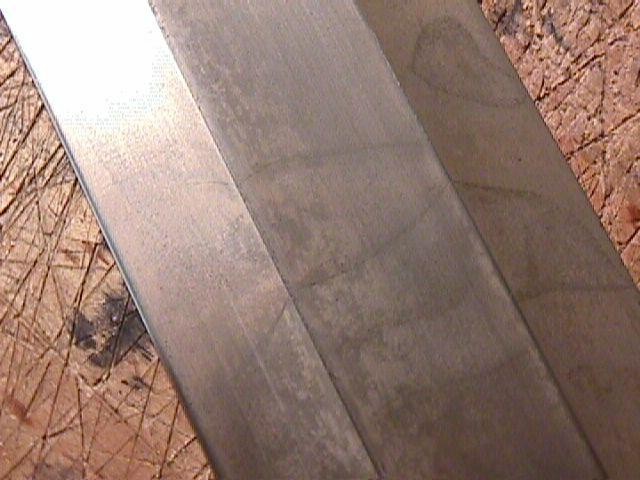
that ""matrix" type look"" I kept on it, it's c@@l as He!! I think..
- Joined
- Jun 25, 2001
- Messages
- 8,474
I think the etch would remove the patern I'll take a picture of the bladeTom Krein said:Dan,
I am in agreement with you. I think the "matrix" look is interesting. I think it reminds me of wootz steel. I have wondered what it would look like if etched?
Tom
and post it..
- Joined
- Mar 7, 2003
- Messages
- 4,270
D2 gets a nice pattern when etched with Muriatic acid (.375 N Hydrochloric). This etch turns it gray and will make the large carbides show on the surface.
FeCl just seems to give a dull black that I haven't been all that impressed with.
The new Trizact CF belts in A45 size will put a nice satin finish on D2.
FeCl just seems to give a dull black that I haven't been all that impressed with.
The new Trizact CF belts in A45 size will put a nice satin finish on D2.
- Joined
- Jan 24, 2003
- Messages
- 2,767
This is really interesting. I'd like to try the D2 etch.

- Joined
- Jul 11, 2003
- Messages
- 3,258
A. Brett Schaller said:I've been having the same problem with ATS34 lately. The stuff seems to have gotten "grainy". Maybe I'll give 154CM a try.
I've been getting some fine results with ATS-34 (mirror-finish), but there's a wee trick to it. You have to hand rub past what you normally would take it down to for mirror polishing. Not to mention this, but I also advise using some very good cutting lubricant. I have used Cool Tool II for years as a machinist, and I'm discovering it has a lot of uses in knifemaking as well. I hate to hand-rub using a liquid such as baby-oil or cool tool, or even water, but the results are very much worth the trouble. I've found that I get the graininess and cloudiness from going to the buffer at a coarser grit than should be.
On normal carbon steels, I llike to take my blades down to a hand-rubbed (dry) 600 grit. Using green chrome, I can get some spectacular results. I often go a little further and use some white compound and a loose buff to just make a little bit more depth to the shine.
On stainless like ATS-34, I have to rub down to about 1000 grit or 1200. I try to use something light as kerosene (Ed Fowler's recommendation, I can't take credit), but I hate the smell and I use low-odor mineral spirits instead.
What we have is a wonderful process of smoothing out the top layers of the steel and making it completely melded into one layer. Going to the buffer too soon, and at a rougher grit - expecting the compound to take it down to a shine will usually result in graininess.
Try it this way, and use some green chrome when you get down to around 1000 grit or so. Load up the buff with the compound and maybe spray a very small amount of WD-40 or Starrett M1 to the buff as it runs (stand to the side, heehee!). This will help thin the compound and make it slide over the blade in a gentler manner.
When I go for a mirror polish on ATS-34 and stainless, I only need a couple light passes to pop that mirrored finish out. No hard buffing required.
Wow! Sorry for being so verbose!

- Joined
- Jan 24, 2003
- Messages
- 2,767
Dan, that's some blade! your grinds look perfect, too. You gonna post a pic when you get done?

- Joined
- Oct 3, 1998
- Messages
- 1,774
I dont have a clue, I never used a D2 knife for a mirror... Thats just me tho.
- Joined
- Mar 22, 2001
- Messages
- 787
Jeff - Thanks for the information. I'll be giving that a try!

- Joined
- Nov 27, 2002
- Messages
- 2,087
If you're using precision ground stock, It's almost certainly been
resulphurised for easier machining. You won't get a mirror finish
on that stuff.
I used alot of D-2, years ago, and found that non-resulphurised D-2
could take a measured finish of 4-6 microinches, and,to the naked eye,
would look very nearly perfect.
I'm led to believe that this may be the same material that Shefield
sells today.
Russ
resulphurised for easier machining. You won't get a mirror finish
on that stuff.
I used alot of D-2, years ago, and found that non-resulphurised D-2
could take a measured finish of 4-6 microinches, and,to the naked eye,
would look very nearly perfect.
I'm led to believe that this may be the same material that Shefield
sells today.
Russ

>jhiggins
>On stainless like ATS-34, I have to rub down to about 1000 grit or 1200. I try >to use something light as kerosene (Ed Fowler's recommendation, I can't take >credit), but I hate the smell and I use low-odor mineral spirits instead.
Try the odorless kerosene that's available now.
I've found a use for all those old belts that I've been saving! They still cut when used in hand rubbing. I've been using WD-40, just because it was handy but I will try the kerosene. Some paper used dry seems to give a better finish than used with a lubricant. I don't know why?
Lynn
>On stainless like ATS-34, I have to rub down to about 1000 grit or 1200. I try >to use something light as kerosene (Ed Fowler's recommendation, I can't take >credit), but I hate the smell and I use low-odor mineral spirits instead.
Try the odorless kerosene that's available now.
I've found a use for all those old belts that I've been saving! They still cut when used in hand rubbing. I've been using WD-40, just because it was handy but I will try the kerosene. Some paper used dry seems to give a better finish than used with a lubricant. I don't know why?
Lynn
- Joined
- Jan 24, 2003
- Messages
- 2,767
Lynn, probably because the wet paper with lube is cutting much more, and the dry sanding wears down. Dry grit on the paper cuts much less with the used grit keeping the actual cttting particles clogged, too. You are actually doing more polishing as you continue to use the same piece of dry piece of sanding paper or cloth. You have broken and small particles mixed in with your regular grains when dry sanding. Wet tends to wash out the used and broken particles, as well as the removed metal particles.Lynn said:>jhiggins
>On stainless like ATS-34, I have to rub down to about 1000 grit or 1200. I try >to use something light as kerosene (Ed Fowler's recommendation, I can't take >credit), but I hate the smell and I use low-odor mineral spirits instead.
Try the odorless kerosene that's available now.
I've found a use for all those old belts that I've been saving! They still cut when used in hand rubbing. I've been using WD-40, just because it was handy but I will try the kerosene. Some paper used dry seems to give a better finish than used with a lubricant. I don't know why?
Lynn