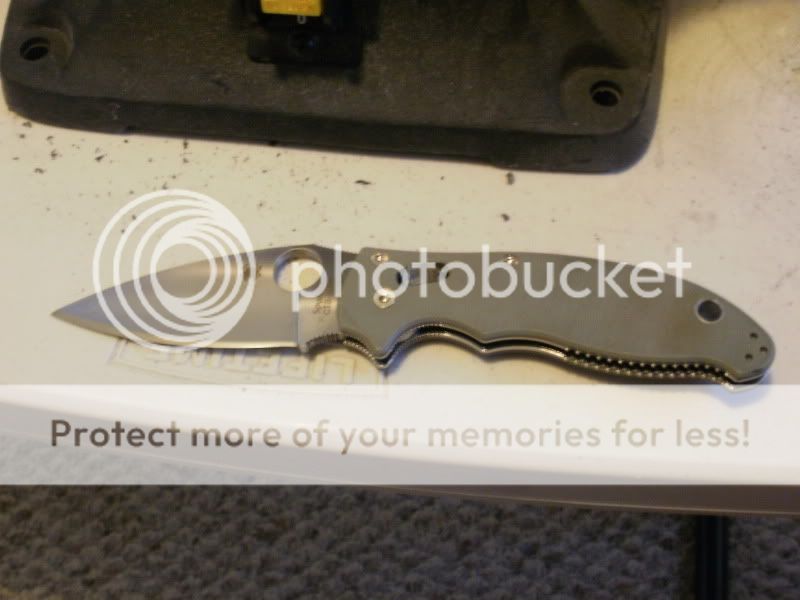
Mirror Polishing A Blade?

Joined
Jul 22, 2009
Messages
11,409
Feeling bored that my knives can't seem to get any sharper, I've been toying with the idea of putting a mirror polish on the entire blade of some of my knives. In particular I wanted to try doing it on non-stainless "Super Steels" like D2 and 3V in order to try and make it more resistant to rusting(I would like a mirror polish over coatings).

I've already tried it on my S30V and ZDP-189 blades, though it seems like there are still quite a bit of visible lines left on the blades. It's often hard to get in some of those "hard to reach" areas with sandpaper and my micro-mesh abrasives. No amount of time spent with the standard buffing wheel and white and green buffing compounds seem to get those ugly lines off. Brasso and elbow grease also haven't seem to have made a dent.

I've tried the slotted paper wheel, though Richard J says it wasn't meant to do that, and it works pretty well, but can't seem to do much against the bigger lines. And so, at the risk of sounding like a mad scientist, I was wondering if my DMT 6, 3, and 1 micron diamond pastes might work well with the buffing (cotton) wheels. I hardly use my diamond strops anymore since the slotted paper wheel seems to work so well. I figure the 6 micron diamond would be aggressive enough to remove enough metal to erase the larger scratches, but leave a fine enough finish that I can easily work it off with my other abrasives.

Also still not sure in which order I should go about it(6 micron DMT paste, White Compound, Green Compound, Brasso), because I don't know the approximate "grit" or how fine the finish is relative to the other. So I don't want to end up going backwards and undoing my work. Only thing I can tell with any certainty is that the slotted paper wheel is definitely rock bottom on the list, leaving the finest finish possible.

Being a lazy slob, I'm kind of fixated on using my power tools to polish and sharpen my knives. Though I feel I'm well within my rights to put my foot down when I spend a week polishing my Endura ZDP-189 blade by hand, and I still can't see my own nose hairs reflected on its surface.
 
i didnt say the slotted wheel wouldnt polish a blade though. i tried and it was too slow for me compared to how i polish now.

go look at this knife i made for kalama. i went from a 400 grit finish to a 600 grit finish and then 1500 before buffing with white rouge on a cotton buff. it didnt take quite 3 hours if that but my hands killed me after i was done. i have a process that works quite well even with skipping the progressive grits. i used 3m wetordry paper to do it with. http://www.bladeforums.com/forums/showthread.php?t=582180
 
I take it down to 1K grit then go thru 3 polishing wheels (sisal, sewn cotton and loose) with the approiate rouge. It takes about one hour for me to achieve good results on normal steels . ie. 440C, ATS-34, ect.. The steels with vanadium are very resistant to polishing . DM
 
I don't have a belt grinder and I've had enough hand polishing with sandpaper to last a lifetime. So I was wondering if there was anything I could do using my bench grinder.

I've tried the DMT 6 micron paste with my cloth wheel, but it doesn't seem to be very effective. For one thing, I think because it's an oil based paste that more or less never dries, the paste doesn't want to stay on the wheel.

There seems to be SOME sort of buffing action, as my previous mirror finish seemed considerably fogged up, but the old scratches are still there. So I figure I might need something a little more aggressive. I'm wondering if the standard Black Emery Compound from Sears will do the job.

I'm also considering using the slotted paper wheels to do the polishing. The more solid surface seems to let me put more pressure on the blade, and it also doesn't "grab" the knife like a cloth wheel does.
 
For a steel like ZDP it might just take a lifetime to get a perfect polish. Starting at about 400 grit you will probably need 3 sheets of every grit for each knife. The 6 micron paste could only be effective after a 2000 grit finish was applied, otherwise your just wasting compound. It would also work better applied to something like balsa wood and used by hand.

What you want to do can be done but realize it will probably take a LONG time. At this point I would guess to say you have not done nearly enough prep work before trying to buff.
 
noctis, i could give you some tips that will help you out quite a bit but its too much for me to type out. email me your number and i'll give you a call.
 
noctis, i could give you some tips that will help you out quite a bit but its too much for me to type out. email me your number and i'll give you a call.
Does it involve a belt sander?

If I'm using it to polish rather than sharpen, I figure I'd need finer grit belts for it.
 
i only used my belt sander to get a good base to start with. what grit belts do you have on hand?
 
Put a couple of sissal wheels on one side of your bench grinder and use grey compound.This will cut the factory grind lines and give you a smooth,but dull finish.Then go to your finish wheel with a white or pink compound.This gives me good results anyhow.
 
Put a couple of sissal wheels on one side of your bench grinder and use grey compound.This will cut the factory grind lines and give you a smooth,but dull finish.Then go to your finish wheel with a white or pink compound.This gives me good results anyhow.
Hmm, how fast does that compound cut? I just don't want to suddenly see a hole where my blade used to be, but I'm not quite committed enough to spend an hour trying to buff out the lines, maybe half an hour. And have you tried it on HRC 60+ steels? That's mostly how hard most of my knives are.

i only used my belt sander to get a good base to start with. what grit belts do you have on hand?
I don't have belts right now. I use 60, 120, 220, and 320 grit sandpaper. I then usually move onto my Micro-Mesh MX kit, which is also done by hand.

I haven't been very neat and tidy with it, as most of any sharp or 90 degree edges are worn down smooth.
 
when i put the mirror finish on the knife i made kalama, i could have done the entire knife without a belt sander but it saved me a little bit of time when sanding from spine to edge so the lines paralell to the spine would show up better. this made getting these lined out much easier since i could see what needed to be done.
 
I've tried the black emery compound from Sears but it just can't seem to scratch the blade. It gets hot, but the previous mirror finish I put on the blade isn't even fogging up. It looks like whatever is in that white rouge from the paper wheels is a lot harder than those puny wax sticks from Sears.

I'm thinking about trying the DMT 6 micron paste on the slotted paper wheel, though I'm not sure the result will be any better.

I'm trying to put off getting a belt sander since I don't have any place to put the thing.
 
i didnt buff until i was done with the 1500 grit wetordry and i used the white rouge. the wheel i used was a rock hard cotton buff. its all in what you do before buffing :D
 
Okay, I think I've managed to make some progress.

Before:
P7300001.jpg

P7300002.jpg

P7300003.jpg


After:
P7300004.jpg


I've found that using the diamond paste on the slotted paper wheel was a hit and a miss at the same time. The paste would stay on the wheel, but the wheel didn't cover enough area to neatly polish the blade.

I once again tried the various rouges from Sears with no luck, those abrasives simply couldn't put a scratch on the hardened steel. Then I thought, "the white rouge that came with the paper wheels can put a mirror edge on my knives", so I thought "what the hoo hah".

I applied the white rouge onto the cotton wheel and it put a mirror finish on my knife in no time at all. Whatever is in that rouge is a far higher quality than the crap in the Sears rouge sticks. While the factory grind lines are still slightly visible, I think they'll disappear entirely if I give it a few more runs.

In the meantime I'll need to throw away the old rouge sticks, buy more white rouge blocks, and maybe see if I can't find better rouges that cut faster and can fix up those messy lines I put in my Endura 4 ZDP-189 blade.
 
its hard to see what the blade looks like since the picture is blurry but it does appear to be shiny :D. i tried once to use the slotted wheel to polish a blade and it was hard to get an even finish that looked good which is why i said it wont work. thats when i done some experimenting and found the method i used on kalama. keep the old rouge sticks, they are good for softer metals and polishing wood and antler.
 
Back
Top