- Joined
- Feb 21, 2005
- Messages
- 2,662
Greetings all.
First, let me preface this with a few comments.
I am a big proponent of free hand sharpening, and I think that all of us with more than a passing interest in knives should have some degree of skill at working with benchstones. It's not really necessary that everyone be able to produce a shaving sharp edge on stones, but a basic understanding is important.
Aside from that, I think sharpening on benchstones is one of the most relaxing things you can do, but this isn't the place for my philosophy of sharpening.
That said, I think tools like the Spyderco Sharpmaker are invaluable for the maintenance of our knives. It takes just a few minutes to touch up an edge to shaving sharp, and with the diamond stones, the Sharpmaker becomes pretty efficient at reprofilling an edge.
But that's where the system is most limited. Many of us like an edge that is thinner than the two preset angles the Sharpmaker gives us.
So what follows is a not entirely simple, though not at all difficult modification to the standard Sharpmaker that will allow it to sharpen to a variety of angles.
The tools needed are simple and you've probably all got them lying around the house somewhere. You will need a drill, a protractor, four bolts, eight nuts, a wrench or two, a Sharpmaker and a piece of wood for the base. You'll also need something to act as angle guides after you're finished. I used dowel rods.
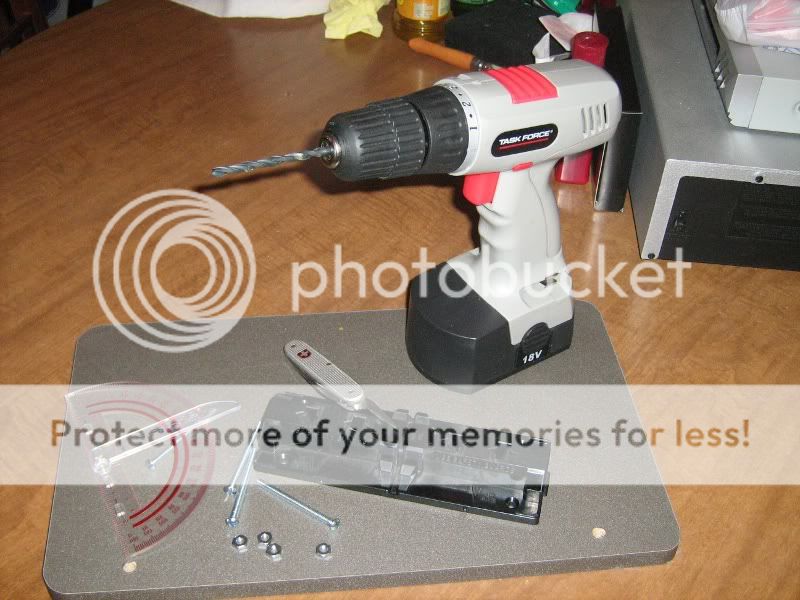
The concept in mind here is that if the edges of the base are raised off the table, it will change the angle of the stones. This isn't a new concept and people have been doing it since the introduction of the Sharpmaker. What I'm about to illustrate, though, is a system for measuring the angles precisely and for keeping the Sharpmaker steady when raised off the table.
In the end, the base will ride on four bolts, positioned at the desired height by nuts. The only bolts I had around that were small enough were the same size as the pre-drilled holes in the base, and since I needed the base to be able to pivot, I had to drill out the holes a little larger (I used the awl on a Victorinox Soldier).
With the first step being to drill out the holes if necessary, we're now ready to move on to marking the wooden base for installation of the bolts.
I used a shelf from an old computer desk, and a fine tip Sharpie to mark my holes.
Once the holes were marked, I used my trusty awl to start the holes and then drilled them (and countersunk the back side so that the heads of the bolts won't scratch the surface I'm sharpening on) and installed the bolts.
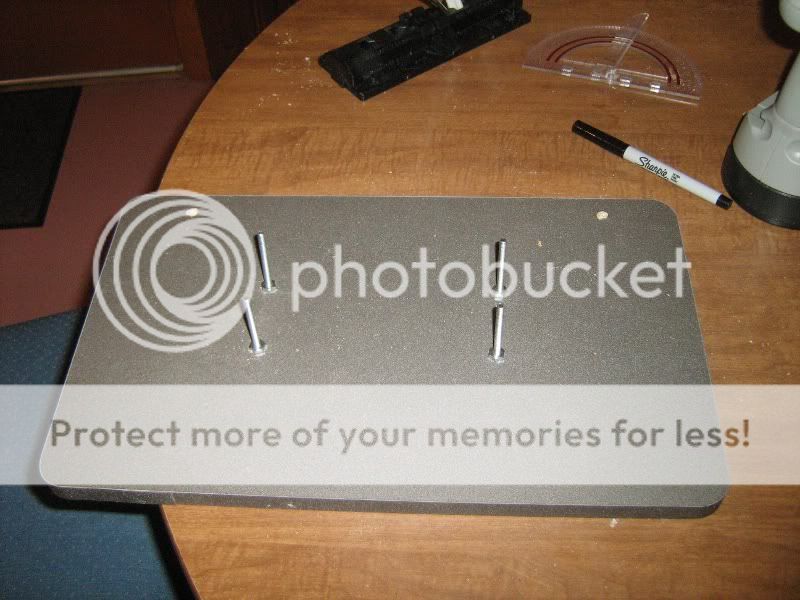
From this point, it's all pretty straightforward. Slide the Sharpmaker down onto the posts and make sure everything rides as smoothly as possible.
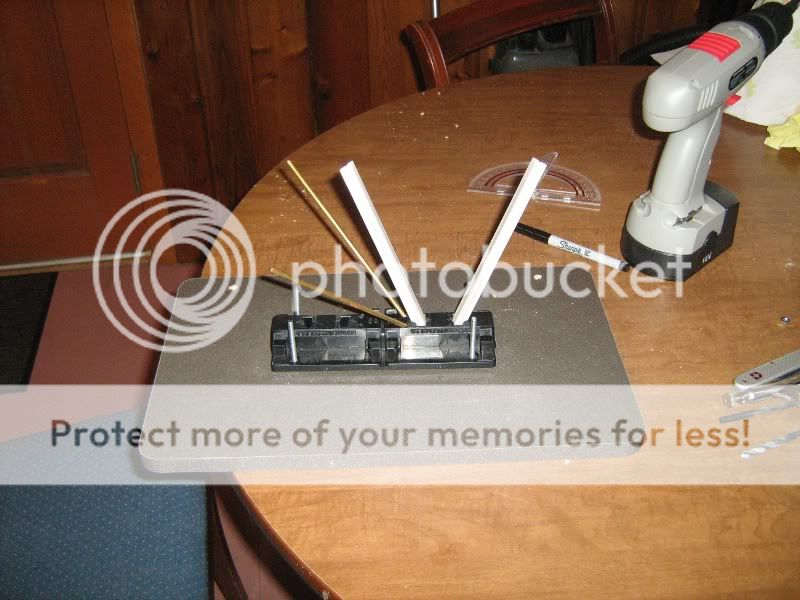
Now with the other four nuts and screw them down to the bottom of the bolts and put the Sharpmaker base back on top.
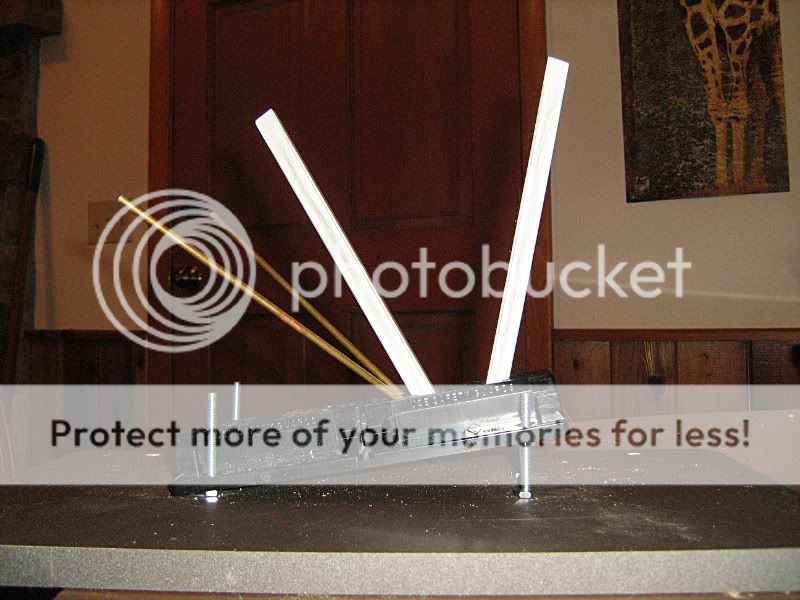
As you can see, I ran out of nuts, so there's only one nut holding the base up, but with four nuts attached, it'll be very stable. Just from eyeballing the protractor, the angle we have here (for the right hand stone) is around five degrees.
The final step, which I haven't done yet, is to make the angle guide. You'll need two guides since the height of the nuts on the left side (or right side if you're left handed) won't be the same as on the right side.
I should also point out that you will be basically sacrificing the use of one set of slots, so it's best to use the 40 degree side.
It's not a perfect solution, but it does give the Sharpmaker a bit more flexibility and it was a fun little project. The total time involved was no more than about an hour of drawing up plans and about half an hour of assembly. Total cost involved... for me it was nothing because I had all the parts lying around, but I don't see any of this costing more than $10 if you start from nothing.
First, let me preface this with a few comments.
I am a big proponent of free hand sharpening, and I think that all of us with more than a passing interest in knives should have some degree of skill at working with benchstones. It's not really necessary that everyone be able to produce a shaving sharp edge on stones, but a basic understanding is important.
Aside from that, I think sharpening on benchstones is one of the most relaxing things you can do, but this isn't the place for my philosophy of sharpening.
That said, I think tools like the Spyderco Sharpmaker are invaluable for the maintenance of our knives. It takes just a few minutes to touch up an edge to shaving sharp, and with the diamond stones, the Sharpmaker becomes pretty efficient at reprofilling an edge.
But that's where the system is most limited. Many of us like an edge that is thinner than the two preset angles the Sharpmaker gives us.
So what follows is a not entirely simple, though not at all difficult modification to the standard Sharpmaker that will allow it to sharpen to a variety of angles.
The tools needed are simple and you've probably all got them lying around the house somewhere. You will need a drill, a protractor, four bolts, eight nuts, a wrench or two, a Sharpmaker and a piece of wood for the base. You'll also need something to act as angle guides after you're finished. I used dowel rods.
The concept in mind here is that if the edges of the base are raised off the table, it will change the angle of the stones. This isn't a new concept and people have been doing it since the introduction of the Sharpmaker. What I'm about to illustrate, though, is a system for measuring the angles precisely and for keeping the Sharpmaker steady when raised off the table.
In the end, the base will ride on four bolts, positioned at the desired height by nuts. The only bolts I had around that were small enough were the same size as the pre-drilled holes in the base, and since I needed the base to be able to pivot, I had to drill out the holes a little larger (I used the awl on a Victorinox Soldier).
With the first step being to drill out the holes if necessary, we're now ready to move on to marking the wooden base for installation of the bolts.
I used a shelf from an old computer desk, and a fine tip Sharpie to mark my holes.
Once the holes were marked, I used my trusty awl to start the holes and then drilled them (and countersunk the back side so that the heads of the bolts won't scratch the surface I'm sharpening on) and installed the bolts.
From this point, it's all pretty straightforward. Slide the Sharpmaker down onto the posts and make sure everything rides as smoothly as possible.
Now with the other four nuts and screw them down to the bottom of the bolts and put the Sharpmaker base back on top.
As you can see, I ran out of nuts, so there's only one nut holding the base up, but with four nuts attached, it'll be very stable. Just from eyeballing the protractor, the angle we have here (for the right hand stone) is around five degrees.
The final step, which I haven't done yet, is to make the angle guide. You'll need two guides since the height of the nuts on the left side (or right side if you're left handed) won't be the same as on the right side.
I should also point out that you will be basically sacrificing the use of one set of slots, so it's best to use the 40 degree side.
It's not a perfect solution, but it does give the Sharpmaker a bit more flexibility and it was a fun little project. The total time involved was no more than about an hour of drawing up plans and about half an hour of assembly. Total cost involved... for me it was nothing because I had all the parts lying around, but I don't see any of this costing more than $10 if you start from nothing.
Last edited: