
Cliff Stamp
BANNED
- Joined
- Oct 5, 1998
- Messages
- 17,562
Awhile ago I posted about sharpening an Endura on a piece of concrete :
http://www.bladeforums.com/forums/showthread.php?t=381975
I recently did similar with a slim Mora after cutting some sod and digging :
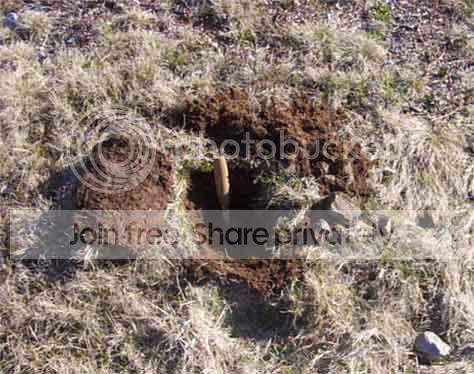
The Mora was used to pry out the rocks, I just kept a grip on the blade itself to keep from overloading it, I had it pinched between the thumb and index finger. The soil was fairly rooty there, the knife was used to cut through and basically skinned the top layer of sod off.
The knife now had no fine cutting ability, a test cut on a piece of 1/2" poly (used and left outside not new), took 105 heavy slices. I looked for a semi-flat rock of no particular type, and found one which had broken to reveal a surface similar in size to the regular hockey puck stones.
It took about a minute pressing very hard to form a clean burr on both sides over the full width of the bevel. The rock was loading with metal from the blade, readily visible. The angle was then increased and a micro-bevel applied with a few passes finishing very light.
The knife would now shave on a draw, would slice the poly in four cuts, and could easily slice paper on a draw and went through thin plastics easily :
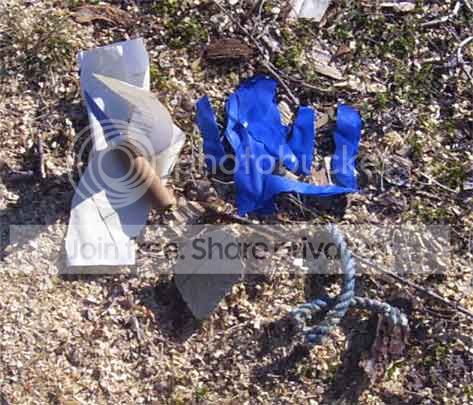
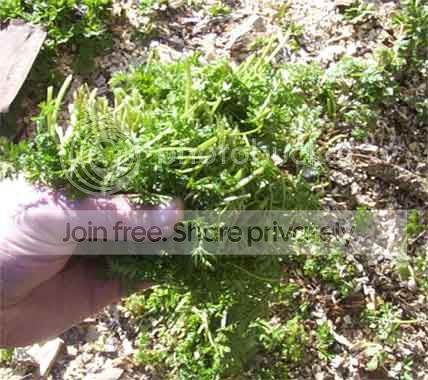
The rock shown was what was used to sharpen the knife. The Mora of course easily cut fine vegetation now as well :
I spent about 15 minutes trying to obtain push cutting sharpness, but had little success. I dug another hole and reset the edge to the above shaving on a slice sharpness. It was later checked on light cotton and was 0.90 (5) cm under 200 grams of tension, which is about 1/3 of optimal for an x-coarse stone, 90 grit AO.
Under magnification the edge was fairly clean, but there was also deformation in places, when using the rock at times the edge seemed to be cut but at others it skipped along the stone. The level of abrasive was also fairly inconsistent, this might be improved if two similar rocks were ground together, what is most likely causing the less than optimal sharpness are large irregular bumps plowing into the edge which skips over it rather than be cut.
A note, before anyone concludes that this shows some inherent ease of sharpening of carbon steels, that is a myth, that rock will cut into stainless steels just as readily, and a 60+ hrc edge is still pretty soft compared to a rock so they can be honed just as readily. I don't live in Arkansas either, that is not a piece of sandstone, just a hard pebbly surface.
-Cliff
http://www.bladeforums.com/forums/showthread.php?t=381975
I recently did similar with a slim Mora after cutting some sod and digging :
The Mora was used to pry out the rocks, I just kept a grip on the blade itself to keep from overloading it, I had it pinched between the thumb and index finger. The soil was fairly rooty there, the knife was used to cut through and basically skinned the top layer of sod off.
The knife now had no fine cutting ability, a test cut on a piece of 1/2" poly (used and left outside not new), took 105 heavy slices. I looked for a semi-flat rock of no particular type, and found one which had broken to reveal a surface similar in size to the regular hockey puck stones.
It took about a minute pressing very hard to form a clean burr on both sides over the full width of the bevel. The rock was loading with metal from the blade, readily visible. The angle was then increased and a micro-bevel applied with a few passes finishing very light.
The knife would now shave on a draw, would slice the poly in four cuts, and could easily slice paper on a draw and went through thin plastics easily :
The rock shown was what was used to sharpen the knife. The Mora of course easily cut fine vegetation now as well :
I spent about 15 minutes trying to obtain push cutting sharpness, but had little success. I dug another hole and reset the edge to the above shaving on a slice sharpness. It was later checked on light cotton and was 0.90 (5) cm under 200 grams of tension, which is about 1/3 of optimal for an x-coarse stone, 90 grit AO.
Under magnification the edge was fairly clean, but there was also deformation in places, when using the rock at times the edge seemed to be cut but at others it skipped along the stone. The level of abrasive was also fairly inconsistent, this might be improved if two similar rocks were ground together, what is most likely causing the less than optimal sharpness are large irregular bumps plowing into the edge which skips over it rather than be cut.
A note, before anyone concludes that this shows some inherent ease of sharpening of carbon steels, that is a myth, that rock will cut into stainless steels just as readily, and a 60+ hrc edge is still pretty soft compared to a rock so they can be honed just as readily. I don't live in Arkansas either, that is not a piece of sandstone, just a hard pebbly surface.
-Cliff
