More questions...

Joined
Nov 14, 2018
Messages
180
In terms of a gyoto 8 inch with full tang hande any ideas of what it should weight? I know it has to be ground thin but I am looking for some quantifiable form of measurement for thin in terms of weight it’s nitro v stainless
Also anyone know where I can get 8 inch buffing wheel that are thick 1.5-2 inches I have this rediculous 1.5hp buffer that has a 1 inch arbor most of the stuff I’m seeing is like 3/8-5/8 thick maybe 1 inch
Thanks!!!
 
Check out "chef knife to go" site for measurements and weights of lots of types of j knives
 
Never saw a gyoto, but I have seen lots of gyuto, I guess they are pretty similar :D;)

I ( and many others) stack the buffing wheels to get whatever thickness we like. Four 3/4" wheels makes one 3" wheel.

Personal rant - don't get me started about the many TV cooking show people who talk about how much they like their santuko ( san-two-koo) knife ( santoku - san/toe/coo). Some of these people are the judges and guest chefs.
 
Last edited:
Yeah I am making my brother some knifes for his birthday and most of them I can’t pronounce (or spell correctly).
Thanks that’s like 40 bucks for each buffing wheel stacked together! Do they last a while? Do I really need one for every grit compound I was planning to use black green and white. Also would need for the p47 polish for handles and some just to buff with no compound right? I need to rob a bank
 
Japanese chef knives are all over the board regarding thickness and weight, there is not a specific standard. The Japanese knife that most resembles a "chef knife" is a gyuto, they can be very thin from the edge to the spine and maybe referred to as a "laser", on the other end of the spectrum, there are some knives that are quite thick at the spine and have a lot of heft...they still are relatively thin behind the edge, theses knives are sometimes called a "workhorse". More important than overall weight is the balance of the knife....most chefs prefer a neutral balance point right in front of the handle, above the heel of the blade or even a little bit blade forward. An knife the is not well balanced is more fatiguing to use than a knife that is heavier, but well balanced.

John gave excellent advice, go to the Chef Knives To Go website and study the specs and descriptions of the many gyutos that they have.
 
Buffs last a long time when stacked.

Out of curiosity, why do you need the buff 1.5" to 2" wide? I have two buffs on my 12" buffers, but use a single buff on my 6" units.

Yes, you should have separate buffs for different grits. Store them in a labeled zip-lock plastic bag.
 
Thanks everybody!
I am looking at a ton of knives on the above mentioned site and it is very helpful!
Perhaps I don’t need as thick a wheel as I have been told. Thanks for the plastic bag idea! Can I just buff with a 1/2 wheel?
Again thanks everyone it is very overwhelming to get into making knives and the more I learn the less I feel I know if that makes sense.
 
Can I just buff with a 1/2 wheel?

I would think it would be pretty hard to buff with half of a wheel.... a 1/2" buff will work just fine.

Not only do you need a buff for each grit, you also need a set for wood, and a separate set for metal. Buffing metal will put a dark color to the buff which you don't want for wood or ivory.
 
Ha!! But the 1/2 wheel is so much cheaper!! I’m the worst at typing as is plain to see
I found a red rouge as well it looks like it goes black, red, green, and then white? Are all these steps necessary? Or is this just propaganda from the big buff companies?
I am assuming the knife should balance right in front of the handle?
 
You sand the blade to at least 1000 grit if you are going for a mirror polish. Many makers sand up to 2500 grit.
Then you normally buff with a coarse polish ( black or green) followed by a fine polish (red or white rouge).

Different folks have different procedures, but I doubt anyone goes up from coarse to medium to fine to extra fine inthe polishes. Two steps is the norm.

I start with green chrome and follow with matchless white.
 
I would think it would be pretty hard to buff with half of a wheel.... a 1/2" buff will work just fine.

Not only do you need a buff for each grit, you also need a set for wood, and a separate set for metal. Buffing metal will put a dark color to the buff which you don't want for wood or ivory.


AAAGGHHHh!! So there's my reason for friggin up some wood handles!! wondered how others kept from getting the pores filled with black compound...
 
Yeah if he didn’t mention that I definitely would just have used the metal wheels for wood.
A few of the kitchen knives I made are balancing nicely. The large gyuto is balancing 1 inch in front of the handle. However I read that one should pinch grip a chef’s knife so it would balance right where pinched. Is that ok ?
 
As Marc said I’d worry more about balance. For the most part the weight will be determined by the thickness of the stock and the size of the knife. Balance is still a preference but I’ve found that a balance point at the front of the scales is liked by most. It’s hard to do that with a 10” knife so it’ll be more front heavy, which I don’t mind either. Handle material also plays into balance. A knife with natural wood like walnut will be hard to get enough weight on the back end. One with thick micarta scales will probably need a tapered tang or holes to lighten the tang. If this is your first knife I’d focus on fit and finish, thin edge(.010” or less) and balance near the front of the scales.


Also post a pic of your drawing for some critique. It will help a lot.
 
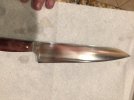
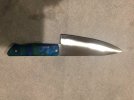
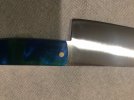
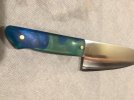
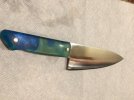
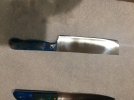
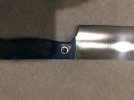
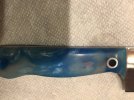
I am going to post the pics of all the knives so I can receive some criticism as to what I can do better next time. I know they suck and that there’s a lot wrong with them but I’m probably missing big important stuff as well. Thanks!!
 
A98F2F8B-33F3-4B23-B53B-B1D0CFE236A6.jpeg 3955F6AA-EFBA-479F-832F-AF21D09755CB.jpeg E61A6546-E366-48A8-AFF7-B47463F8CC46.jpeg
 

Attachments

  • 72C69F30-C573-43AE-ACD1-3E5FB949AB86.jpeg
    72C69F30-C573-43AE-ACD1-3E5FB949AB86.jpeg
    222.3 KB · Views: 8
  • 9E0E9D58-5774-43A5-94CA-1F21014385D0.jpeg
    9E0E9D58-5774-43A5-94CA-1F21014385D0.jpeg
    212.4 KB · Views: 7
  • CD6FE8EA-90CA-4F91-B714-BF08B133BAA3.jpeg
    CD6FE8EA-90CA-4F91-B714-BF08B133BAA3.jpeg
    209.3 KB · Views: 7
  • 9169C8B3-65E9-415A-AE3B-CDC13563CBAE.jpeg
    9169C8B3-65E9-415A-AE3B-CDC13563CBAE.jpeg
    253.2 KB · Views: 7
  • 720E55A3-25BB-4C2E-AB87-2D24949424E3.jpeg
    720E55A3-25BB-4C2E-AB87-2D24949424E3.jpeg
    186 KB · Views: 7
  • C868AB80-894B-4B82-8D70-A2E59D02E336.jpeg
    C868AB80-894B-4B82-8D70-A2E59D02E336.jpeg
    197.5 KB · Views: 7
  • 1E56EE27-5615-4ADF-9CE9-B8652ECA3F54.jpeg
    1E56EE27-5615-4ADF-9CE9-B8652ECA3F54.jpeg
    197.1 KB · Views: 7
Back
Top