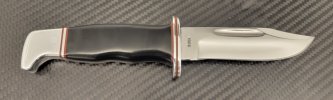
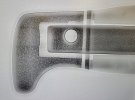
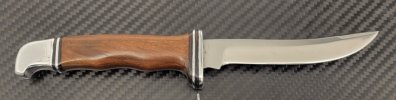
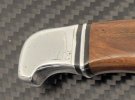
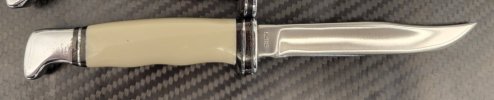
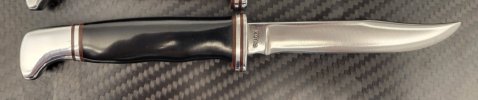
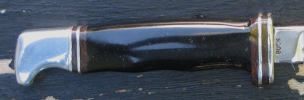
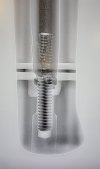
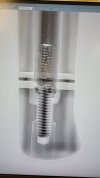
More X-Ray Fun...1960s Barrel Nut vs Flat Tang 119

Generalist

Gold Member
Joined
May 10, 2025
Messages
389
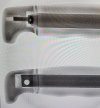
There's no real point to this post other than sharing some new images I took and found interesting that maybe someone else will enjoy.

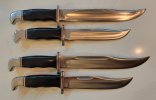
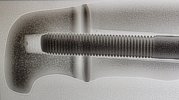
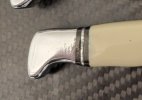
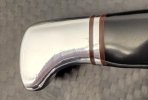
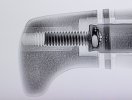
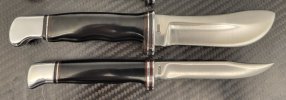
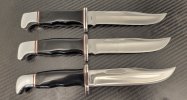
Top: Barrel nut fiber spacer 119 (late 1962- early 63)

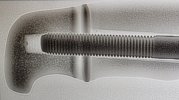
Middle: Flat tang, flat pommel pinned 119 (late-ish 1963)

Bottom: Flat tang, rounded pommel 119 (1964-66ish)

1000021440.jpg

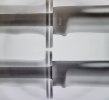
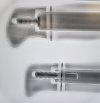
Top 2 knives:
1000021441.jpg
1000021442.jpg

I couldn't fit all 3 in one field of view, so you'll have to take my word that the bottom knife's tang and handle internals looked essentially identical to the 2nd.

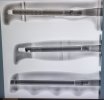
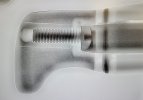
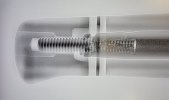
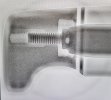
The barrel nut up close.
1000021444.jpg
 
Awesome thread! Will this be an ongoing thing?
I've done 2 x-ray imaging sessions recently. The purpose of the first was to understand why the 1947-48 105 (middle below) was pinned. Turns out the pommel was threaded as the primary attachment mehanism and the pin was only added to prevent the threaded pommel from loosening. Images below. See the "Old Fixed Blade Construction" thread for more.

1000021347.jpg1000021352.jpg
1000021346.jpg

The 119 imaging was to answer a question I had about one of the pictured knives.

I'm not opposed to doing more but don't have any immediate plans.
 
I'm sure this is not the case, but I can't help imagine that somewhere an x-ray tech is being interrogated by hospital administration about power spikes at odd hours and no patients logged...

Great images, though.
Lol, I work in electronics manufacturing. We have a handful of x-ray systems to validate product quality and perform root cause analysis when something goes wrong in circuit board production.
 
The next x-ray will be this guy. I suspect we'll find this is one of the rare knives made during the switch from barrel nut to pinned construction in ~May 1963. Prior to the switch Buck had pre drilled some pommels to accept barrel nuts, and when the switch to pinned construction occurred, instead of throwing them away, the barrel nut hole was plugged with aluminum and the pin hole was drilled. Hope to have the x-ray image within the next week or so.


1000022546.jpg
1000022542.jpg
 
Last edited:
 Results

This 119 pommel was indeed made initially to accept a barrel nut and repurposed to a pinned pommel. Very rare (as far as I know) and a very interesting piece.

1000022935.jpg
20251224_201755.jpg

Note the irregular shape of the right side of the pommel interior cutout vs the straight wall of the flat tang 119 in the prior post early in the thread. Originally drilled to accept the fat bolt head of the barrel nut system. Also note the aluminum barrel nut hole plug. Difficult to see. Zoomed in in second image.

1000022911.jpg
1000022909.jpg
 
Last edited:
One of my goals as a collector is to add to the public knowledge of early Buck knives. The info shared below isn't new, but the images are, and I hope they may provide some clarification to anyone else, like me, who has struggled to understand specifics of some earlier writings.

A brief history of barrel nut Buck knives

From Vern Taylor's wonderful August 1997 BCCI article, Forgings, Barrel Nuts, and Bar Stock Butts:

"Only the very earliest [1961 factory] knives had the butt threaded to accept the quarter inch bolt..."

I dont own one of these from the factory era. Bert shared a wonderful example of one in the Old Fixed Blade Constructiom thread.

Here's an example from 1955-56, an early 118.

1000022942.jpg
1000022873.jpg
1000022875.jpg

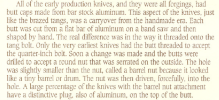
Back to Vern..."Soon a change was made and the butts were drilled to accept a round nut that was serrated on the outside. The hole was slightly smaller than the nut, called a barrel nut because it looked like a tiny barrel or drum. The nut was then driven forcefully into the hole. A large percentage of the knives with the barrel nut attachment have a distinctive plug, also aluminum, on the top of the butt..."

Where x-ray comes in...Vern will next describe the two styles of barrel nut construction.

First method

"...Originally this plug was necessary when the operator drilled all the way through the butt [drilling from the blade end] instead of making a blind hole for the barrel nut..."

Pictured on a leather spacer 102 melamine barrel nut circa 1961-1962. Note what appears to be some kind of adhesive inside the pommel cavity above the bolt head.

1000022923.jpg
1000022907.jpg
1000022903.jpg

Later method

"...A little later the hole for the nut was made from the top [meaning the butt end] and a smaller hole accommodated the bolt on the tang, which was smaller than the outside diameter of the barrel nut. This ensured that the nut could not pull out of the butt."

Pictured on a fiber spacer 102 barrel nut circa 1962-1963.

1000022932.jpg
1000022919.jpg
1000022917.jpg
 

Attachments

  • 1000022875.jpg
    1000022875.jpg
    214.6 KB · Views: 1
Last edited:
The barrel nut up close.
Screenshot 2025-12-26 at 11.47.28 AM.png

The above is from Vern Taylor's article in the August 1997 Newsletter. With the nut serrated on the outside and then driven into the hole in the pommel, the whole pommel would have to be rotated to tighten things. I think Vern Taylor may not have described the procedure correctly. My interpretation of Taylor's comment is that the barrel nut with serrations would be pretty much the same as having a threaded pommel.

Generalist, do you have a comment?

Bert
 
Last edited:
View attachment 3059770

The above is from Vern Taylor's article in the August 1997 Newsletter. With the nut serrated on the outside and then driven into the hole in the pommel, the whole pommel would have to be rotated to tighten things. I think Vern Taylor may not have described the procedure correctly.

Generalist, do you have a comment?

Bert
My understanding, based solely on Vern's writings, is that the whole pommel was rotated to tighten it just as in the threaded pommel method. Could the barrel nut itself be rotated independent of the pommel while still maintaining a friction fit into the pommel? It's very possible this was just described incorrectly, who knows? I havent disassembled one, though I have owned 2 barrel nut knives with loose pommels that rotated a bit when twisted.
 
My understanding, based solely on Vern's writings, is that the whole pommel was rotated to tighten it just as in the threaded pommel method.
You have seen this before. This is an early 102 barrel nut from 1961. It has a metal spacer between the leather spacer and the pommel, presumably to protect the leather spacer from rotation of the pommel. Only the earliest barrel nut knives have that spacer, which makes me think that people realized that metal spacer wasn't needed since the pommel wasn't being rotated.

Bert
Screenshot 2025-12-26 at 12.40.37 PM.png
 
My understanding, based solely on Vern's writings, is that the whole pommel was rotated to tighten it just as in the threaded pommel method. Could the barrel nut itself be rotated independent of the pommel while still maintaining a friction fit into the pommel? It's very possible this was just described incorrectly, who knows? I havent disassembled one, though I have owned 2 barrel nut knives with loose pommels that rotated a bit when twisted.
I just spoke to someone more knowledgeable than I who has repaired barrel nut knives. They said the barrel nut itself is tightened, not the pommel. So either Vern's writing wasn't correct on the serration point or it only applied to the first version of barrel nut construction.

I hope you consider selling me that 102 someday 😀
 
Here's another oddity I ran across. The top knife is normal. The one on the bottom was broken at the pommel and repaired.

1000022940.jpg
1000022887.jpg
Same knife, different x-ray angle.
1000022888.jpg

You never know what you'll find when you start to x-ray.
 

Attachments

  • 1000022888.jpg
    1000022888.jpg
    118.3 KB · Views: 4
  • 1000022888.jpg
    1000022888.jpg
    112.5 KB · Views: 4
Last edited:
So either Vern's writing wasn't correct on the serration point or it only applied to the first version of barrel nut construction.
Since that 102 is a very early barrel nut, maybe it has serrations. I wonder what you would find if you did some imaging with it?

Bert
 
Back
Top