Multi-blades- American taste?

Joined
Oct 2, 2004
Messages
17,619
{ Quote mnblade - Interestingly, here in Europe, most any man who carries a knife carries a SAK. Once in awhile you might see a modern, single-blade folder or multi-tool, but I've NEVER seen anyone with a stockman or trapper or jack. And I've lived here on and off since 1993.

-- Mark }


This something I have also wondered about for many years. While serving just over 10 years of what was to be at least a 20 year career in the Army, I got to travel to some very interesting places. I spent one tour of a bit over a year at an American Air Force base in eastern England, two tours in southern Germany, a 6 month TDY duty at the old Wheelus Air Force base in Libya while the army engineers made the runways longer, and while stationed in Europe traveled a lot to take it in while I was there.

Being a knife knut, I of course watched very carefully for knife sightings to see what the locals were using, and I broused local shops to see what was for sale. Also, it was pretty standard practice to have the engineers working with local civil engineers on construction projects that had something to do with the local infrastructure. Like laying a pipe line to link in an American base with local water and sewer lines. So working with German, English, and even some Turkish and Libyan workers was the norm. These were not the suit type high ups, but blue collar workers just like us, leaning on a jack hammer, or using a D handle shovel feeding the cement mixer, or cutting off the right length of 2X4 with a Skill Saw.

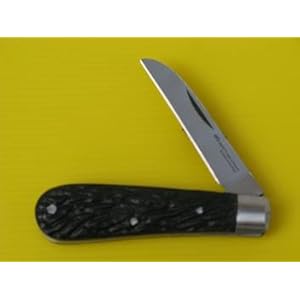
In all my time traveling around the world, the only multi-bladed knives I saw, exept for sak's, were all carried by my fellow Americans. My buddy Paul carried a Case stockman, I carried a Buck stockman, a few of us carried two blade jacks, some the issue MLK knife, then of course the TL-29. But when I saw a knife in the hands of an English guy cutting open a bag of cement, or a German guy stripping some wire in a warehouse we were building, or anyone who was local, it was always a simple single blade knife. Sometimes it was a lockblade, like the K55 knife made in Germany. But sometimes it was just a simple sodbuster kind of knife, made by Kissing Krane or somebody else. I saw Douk-Douk's, Opinels, sodbusters, and even some big friction folders in northern Italy. In England, the universal knife of the working man seemed to be a mid size, dark wood handle, single blade knife with a sheepsfoot blade. But in my travels, I never saw a stockman, trapper, congress, or any of the other patterns we admire on this forum. The only exception was sak's. Even then, they were a popular carry item in the pocket, among the European folks.

Now I know that in their heyday, the Sheffield firms made all kinds of multi-bladed pocket knives for the gentry. Mother of pearl wonders with sissors, pipe stem reamers, nail files, and such. But were these the exception to the rule for the very wealthy? Or perhaps just the gilded age of the late 1800's?

From my own observations, the pocket knife with more than one single cutting blade seems to be an American taste.

Carl.
 
carl,

i love your posts, they always seem to make me think about things in a different way, like how many blades our knives have. Maybe they were just generally of the less is more way of mind, like why do i need two or even three blades when a single blade will do most anything i might need. who really knows, i love my stockmans, and peanuts, but as of late all i have been carrying is a sodbuster and i have been really liking it. it is also the american way to have more than you need, i'm really just starting to learn this as i have gotten married and moved out of my parents house, and started to see alot of things i thought i couldn't live without become unimportant and almost unmissed. oh well, who knows my thinking may not be even remotely close as i am still young at 24, and still need to spend more time around my local liars circle.

thanks
sam
 
It may go in trends or seasons.
Lots of old British knives were multi-blade affairs from the manufacturing age. I don't know what people carried back then, but it always interested me when a pocket knife had a tool for scraping out the bowl on your pipe. I always thought it was interesting when an English Drilling gun had two shotgun barrels with a rifle barrel married underneath.

The Boy Scouts and the "Be Prepared" thing may add to worldwide multi-blade appreciation, but I always think of a Boy Scout knife as an American product. After being in the Boy Scouts in America, I always seemed to gravitate towards multi-blade pocket knives, and other utilitarian devices like pickup trucks with multi-compartment tool boxes, etc.

Most Hunting knives seemed like one fixed blade, so maybe that's why a lot of guys I knew in construction trades seemed to have a Buck 110 on their hip (there was always a truck full of other tools nearby).

After loading dynamite for a while in the 1970's I always wanted a knife with a "junk" blade available on it (nitroglycerin seems to eat blades), so while everybody else was wearing a Buck 110, I wore a Buck Wrangler (big stockman) in a belt pouch so I could invariably turn the spey into a screwdriver or junk blade.

I found the best for making a place for a blasting cap in a stick of dynamite was a small two-bladed Congress. The pen would get wasted after a while, then I'd put up with the sheepsfoot for a while until I found another. Back then hardware stores had a decent selection of patterns. I seemed to go through Case two-bladers pretty regularly. They were cheap enough in that pattern in the 1970's.

Nowadays I generally have a multi-tool handy.
 
Last edited:
Which multi blade patterns were the most prevalent in old Sheffield catalogs? Did Sheffield export to mainland Europe? How old is the Opinel?
 
While in the U.S. Navy (24-years) and my travels throughout the world I observed:

In Japan, I didn't see too many knives of any kind carried by individuals. I think one of the reasons for this was the "Status of Forces Agreement" between the United States and Japan that was very restrictive on what types of cutlery could be made by the Japanese for use in Japan and who could own various types of cutlery.

In most of Southeast Asia I noticed that most people carried fixed blade knives varying in size from 2" blades up to 20" inches or more.

In the Philippines, the Balisong Knife (the one you flip around) was very prominent. When we'd come into a port, the philippino kids would put on Balisong shows flipping those things two at a time sometimes in hopes of getting a peso or two from the Sailors.

In Europe during my travesl through Germany, France, and in other mid-European countries, a SAK (Victorinox or Wenger) was the most common type knife carried while in Great Britain, knives that we carry here in the U.S. were pretty common -- not stockman or trapper knives but pen knives, 2-blade jack knives, etc.. A funny thing -- my first wife was a gal I married while stationed in Scotland. Her folks owned a farm and when her Dad was castrating pigs, he used a plain ole single edge razor blade not something fancy with a spey blade.

Now most of my travel through Europe was done in the 1968 to 1971 time frame while most of my time in Japan was in the 1965 to 1968 time frame.

I have no idea what they are carrying now-a-days but I'll bet in the Philippines, theyre still carrying those Balisongs.
 
Last edited:
I have no idea what they are carrying now-a-days but I'll bet in the Philippines, theyre still carrying those Balisongs.
Yes indeed, they still are! Just yesterday, I was talking to a deckhand on one of our tugs, who is from the Philippines, and when I showed him the balisong in my pocket (a Filipino hand made knife), his eyes lit up and he started flipping it around, and he proudly declared that he's from Batangas and that everyone there carries and uses these knives.
 
Which multi blade patterns were the most prevalent in old Sheffield catalogs? Did Sheffield export to mainland Europe? How old is the Opinel?


Joseph Opinel set up shop for making knives in 1890. The same year Charles Elsner and his mother, Victoria, set up making the first sak's. A kind of weird co-incidence.

Sheffield made lot of very nice, to out and out beautiful, multiblade knives. But looking at them, they don't look like what the regular ditch digger, wagon driver, sailor, or laborer would have bought. More like the landed gentry, who employed butlers and grounds keepers for the real work.

On the other hand, in the catalogues of that era, I see a lot of heavy duty single blade sheepsfoot knives put out by the cutlery houses of Sheffield. It stands to reason they would sell to the full spectrum of the market.

Carl.
 
It may go in trends or seasons.
Lots of old British knives were multi-blade affairs from the manufacturing age. I don't know what people carried back then, but it always interested me when a pocket knife had a tool for scraping out the bowl on your pipe. I always thought it was interesting when an English Drilling gun had two shotgun barrels with a rifle barrel married underneath.

The Boy Scouts and the "Be Prepared" thing may add to worldwide multi-blade appreciation, but I always think of a Boy Scout knife as an American product. After being in the Boy Scouts in America, I always seemed to gravitate towards multi-blade pocket knives, and other utilitarian devices like pickup trucks with multi-compartment tool boxes, etc.

Most Hunting knives seemed like one fixed blade, so maybe that's why a lot of guys I knew in construction trades seemed to have a Buck 110 on their hip (there was always a truck full of other tools nearby).

After loading dynamite for a while in the 1970's I always wanted a knife with a "junk" blade available on it (nitroglycerin seems to eat blades), so while everybody else was wearing a Buck 110, I wore a Buck Wrangler (big stockman) in a belt pouch so I could invariably turn the spey into a screwdriver or junk blade.

I found the best for making a place for a blasting cap in a stick of dynamite was a small two-bladed Congress. The pen would get wasted after a while, then I'd put up with the sheepsfoot for a while until I found another. Back then hardware stores had a decent selection of patterns. I seemed to go through Case two-bladers pretty regularly. They were cheap enough in that pattern in the 1970's.

Nowadays I generally have a multi-tool handy.

Western Cutlery actually made a special stockman pattern for miners - it had four blades, all the exact same size sheepfoot. They made it in response to miners who kept wearing out the sheepfoot blade on their standard premium stockman knives.
 
Back when I was young in the late 60's early 70's there were very few styles of knife to choose from in the shops around where I lived. I'd say 90% of the available knives in hardware stores were Lambfoots. Most people if they carried a knife at all seemed to carry a Lambfoot. I think if I had to pick a typical British knife of that period it would have to be the Lambfoot.

31S9%2BOD312L._SL500_AA300_.jpg
 
Western Cutlery actually made a special stockman pattern for miners - it had four blades, all the exact same size sheepfoot. They made it in response to miners who kept wearing out the sheepfoot blade on their standard premium stockman knives.

So I guess those miners were using lots of dynamite?

I'm not sure about the chemistry, but the dynamite would take the edge right off first day. Then it would go to work dissolving the hinge pin, etc. Pretty soon my fairly cheap to begin with two-blade Congress was getting real loose in the joints.

I finally went to a small spear wood handled no-name folder that had a set-screw for the hinge pin I could tighten. Not sure what that blade was made of but it darkened immediately but stayed in shape pretty well despite the edge being gone.

Don't need much edge to plant a cap in a stick of dynamite. Just something to make a cigarette butt sized cavity in soft clay-like material.

Did I mention you don't want to wipe your brow with a nitro contaminated hand? It jacks your blood pressure through the roof and hammers you with a headache, fast! There's a reason they give nitroglycerin pills to heart patients.:(
 
I lived and grew up in southern Europe for a large part of my youth. This was during the 60s, 70s,and 80s. The typical pocket knives were SAks and other locally made knives. It seems that every country has (had) their own favorite models. Most were indeed single blade models, with very few having a secondary smaller pen blade. What I remember the most is that they were cheap and poorly made, but usable and easily replaced. Rusted easily, even the stainless (inox) ones. Plastic and horn were very common scale materials. More often than not,the models I used to see had some kind of advertising on them. Well... On second thought it just may happen that I was cheap and hanged around with other cheap people, like me LOL
 
Interesting observations and a nice topic for some thinking.

First Im intriged about how some of you have traveled around. it makes good reading to hear you tell about the journeys. It always interesting to watch a environment through eyes thats not blinded of the common things you are too used to notice.

Here in Sweden the single bladed folders has been common. Mostly done by EKA or the other factorys of eskilstuna that now no longer exist. But we also had a tradition of twobladed jacks and pens with corkscrews.

Compared to America I think the tradition of fixed blades has been stronger. In Sweden the folders always has been looked upon as light duty and leasure knifes. Real work has been done with a Mora type knife. (simple knife with wood handle)

Nowadays One can see multitools, spydercos and other tacticals but a common "happy camper" most often has a SAK. More often in their pack than in their pocket. Im interested in knifes and how people use them and I can say that not many EDC on a regular basis. People tend to carry a fixed blade when they know a knife can be needed.

So Im a strange seed in this crop. I like the american patterns, and the more traditional swedish folders of course, but I carry knifes that I look upon as typical american high end patterns as the trapper or stockman. This has brought me a lot of joy out of my interest but I have had a Hard time geting some of them into my posession. Not many of the other knifeusers around me can tell the quality of what I EDC and has an appriciation for multibladed slipjoints.
A forum like this Is for me what the hole in the ice is for a seal in the norhtpol. A place to breath.

Bosse
 
This is a very interesting thread. One of the great things about a venue like this is that we can have this type of discussion, with folks from all over the world chiming in.

Bosse, the 10 dollars I spent on my Mora is probably the best deal I've ever gotten on a knife. It's durable, incredibly sharp, and at 10 bucks, if it get's lost or damaged, I won't lose any sleep.
 
Question: Was it American cutlers who invented the patterns associated with the USA, like the stockman, or was it German cutlers? Judging by the previous posts the stockman is primarily used by Americans, but there's many German brand stockmans, both new and old. Presumably used mainly by Americans despite their origin.
 
Hi,
I remember back in the 60's and 70's almost every corner shop sold budget Sheffield-made penknives. They came in a range of sizes from tiny ones with a blade 1" or so long upwards. Some had 2 or more blades but the majority had a single, leaf-shaped blade. The scales were usually thin tinplate covered in imitation mother-of-pearl. They were cheap enough to be more-or-less disposable though the Sheffield carbon steel would take a nice edge.
 
This is an interesting thread!:)

Growing up on a US farm, we all carried three bladed stockman knives. The sheeps foot blade always seemed to be used as a cut all and rough blade to strip wire, scrape metal parts, etc. The spey blade was kept razor sharpe and used for animal surgeries and cutting only meat. The long clip was used for dressing small game, cutting twigs, etc.
It wasn't uncommon for folks to have a nice pocket knife to carry on Sunday as well. Today I find myself drawn to single bladed designs for their thin profile, and the fact that I usually carry multiple knives. I also carry depending on what I am planning to do, as in hunting, yard work, or my job. This may be due to the fact that I like knives and can afford several.:p
 
Must be one of the reasons I can´t warm up to them multi blade classics.
I got a yellow mini Trapper, but I never carry it because I don´t see the need of a second blade.

If I want to carry a heavier knife, I rather carry my Farmer, which is about the same weight and thickness.
Just one blade I have to sharpen and a bunch of very handy tools instead of 2 or 3 additional blades.

And if people carry a knife over here(which I hardly ever see) it is a SAK of some sort.
 
This is an interesting thread!:)

+1
I find it fascinating that my favorite knife is my A.G. Russell medium stockman.
Maybe it's because I grew up hunting squirrels and occasionally tried to impress the elders with my primitive carving skills... but I still should have the option for a stupid sharp blade should it be needed.
Guess my formative years had an impact on me.

The OP is thought provoking and insightful.
 
Last edited:
Back
Top