My first integral chef knife

Joined
Aug 27, 2007
Messages
2,466
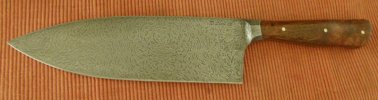
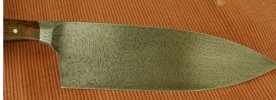
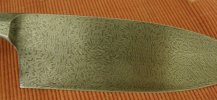
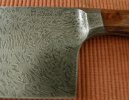
As you know I have been forging integral chef knife blades for Mike Rader well I also forged a couple for myself. Mike likes the hidden tang style so thats what I make for him. I thought I should try full tang so to not be copying Mike not that I could. this is not my first chef knife it takes a few to really start to understand how to grind a blade this thin. this is my best effort to date. This knife will slice through a rotten tomato and a supper hard squash with ease. I will start to work on making the shape a little more pleasing to the eye. for this one I am happy with the function. but I would like to know what you think.
attachment.php


attachment.php


attachment.php


attachment.php
 

Attachments

  • intracl1.jpg
    intracl1.jpg
    31.1 KB · Views: 336
  • intracl2.jpg
    intracl2.jpg
    44.6 KB · Views: 333
  • intracl3.jpg
    intracl3.jpg
    24.4 KB · Views: 332
  • intracl4.jpg
    intracl4.jpg
    27.4 KB · Views: 335
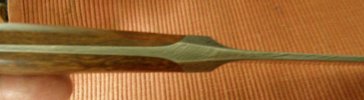
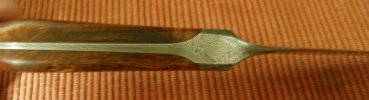
Great Damascus as well as the facets on the bolsters:thumbup:. But the handle profile needs a little tweeking, imo.
 
Very cool Dave. Looks like a monster! I can't imagine trying to control that much drop on the blade and still keep that bolster area centered.
 
verrry kewl...:thumbup:
 
I am with you on that Mike I learned a lot on this one I will put it to work on the next one
 
Blade steel is beautiful.

Comments from a chef about the handle though.

I don't know knife terms well yet so forgive me.

The point where the index finger rests at the blade and handle needs to be very smooth and round. While working a chef's knife, one moves their hand up on the blade for finer work and tends to move the hand around frequently, so you don't want any angles to disrupt that movement. You don't want any angles in there.

Also, personal preference, I like handles that drop to a bit of a belly towards the end. This makes riding up on the blade comfortable and 'intuitive' and also gives a bit of a snag to hold onto to keep the handle from slipping away when you are covered in grease.

For blade shape, I like an ever so slight belly/curve to the blade from the hilt (back I think) to the tip. If it's flat it would be maybe the last inch to two at most. A rocking motion is very very common with a chef's knife as you use it.

Weight bias I've always liked an almost kukri like bias of weight out at about the 2/3 out towards the tip for chopping.

I'm not a working chef anymore, but I had some odd collections of knives I'd hide around the kitchen as my own. Most of which had years of wear and use on the blade and had worn into what I describe.

Subtle is the key when it is in your hand for hours at a time. Small edges/protrusions become annoying, particularly with soaking wet or greasy hands.

I have to run out, but actually later if I remember I can put up a few pics of gripping as I describe.
 
Thank you Kingsqueak I will keep all of that in mind when I make the next one there are so many little things to get right when making such a tool like a chef knife I am lucky to have Mike Rader working next door to me 3 days a week I know I have a ways to go before I am killing it in the chef knife world but hay you have to start somewhere this is my start but please keep watching as I fine tune this beast. now I have to go pound on some steel see you all tonight.
 
First, I am not a maker. I like looking around over here as I really appreciate the craftsmanship I see.

But I do cook. And I mean a lot! When we have company, it isn't unusual for me to stand at the counter and cut up food for a solid hour. An the average, I use my larger kitchen chef knives for meal prep for about 10 meals a week.

The knife is quite nice. But if I were to buy it, I would have a couple of tweaks I would like to see. Remember... this is just an opinion!

First, I like the back side of the blade (the heel?) facing the handle to have a thicker and more rounded profile. If my hand slips forward, then it doesn't hit a square, and possibly sharp edge. This is pretty easy to do when your hands are wet.

Second, I would drop the butt of the handle a bit, starting at about half way down the handle. It makes kind of a crook pattern when you do this.

http://hubpages.com/u/3111052.jpg

Dropping the heel of the handle makes the knife much easier to use for routine chopping. I use my chef's knife for a lot of chopping, so the dropped handle heel tilts back my wrist to a better position when I rock the knife back and forth on the board. Hold the knife in front of you and grasp the blade with your left hand which will tilt your wrist slightly to the left. When you then grasp the knife with your right hand, your hand should sit on the handle and tilt slightly to the right. With a straight handle, you either move your hand a bit off the handle to do this, or your wrist is parallel to your cutting surface. After a few pounds of potatoes, onions, carrots, etc., for a really large roast your hands will be pretty tired.

Last, for me, a bit less sweep on the blade would make it easier to slice and control with that much sweep it appears that you would have the handle of the knife high off the board when using the tip. This makes you have less control of the knife, but also increases motion needed to use it. It might make it uncomfortable to use the tip of the knife for routine slicing.

The trick on that is to find that magic point where there is enough sweep to rock the knife easily back and forth over your material to be cut, but no so much you have a large amount of hand motion needed to use the length of the blade when doing so. That's why you don't see commercially made chef's knives with a large sweep design.

I find that when I do use my chef's knife for slicing that less sweep makes it easier to use the length of the blade as well.

All that being said, the knife is gorgeous and I am sure whomever gets it will be thrilled. I would be!

Robert

 
Very cool piece Dave! The steel is just whicked! :)

I also appreciate the feedback you're getting. It's one thing to make a fighter or bowie that people wave around and think feels nice in the hand... it's a totally different animal to try and make a kitchen knife with the proportions/balance/geometry/and subtle handle nuances that a real chef would approve of.

I've made a few kitchen knives that stayed VERY close to home and for a block-head like me, they work great. But I cringe to think what a real cook would have to say about them after a full night of work! :eek: :o

I know you'll be knocking out home runs in no time Dave. It sure doesn't hurt to have Michael next door and a sea of professional cooks within throwing distance of the shop! :thumbup: :)
 
If you look at Henckel or Wustof knives, they are super popular for a reason.

You'll also notice they have slightly varied blade profiles between the larger blades. Thus some better for slicing, some better for rocker type dicing etc.

My most used knife by far was typically a 10" chef's knife, it was my staple all day long.

Another point to keep in mind, you want them fairly light and balanced, but they are used for some quite abusive things depending on the environment.

One of my Henckel knives was used to crack into 50+ live lobsters a night for a few months running to split them for broiling. It was the same knife I'd steel up, and do fine prep work with too.

Get a 5lb lobster and a knife you've been using all week and you find yourself throwing a towel over the spine and batoning it. The amount of abuse my 10 and 8" Henkels have seen is pretty amazing.

I just looked at Henckel's site, disappointingly they seem to have dropped a lot of their line. So here's a Wustof link

http://www.wusthof.com/desktopdefault.aspx/tabid-75/52_view-121/categories-121

10" "Wide Cook's Knife"
Almost forgot to mention this point. The 'wide' is very useful as you roll your finger tips under while holding say celery and use your knuckles against the flat of the blade as a feeding guide. The wider profile makes this a lot easier.

7" "Cook's knife"

Those two are basically the profile I did all my work with, with a few paring blades. I was a line cook, not a garde manger. Notice the sweep on most of the blade, but that it is subtle through most of the blade.

I also had a cleaver, a filet knife, and I can't recall the name, but it was basically a near machete profile for butchering.

A santoku is another very useful blade type for vegetable work.

In the speed of a production kitchen though you grab the most 'down the middle' blade and hang on to it.
 
Robert thank you. That is some very useful advice thank you all . I am starting to understand just how much all the little things matter when making a chef knife.
 
Super damascus! I like the height of the blade for keeping the knuckles off the cutting surface. I agree with the comment about rounding all edges/surfaces except for the cutting edge. My preference would be for a longer handle, based on my guess of the dimensions, for a variety of different grips.

It is a cool integral, nice job.
 
Back
Top