
My first knife, please critique sketch, suggestions

Joined
Dec 8, 2010
Messages
340
Hello all,


I've gotten the knifemaking bug, and have been mulling around the idea of making my first fixed blade. I am going to be making a pair of camping/hunting knives, one for me, and one for my fiance. I thought it would be great for the first knives I make to be a gift for both of us. I finally got around to sketching up the design tonight while I was watching TV. I purposely did not look at any other knives while making the sketch, because I wanted it to be my own... I realize there are probably knives that look exactly like this, but this sketch was 100% freehand.

I'd like some critiques on the design, and any suggestions anyone may have for a first time knifemaker.

I do have about 20 years of metalworking experience, and am a machinist/fabricator by trade. I've done a lot of tool grinding as well as some tool and die work, so am pretty confident that I can handle the blade grinding aspect. I know my way around a shop quite well. However, I in no way claim to be a knifemaking expert, or even a novice for that matter. I'm open to any advice/suggestions.

I'm especially curious about steels... I would like to try and do my own heat treat if possible. I do have a programmable kiln that can reach 2000F, that we use for firing machinable ceramics. Other than that, though, I have no other heat treating equipment or experience.

What would be a good, easy to work steel? I don't really have any preference on the carbon/stainless thing.


On my knife, I'm planning on black or olive (or maybe two-tone) G10 scales, with a .150 blade thickness. Blade length is 4.625", OAL is 9.875". I haven't decided whether I'll be using swaged tubes, screws, or rivets for handle attachment.
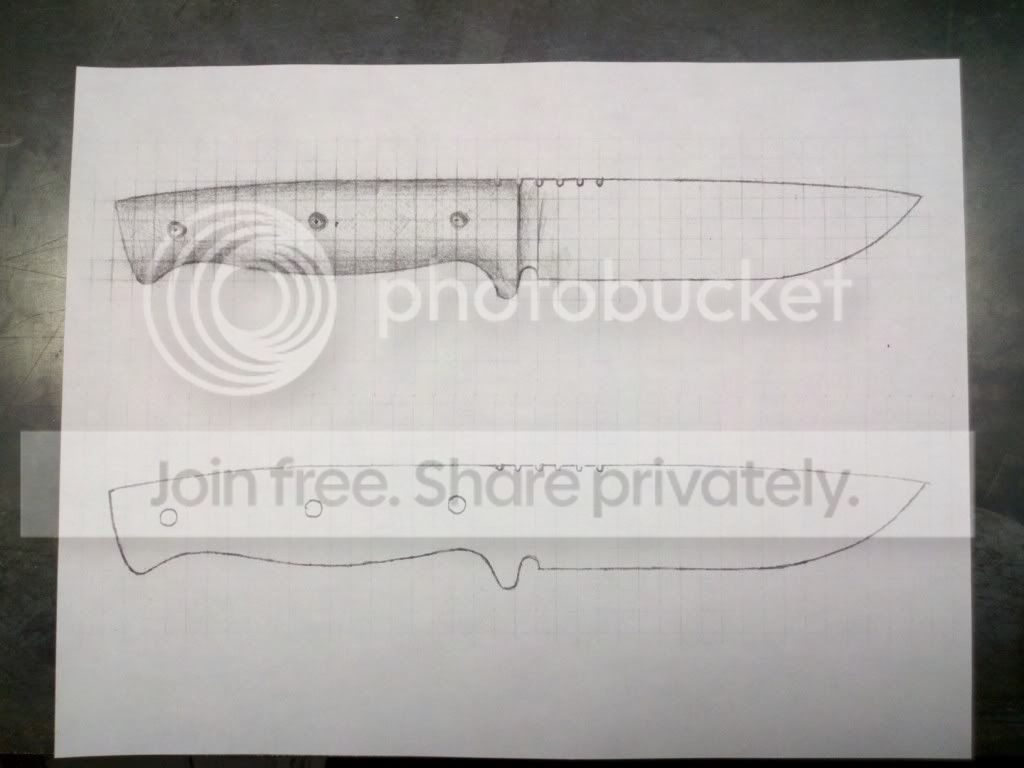
knifed001.jpg


My fiance said she wants pink handles, and skulls and hearts on her knife, so what she wants, she gets. I will probably be using pink G10, and etch the skulls/hearts into the blade before light stonewashing. Any suggestions here are more than welcome.

(FYI I put absolutely NO effort into the layout of the blade graphics. It was just a 2 minute concept sketch)
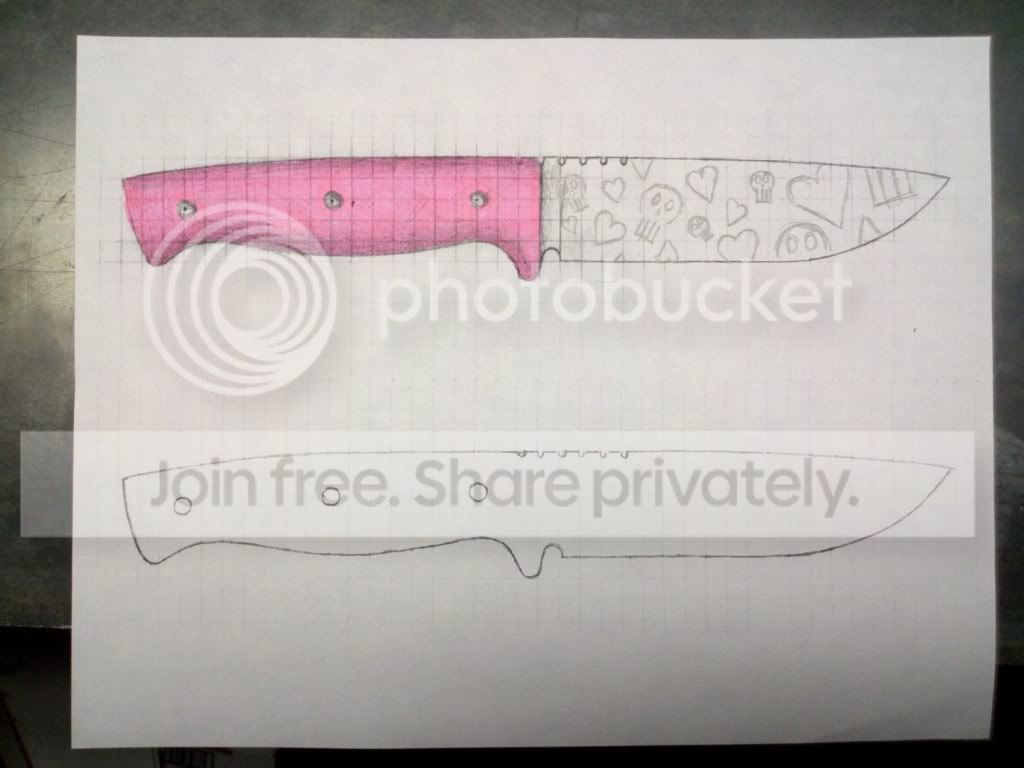
knifed002.jpg


Thanks in advance for your time and help,


Ian
 
I think it's great, I would swell the butt out a little wider and I would round off the thumb notches to lower stress risers there, but otherwise it looks great.

It's a very cool concept.
 
I think it's great, I would swell the butt out a little wider and I would round off the thumb notches to lower stress risers there, but otherwise it looks great.

It's a very cool concept.

As in wider, should I swell in the downwards direction, and keep the top profile the same?

The thumb notches are drawn in with a .030" radius, so they actually are round bottomed. Do you mean the top edges? I don't want to lose the traction too much.

edit: FYI the narrower rear was inspired by knives like the spec bump and gaylean turbulence, both of which I find really comfortable.

Thanks for your comments.
 
Last edited:
I think it looks really good. Is there a way for you to mock up a handle and try it out before you actually go ahead and make the knife? I've bought dozens and dozens of new knives and sold dozens and dozens of slightly used knives simply because the handle looked right but was uncomfortable to use for me.
 
I think it looks really good. Is there a way for you to mock up a handle and try it out before you actually go ahead and make the knife? I've bought dozens and dozens of new knives and sold dozens and dozens of slightly used knives simply because the handle looked right but was uncomfortable to use for me.

I was going to buy some of that hard green florist's foam, and sculpt the handle from that first before I start cutting the blanks.
 
Looks good. The jimping on the spine can be cut in after HT with carbide tooling. That way it can be as sharp edged as you wish and will be of no concern during HT.
For steel type, your oven might work for stainless steels , and is good for any carbon steel. If it has a max of 2000F, most similar small ovens take a lot of time to get to 1900-1950F, so stainless might be best sent out. For camp knives I would suggest 5160 in carbon steel and 440-C or CPM-154 for stainless steel. Other carbon steels tat will work well are O-1 and 1084. The HT for the stainless may require more extra work than you want, so the 5160 is probably the easiest to nail right in a simple HT. You can use a gallon of canola oil for the quench. 5160 makes a superb camp knife.

HT For 5160:
Fill out your profile before pre-heating the oven.
Austenitize the blade at 1500-1525F and hold for 5-10 minutes.
Quench in 120-130F medium speed oil.
Temper at 425 for two hours
Quench in room temp water
Re-temper at 425F for two hours
Water quench to cool
Re-sand and finish the blades. Final hardness should be in the Rc58-59 range.
Check that your profile is filled out and post pictures of the blade and progress as you make the handle.
 
Nice design, I think I've done one almost identical to that as well, you have good taste! :) One thing I learned from that design is in regards to the guard area. The way you show your handle material, you will have a very small, thin bit of the scales down at the bottom of the guard. A couple of issues I personally had with that design when I did it:
1. This small area has the potential to break off. G10 is pretty strong stuff though, you may be ok.
2. If you don't use epoxy and everything is not PERFECTLY flat, you may have a gap between the scales and the blade, especially at this area. Not to mention, without that epoxy bond, there is a greater chance of cracking these small pieces off.

I ended up rounding the scales off above that extended guard to avoid it. YMMV.

Looks great though, you will have a blast! BTW, you are a great artist!
 
Looks great; I actually have a blade cut out that looks almost exactly like that one. ;) :)
 
Your design isn't terribly original, but that's OK, there's a reason for that - it's a darn good design for a utility/camping/hunting knife. Often, there's no sense trying to reinvent the wheel. Nicely done :thumbup:
 
For hunting work you may want to make the belly coming down from the tip a little less obtuse. This is one of the first things I and other folks from the backwoods of MI notice about a lot of commercial hunting knives. That obtuse point makes it harder to turn the blade around under the skin and do that slick unzipping that keeps a lot of hair out of your work. Also I noticed you have the popular half round cut where the edge meets the ricasso/choil area… good, it has a legitimate purpose. I am always discouraged to see that common sense feature criticized because it doesn’t match up to a few guys ideas of plunging the knife into things. Not everybody uses their hunting knife this way, but everybody does eventually sharpen them, and a very good reason for that notch is to make it so you can sharpen all of your blade without bumping up against the ricasso. Without it you will get a dip down there after many sharpenings that will grow as the area gets increasing more difficult to even get with a stone. I would however move that feature forward about 1/8” to facilitate that sharpening lining up with the grind plunge.
 
Last edited:
Looks good. The jimping on the spine can be cut in after HT with carbide tooling. That way it can be as sharp edged as you wish and will be of no concern during HT.
For steel type, your oven might work for stainless steels , and is good for any carbon steel. If it has a max of 2000F, most similar small ovens take a lot of time to get to 1900-1950F, so stainless might be best sent out. For camp knives I would suggest 5160 in carbon steel and 440-C or CPM-154 for stainless steel. Other carbon steels tat will work well are O-1 and 1084. The HT for the stainless may require more extra work than you want, so the 5160 is probably the easiest to nail right in a simple HT. You can use a gallon of canola oil for the quench. 5160 makes a superb camp knife.

HT For 5160:
Fill out your profile before pre-heating the oven.
Austenitize the blade at 1500-1525F and hold for 5-10 minutes.
Quench in 120-130F medium speed oil.
Temper at 425 for two hours
Quench in room temp water
Re-temper at 425F for two hours
Water quench to cool
Re-sand and finish the blades. Final hardness should be in the Rc58-59 range.
Check that your profile is filled out and post pictures of the blade and progress as you make the handle.

Thanks for the post. Good info.

I'm thinking Stainless may be the way to go for a knife that I want to abuse to some degree, so maybe I need to let someone else take care of heat treat. I am pretty good about taking care of my knives though, so I probably can get away with carbon.

Nice design, I think I've done one almost identical to that as well, you have good taste! :) One thing I learned from that design is in regards to the guard area. The way you show your handle material, you will have a very small, thin bit of the scales down at the bottom of the guard. A couple of issues I personally had with that design when I did it:
1. This small area has the potential to break off. G10 is pretty strong stuff though, you may be ok.
2. If you don't use epoxy and everything is not PERFECTLY flat, you may have a gap between the scales and the blade, especially at this area. Not to mention, without that epoxy bond, there is a greater chance of cracking these small pieces off.

I ended up rounding the scales off above that extended guard to avoid it. YMMV.

Looks great though, you will have a blast! BTW, you are a great artist!

I kind of worried about that also. Maybe I'll try and redraw it so that the guard is just bare metal and the G10 ends above it like you suggested.

I probably will use epoxy to seal the scales, I would like to try to keep moisture from getting under them.

I'm very excited. I've done a lot mechanical drawing and sketch work, I work in R&D so I'm always scribbling up some hand-drawing to communicate at work.

Your design isn't terribly original, but that's OK, there's a reason for that - it's a darn good design for a utility/camping/hunting knife. Often, there's no sense trying to reinvent the wheel. Nicely done :thumbup:

I'm definitely not trying to break the mold here. This knife is designed based upon what feels comfortable to my hand, and the blade shape that I personally connect with.

That just happens to add up to make a classic hunting knife design. ;)

For hunting work you may want to make the belly coming down from the tip a little less obtuse. This is one of the first things I and other folks from the backwoods of MI notice about a lot of commercial hunting knives. That obtuse point makes it harder to turn the blade around under the skin and do that slick unzipping that keeps a lot of hair out of your work. Also I noticed you have the popular half round cut where the edge meets the ricasso/choil area… good, it has a legitimate purpose. I am always discouraged to see that common sense feature criticized because it doesn’t match up to a few guys ideas of plunging the knife into things, as far I know, hunting knives are for cleaning game not stabbing it to death. Not everybody uses their hunting knife like a spear, but everybody does eventually sharpen them, and a very good reason for that notch is to make it so you can sharpen all of your blade without bumping up against the ricasso. Without it you will get a dip down there after many sharpenings that will grow as the area gets increasing more difficult to even get with a stone. I would however move that feature forward about 1/8” to facilitate that sharpening lining up with the grind plunge.

Yeah, that's why I went pretty deep with the notch. I wanted to leave plenty of room for sharpening in the future. You think that it should basically straddle the plunge?

What do you mean by obtuse? I'm having a little trouble visualizing what you are describing. Do you mean how the top slopes down a bit? If that is the case I think you would be describing a more scimitar-like shape as being easier for game dressing?
 
For hunting work you may want to make the belly coming down from the tip a little less obtuse. This is one of the first things I and other folks from the backwoods of MI notice about a lot of commercial hunting knives.

Ahh, the devil's in the details as always :) I can say that some hunters have mentioned this to me as well, asking for somewhat narrower blades and pointier points for field-dressing deer and whatnot.
 
...What do you mean by obtuse? I'm having a little trouble visualizing what you are describing. Do you mean how the top slopes down a bit? If that is the case I think you would be describing a more scimitar-like shape as being easier for game dressing?

No, no, that would defeat what I am talking about, your drop point concept, as far as the spine goes, works great. I mean on the edge side, and basically I am recommending a little more streamlining so that when cutting edge up the point, and edge immediately behind it, the can ride under the hide slightly instead of pushing directly into it. Your design with a wider belly swell near the point will work fine for sweeping skinning type cuts with the spine facing you but not so well if you reverse things with the edge facing you, a very common technique in dressing game.
 
I like the design. I think it will serve you well for the tasks you've identified and look really nice too.

What you've drawn will probably fit you pretty well. I'm not so sure about your fiance though unless she has large hands. It looks awfully wide to me (top to bottom) especially for woman's hand.

It looks like you plan to have the back-most thumb notch where the handle material will be. I think that might end up giving you some problems and making it more difficult constructing it than it is worth. It's just one little notch. I wouldn't put it there myself.

As it's drawn it seems to me that the front of the handle material is going to end up flat and perpendicular to the blade rather than rounded off. Am I seeing that correctly?

I think you're going to end up with a really nice knife. I hope you show us pictures as you're doing it.

- Paul Meske, Wisconsin
Alias LonePine
 
Back
Top