
My first knives, thank you.

Joined
Mar 8, 2007
Messages
242
Just want to say thanks to everyone on here that helped me out. This would be next to impossible without all the input I received. I'm finally posting the knives I've been working on. It's taken forever, I can't buy free time these days. They're not actually my first, I made some 440C paring knives for xmas presents last year. They were my first but I only had hand tools and finished them on xmas eve and didnt' have time to photo before they got boxed up...take my word, you didn't miss anything! I know these leave a lot to be desired, especially in the fit and finish department. The photograph is poor but that's probably for the better or you'd see just how green I am on the grinder. Anyways, these are 1080, stock removal, I heat treated them so I'm curious to see how they perform. The handles are from a dogwood tree that was knocked down by a tornado in my brothers yard. I used this for the handles because these are going to 4 of my friends that grew up here in Georgia and have all moved to other places where dogwoods are less common....a touch of home i guess. The wood wasn't stabilized but it sat in the garage for over a year and I treated it with oil and wax. Hope they hold up. I put convex edges on all of them because at this point it's about the only edge i can do with some success. I tried a scandi grind on the bushcraft looking one but had to transform to convex cause I couldn't keep a consistent bevel. I would get a good pass, then the next one would be a couple degrees off and i end up with some sort of secondary bevel. it was a mess. Got a lot to learn but that's what it's all about. Corby bolts for the pins. The designs I copied from here or there, stuff that appealed to me. Hope nobody takes any offense at that. I give credit to bgoode knives for the larger one. I really admire his work. So, thanks again for the help. Hope to post a new creation soon.
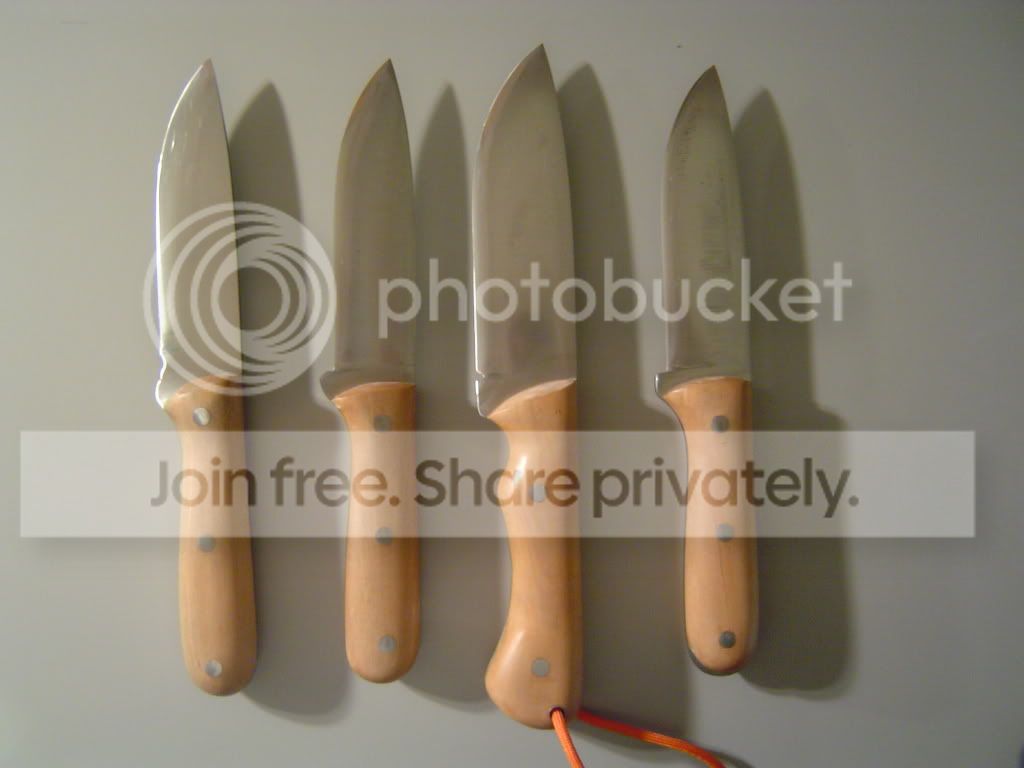
DSC08111.jpg
 
I don't have one yet, I may pony up for a etch machine at some point but for now they will be unmarked.
 
Nice clean designs - fluff free in fact. Nice work!
 
That dogwood looks really nice.

A knife maker in from the Santa Cruz area showed me how to etch knives using an old DC power adapter.

so here's what I do:

The electronics: used DC power supply. I use a 7.5V 100mA because that was I had at the time. Cut the DC plug adapter off. Strip the wire back and attach some cheap alligator clips.

The mask: I use nail polish. Paint a uniform coat on the area you want to etch. When it is partially dry, use a wood or brass stylus (i.e. bamboo skewer with a pointy end) to make your mark, write your name etc. Let it dry, then mask the surrounding area with masking tape.

Etch pad: Cotton swab a.k.a. Q-Tip

Attach the positive to the knife blade. Attach the negative clip to the q tip so that it contacts the cotton the cotton. Saturate it with ferric chloride etchant (I dilute mine 1:1 with water), make sure it is in good contact with the alligator clip on the cotton.

Hold the Q tip on part of the mask where you made your mark. I usually hold it there for 10-15 seconds then move it to another part of the mask. I repeat over the whole pattern to be etched until I think its deep enough. It doesn't take me more that a few minutes to get a good etch. It takes me longer to prep the and make the mark than to do the actual etch.

After I'm done etching, I wash and rinse well with some dish soap and water. Dry and use some solvent to remove the nail polish.

Try it on a test piece. If it doesn't etch, try switch the alligator clips.

It's not the fanciest system, but it works for me. My first few knives, I just used the etchant without the benefit of DC current. I had to let it etch for several hours....

Ric
 
That dogwood looks really nice.

A knife maker in from the Santa Cruz area showed me how to etch knives using an old DC power adapter.

so here's what I do:

The electronics: used DC power supply. I use a 7.5V 100mA because that was I had at the time. Cut the DC plug adapter off. Strip the wire back and attach some cheap alligator clips.

The mask: I use nail polish. Paint a uniform coat on the area you want to etch. When it is partially dry, use a wood or brass stylus (i.e. bamboo skewer with a pointy end) to make your mark, write your name etc. Let it dry, then mask the surrounding area with masking tape.

Etch pad: Cotton swab a.k.a. Q-Tip

Attach the positive to the knife blade. Attach the negative clip to the q tip so that it contacts the cotton the cotton. Saturate it with ferric chloride etchant (I dilute mine 1:1 with water), make sure it is in good contact with the alligator clip on the cotton.

Hold the Q tip on part of the mask where you made your mark. I usually hold it there for 10-15 seconds then move it to another part of the mask. I repeat over the whole pattern to be etched until I think its deep enough. It doesn't take me more that a few minutes to get a good etch. It takes me longer to prep the and make the mark than to do the actual etch.

After I'm done etching, I wash and rinse well with some dish soap and water. Dry and use some solvent to remove the nail polish.

Try it on a test piece. If it doesn't etch, try switch the alligator clips.

It's not the fanciest system, but it works for me. My first few knives, I just used the etchant without the benefit of DC current. I had to let it etch for several hours....

Ric

Ric, thatnks for tip. Im an idiot when it comes to electricity. Would a DC supply be the same as cutting the end off my cell phone charger and putting gator clips on the seperate wires then plugging it into the wall? thx
 
Smorgan- you got it right! Just make sure it's not a charger that you need any more. A 9V battery ought to work too.


Ric
 
Ha ha! How did my name get into this thread :)
Damn good start man!! Simple user designs and clean construction. What not to like :)
 
Back
Top