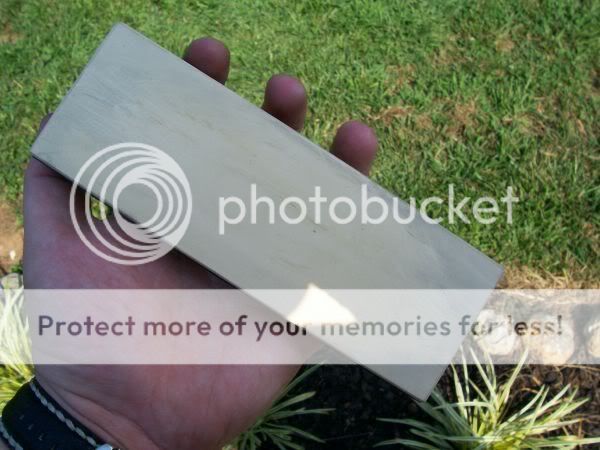
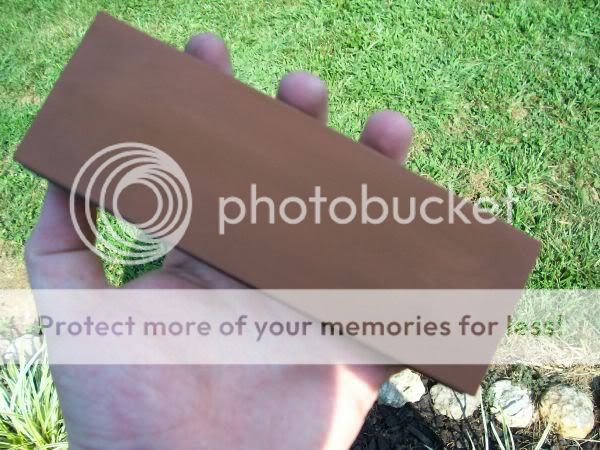
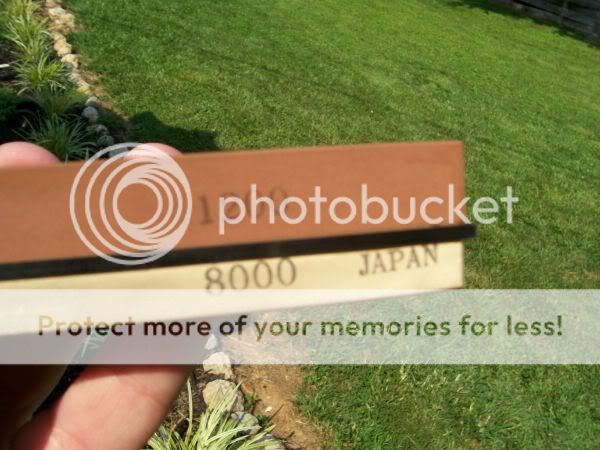
My first water stone (1200 - 8000 combo)

Joined
Jun 17, 2006
Messages
1,108
Just got my first water stones in the mail the other day. I was not sure what kind to get, so I got the 1200-8000 grit combination. I have been freehand sharpening with various grits of hard arkansas and india stones since I was a little boy, and those have always gotten me the hair popping edge that I desired.

I had only recently learned about Japanese waterstones and decided to finally pick one up. I am super impressed with how fast they cut, and how smooth they feel, and the extremely high polish the 8000 grit stone leaves on my edges.

I do have to say that they are very different than what I'm used to. These things are messy! I have a slight problem... even though my edges are brighter than the highest polish I could ever get with a fine Arkansas and a strop, they don't seem to be sharper. Maybe I need to practice alot more.

If there are any tips or techniques you guys can offer, I'd really appreciate it.

000_1913.jpg


000_1912.jpg


000_1911.jpg
 
You might get recommendations to the contrary, but I've always found that using only trailing strokes for the final step on a waterstone is key. I assume that the softness of the stone leads to plowing where the edge actually cuts slightly into the stone so that you actually shave a little grit off the surface, even though you might not notice it, but it is enough to dull a very fine edge. I found, that the effect is more pronounced, the softer the stone is. Shapton stones are so hard, for example that leading vs. trailing makes only a small difference but on something like the non-paraille blue pushing strokes are practically impossible. The King stones (and it looks like you've got yourself one of the Icebear/King stones) are somewhere in between.

Good luck!
 
HoB said most of the things that I was thinking of. Now I'll have to think a little more....

The issue is not simply that a waterstone only works with edge trailing stropping-style strokes. The waterstone is intended to be used extensively with circular or back-and-forth strokes for bevel formation. It works pretty well if you are working flat on a bevel or not pressing down too hard. Think about how waterstones are extremely popular with wood workers who polish the broad flat bevels of chisels. What waterstones are not as flexible for is when you slightly elevate your honing angle to add a microbevel at the apex of your edge. The easiest way to get shaving sharpness is to do your edge profiling at a low angle and then very lightly hone at an elevated angle to get an ultra keen microbevel. I can only do that microbeveling with a waterstone if I strop with it rather than hone edge-forwards.

Even if you are not trying to microbevel you are likely to do some honing strokes that are at a slightly elevated angle if you are honing by hand. This can gouge into the hone and compromise the apex of your edge. If you use great care and skill you can minimize this. It also helps to use very light honing pressure during your last few strokes.
 
For some people a very polished edge just seems duller than a coarser edge. This could be what your noticeing. An 8000 water stone is alot finer than a hard Ark. stone. How is the edge after useing the 1200 stone?
 
Buy a rubber base that is made for waterstones. It really improves the whole sharpening exerience.

I think from your photo that you have a KING brand waterstone. I have a slightly courser one.

It is a good stone.
 
Wow guys thanks for the replies and good advice. I'm so used to using the hard stones, and pulling the edge down towards me. I was sharpening my Spyderco today and noticed that the very fine edge began to gouge into the 8000 stone and even shave a little bit off the top. I was surprised at that. My ZDP Spyderco is wickedly sharp though, with a polished edge you can see yourself in.

I guess I'm gonna have to approach this stone alot differently. I didnt even think to use a stropping motion with it.

The 1200 grit side cuts very fast btw. It leaves a really nice and even frosted kind of look to your edge. (best way i can describe it) Doesn't leave any kind of deep scratch pattern that other coarse stones can leave. It's really smooth.

whats an ideal time to let this stone soak? I put it in a big bowl of water for about 10 minutes and then went at it. Does the soak time have any relevance to the stones performance?

Should i be preparing the 8000 grit stone with a nagura stone? or is it ok to just use the 8000 grit without it?
 
Murray Carter puts out a great dvd on waterstone sharpening.

He just put out a new one that I haven't seen yet but reports are that it's much better than his first one.
 
It is not necessary but you will definitely get more out of the 8000 side with a Nagura stone. If will feel very different. You can aways to both with and without, in fact some japanese woodworkers will use different naguras on the same stone to get a different finish, but for your purpose any Nagura will work.

Soak time depends on the stone. As a rule of thumb, the coarser the stone, the longer the soak time. There is no performance difference per se. If you don't let it soak long enough, the surface will not remain wet and you are sharpening basically on a pretty dry stone. You just want to soak the stones so that the surface requires only a few drops in between to remain nice and wet. For the two King stones 10 min should be more than enough. The 8000 side would probably need no more than 1 or 2 min. Don't worry you can not harm the stones by soaking them too long (you can even store them under water, but they tend to develop mold, they are essentially like sponges). You will know immediately when the stone is too dry, you will have to add water after every stroke and you will get annoyed....then you know :).
 
well, I just ordered this and a nagura. anyone know what the micron size is for the two sides? I'm guessing around 13 & 1.5
 
Don't know, but those numbers sound about right.

I've oversoaked a King 6000 and King 4000, so it can be done. They're combo stones and the 1000 side on both was fine.

My experience with synthetic nagura stones (haven't tried natural ones) is that they're great for cleaning steel-clogged stones, mezzo-mezzo for flattening them, and don't make for sharper edges. Not the only one to experience that, either. Former forumite Dave Martell told me to skip the nagura when I had trouble getting a desired edge on a stainless kitchen knife using a King 8000 and the nagura-less edge was indeed keener.

One chef at another forum has shared that he no longer uses fine-grit waterstones and just sharpens his knives with a 1000 or 1200 on a daily basis and regrinds their edges with a coarser stone (he didn't say, but my money is on the 220 grit SiC green brick of doom from King) once a week. His rationale is that the benefits of the higher polish are lost quicker than the time it takes to gain them. I'm not a chef, so I still go for the 4K-30K finishes.
 
Those stoneholders are a godsend; the 0.3 micron lapping film will cut quicker than you may imagine; and having an 800/1200/4000/8000 progression isn't the end of the world. In fact, either combo stone is great for stand-alone high-polish finishes or as precursors to the magical mystery 0.3 microns lapping film. You poor, addicted, doomed man.
 
Lots of good waterstone tips in this thread. I need um, cuz so far I haven't had much luck with mine. I have more on the way just in case firepower helps.
 
Which watersones do you have? More importantly: Have you made flattening your waterstone(s) part of your sharpening creed? Until you make peace with flattening your waterstones, they're unlikely to make peace with your edges.
 
I don't see any point in flattening stones. Why do you imagine it is important? If convex edges work at all, a little minor dishing of a hone is trivial (unless you are sharpening the flats of a plane, chisel, or Scandinavian ground blade). I have used old oil stones that were dished maybe 3/16 inch. They worked just fine. I think the flattening tradition comes out of polishing the flats of swords.
 
I don't see any point in flattening stones. Why do you imagine it is important?

For me, it's the difference between a sharp and a semi-sharp edge. The medium stones dish much faster than the fine stones, so maintaining approximately the same angle is much easier to do with stones which are either flat or dished to a near identical degree.
 
Do the SiC /ceramic waterstones like Bester's 1200 need a flattening stone or is an occasional dose of DMT's 600 grit diamond or sandpaper sufficient? God I love this stone!

NJ
 
It is fairly common to use DMT's for flattening waterstones according to the posts i read.

I just unwrapped a Bester 700 and a Naniwa 10,000.

The label on the surface of the Naniwa reads:
"Fine sharpening-taste as natural stone gives"

How profound.
 
A diamond stone is all the flattening plate you'll ever need.

Matt321,

Very jealous of your Naniwa/Bester score. I keep trying to get the courage to throw $90 into one of those Naniwa 10K's for I, too, want to experience sharpening goodness of highest flavor degrees.
 
Back
Top