My own ABS JS test..

Joined
Oct 29, 2006
Messages
2,912
I decided to try to make a knife to pass the ABS test standards for JS.

I started with the 13/64" x 2" 5160 bar stock from Knifemaker.ca and forged it thicker and narrower, down to about 1 1/2" wide by almost 1/4". This was all I had to start with as I would have aimed for about 1/4" after grinding.
Finished off the forging with a heat to critical and into vermiculite.
Flat ground until ready for heat treating then did normalizing heats.
Cleaned up the blade and did 3x edge quench followed by 2 tempering cycles of 2hrs at 350˚F. Then into a trough of cold water, I drew the spine and tang just to be sure.

Finished with a full convex grind. Threw on some old walnut scraps for a handle making sure to keep the pin holes small. I was in a rush so I used West System 5 minute epoxy with filler for a little extra strength.

Here are the sequence pics. BTW, the knife has about a 9 1/2" blade.

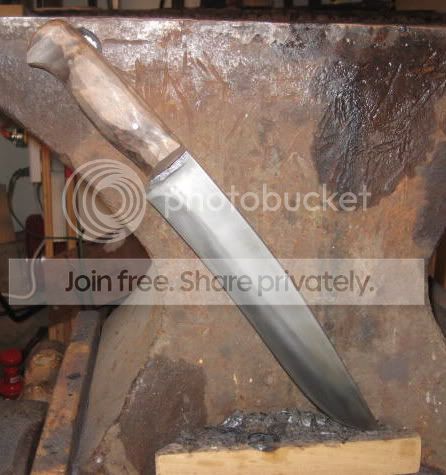
Here's the knife, very rough finished handle but pretty clean blade and rounded spine to reduce any stress risers. Lightly etched to show the differential HT.
ABSTest.jpg


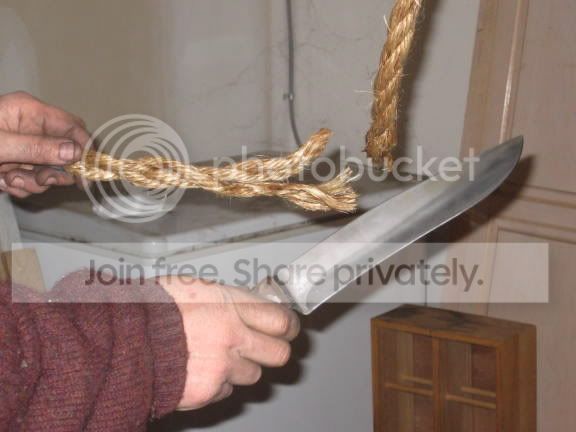
Couldn't find 1" rope so used 3/4". Sailed through very easily so I'm sure 1" would be no problem.
ABSTest1.jpg


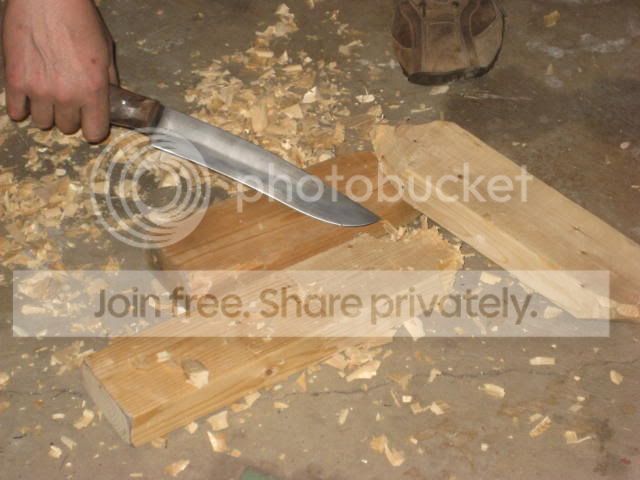
Two times through the 2"x4"

ABSTest2.jpg


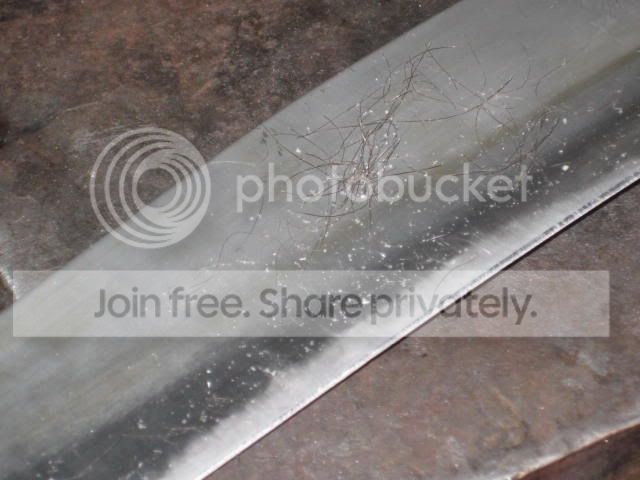
Shave my arm.. Didn't see any edge deformation.
ABSTest3.jpg


Onto the bend... 90˚ and no cracking at all!!! :D:D
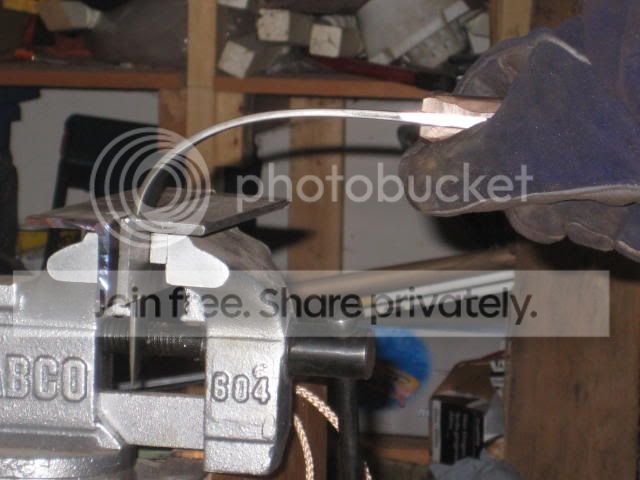
ABSTest4.jpg


Here she is. It's going on my wall. I did notice a little bit of chip out from the vise but very very small. And it came back to about 45˚
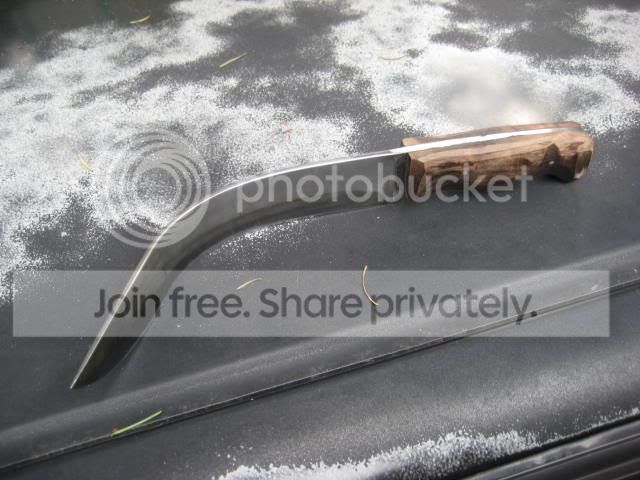
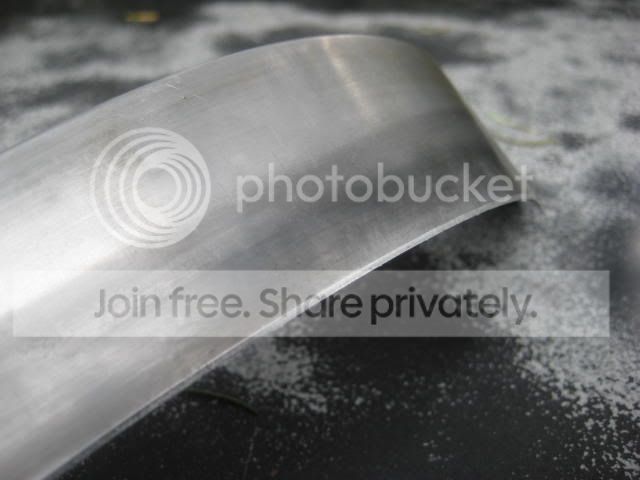
ABSTest5.jpg


ABSTest6.jpg
 
Last edited:
That's really impressive. Even though it sounds like you are trying to say you just slapped the knife together, I actually like it a lot. It would have KILLED me to bend a blade like that, though :)

I forge knives (I am nowhere near good enough to consider myself a bladesmith), and I do my own heat treatment, so I'm versed in differential heat treatment, the advantages, the attention to detail required to do it right, etc. But I've always been a little confused by the structure of the ABS performance tests. Sure, they allow the smith to demonstrate his knowledge about design, heat treatment, edge geometry and all that, but testing it essentially to destruction, doing something completely outside the realm of what one would ever actually do to a knife (bend your blade 90 degrees?) just seems strange to me.

Not trying to raise a stink, just curious.
 
Basically I think of the ABS tests like this, they want to make sure you have the knowledge and ability to make a knife to a set of given standards. A passing blade requires a good general knowledge of smithing and steel.
 
Nice Stuart. But I would like to point out one thing, please don't think that I am an a$$ for doing so. This is my opinion but I think it is shared by many other master smiths. If you were to show up at my shop with this knife I would suggest that you not test and If you insisted then you would fail before the first cut. this is because the hardened portion of the blade runs off at the rear and does not carry the whole length of the blade. that is/would be my only problem with this knife. your heat treat seems good you just have to get it the whole length of the blade. keep up the good work.
 
Comment for Bill. Not arguing, but if you look at the first photo real close, the plunge-cuts are really curved and do drop off about 3-1/6 from the heel of the blade, but the hardness does appear to run all the way into the ricasso. Seems like this one would probably be okay with me.

So, Stuart, is this for your knowledge and confidence or are you interested in taking it all the way? Joined the ABS yet?
-M
 
Thanks Bill. Not a problem for mentioning this. It's a very good point and one I will certainly take to heart. But please know that I was aware of this and wouldn't dream of showing up with a knife like this for testing. I didn't want to spend too much time on this knife and was doing it purely from the point of view of testing the physical performance of the cut and bend. The knife I will test with will be done up as good as anything I would be proud to sell.
On the other hand, I probably could've done some fancy blade design and just ground that unhardened portion away. :p:p

It was one of those torch heat treats where the full tang design kept sucking the heat away. I always have a heck of a time trying to torch HT long blades like this, keeping the heat even. It just seems to drain away.

An to Michael.. Yes, I joined the ABS last spring so I'm not sure if I am on my second year and can test for Blade 2012 or if I have to wait until 2013. (not that waiting is a bad idea at all.. :))
 
good sauce, Stu!
 
try heating the tang area a little bit also. You dont want to get it up into the criticle range but it is ok if it get to 900 or so. doing this will keep the cold tang area from sucking the heat out of the rear of the blade like you mentioned. I noticed this because I used to do the same exact thing especially on larger knives.

Thanks Bill. Not a problem for mentioning this. It's a very good point and one I will certainly take to heart. But please know that I was aware of this and wouldn't dream of showing up with a knife like this for testing. I didn't want to spend too much time on this knife and was doing it purely from the point of view of testing the physical performance of the cut and bend. The knife I will test with will be done up as good as anything I would be proud to sell.
On the other hand, I probably could've done some fancy blade design and just ground that unhardened portion away. :p:p

It was one of those torch heat treats where the full tang design kept sucking the heat away. I always have a heck of a time trying to torch HT long blades like this, keeping the heat even. It just seems to drain away.

An to Michael.. Yes, I joined the ABS last spring so I'm not sure if I am on my second year and can test for Blade 2012 or if I have to wait until 2013. (not that waiting is a bad idea at all.. :))
 
I'll try a little harder next time. I kept having to ramp up the oxy/acet. to get the thing to heat up. I would work the tang and the tip would cool...back and forth.

My other problems were that this was my first time with 5160 and I made a quick quench tank out of a half piece of pipe but it wasn't large enough. I heated the vet.grade mineral oil to about 140 degrees but the heat from the knife had it jump up to about 180 real quick. I think that contributed.

The tang sucked heat away while heating and gave it back while cooling.
 
Great job Stuart! This is the right apprach to take - do the test a bunch of times before you take the test. Getting as much feedback as you can from others who have been there is smart, too.
 
Back
Top