I've owned several knives with stag covers, and I've examined many. They often show a black line where the covers meet the bolsters. Bone handles usually do not, probably because cow shins are very thick. I'm thinking the line is related to the marrow inside the antler. Except for this line, I like stag. But because my purchases are often online, where I can't pick the one I want, I usually choose bone. Can you help me to better understand this conundrum?

-
The BladeForums.com 2024 Traditional Knife is available! Price is $250 ea (shipped within CONUS).
Order here: https://www.bladeforums.com/help/2024-traditional/
You are using an out of date browser. It may not display this or other websites correctly.
You should upgrade or use an alternative browser.
You should upgrade or use an alternative browser.
My trouble with stag
- Thread starter Killdeer
- Start date
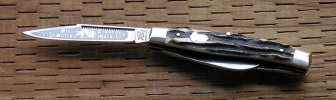
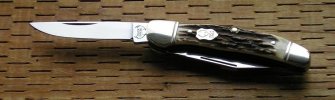

Railsplitter
Gold Member
- Joined
- Oct 31, 2010
- Messages
- 8,262
I don’t recall seeing a black line but my guess is that some makers add that layer to protect the stag from developing verdigris from the stag contacting the brass.
Do you only see this on knives where the stag would otherwise touch brass?
Do you only see this on knives where the stag would otherwise touch brass?

r8shell
Knifemaker / Craftsman / Service Provider
- Joined
- Jan 16, 2010
- Messages
- 26,184
I've owned several knives with stag covers, and I've examined many. They often show a black line where the covers meet the bolsters. Bone handles usually do not, probably because cow shins are very thick. I'm thinking the line is related to the marrow inside the antler. Except for this line, I like stag. But because my purchases are often online, where I can't pick the one I want, I usually choose bone. Can you help me to better understand this conundrum?
 Railsplitter
's suggestion is what I was thinking: that you could be seeing a thin spacer. A picture would be helpful.
Railsplitter
's suggestion is what I was thinking: that you could be seeing a thin spacer. A picture would be helpful.Also, I don't think antler has marrow, at least not the way bone has a channel of marrow. The inside is usually kind of porous or pithy. At least it looks that way when it's dried.

Modoc ED
Gold Member
- Joined
- Mar 28, 2010
- Messages
- 14,521
I don’t recall seeing a black line but my guess is that some makers add that layer to protect the stag from developing verdigris from the stag contacting the brass.
Do you only see this on knives where the stag would otherwise touch brass?
Also, I don't think antler has marrow, at least not the way bone has a channel of marrow. The inside is usually kind of porous or pithy. At least it looks that way when it's dried.
I took it he is talking about where the stag covers meet the bolsters. Y-all make a valid point when it comes to liners though.
Railsplitter
Gold Member
- Joined
- Oct 31, 2010
- Messages
- 8,262
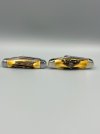
I think these are the only stag knives that I own. I don’t see it on either of these.

draggat
Gold Member
- Joined
- Jul 26, 2010
- Messages
- 3,201
I don’t recall seeing a black line but my guess is that some makers add that layer to protect the stag from developing verdigris from the stag contacting the brass.
Do you only see this on knives where the stag would otherwise touch brass?
Also, I don't think antler has marrow, at least not the way bone has a channel of marrow. The inside is usually kind of porous or pithy. At least it looks that way when it's dried.
I think you are both right. I've seen quite a few lower end knives, particularly Rough Rider, using a thin black liner on the bolsters and underneath stag and bone. I always assumed it was meant to help stabilize it, but preventing verdigris sounds realistic.
The inside of the antler is referred to as pith. It still carries marrow, but not quite the same as bone.
Railsplitter
Gold Member
- Joined
- Oct 31, 2010
- Messages
- 8,262
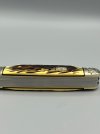
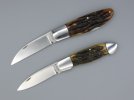
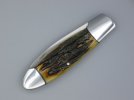
I have a Rough Ryder like that. Ray Cover used a black spacer on his knives as well but none of these are stag.I think you are both right. I've seen quite a few lower end knives, particularly Rough Rider, using a thin black liner on the bolsters and underneath stag and bone. I always assumed it was meant to help stabilize it, but preventing verdigris sounds realistic.
The inside of the antler is referred to as pith. It still carries marrow, but not quite the same as bone.

Old Engineer
Gold Member
- Joined
- Nov 30, 2014
- Messages
- 10,171
I did not see any Black Lines on any of a number of my Stags .

Harry
Harry
These are all very nice knives.
The Boker in this ad shows what I'm talking about.

 smkw.com
The Boker in this ad shows what I'm talking about.
Boker TS 2.0 Copperhead Backlock Stag BK110872
The Boker TS 2.0 Mini Copper Lock Stag features a 2.63-inch D2 tool steel clip point blade with a satin finish and a brown stag handle.
smkw.com


Old Engineer
Gold Member
- Joined
- Nov 30, 2014
- Messages
- 10,171
Those appear to be Small Gaps between the Stag and the Bolsters . IMO If you do not like it in Photos , you will not like it in hand . Remember they try to pick a nice knife for photos . You also most likely will not get the knife they show in the photo .These are all very nice knives.
The Boker in this ad shows what I'm talking about.
Boker TS 2.0 Copperhead Backlock Stag BK110872
The Boker TS 2.0 Mini Copper Lock Stag features a 2.63-inch D2 tool steel clip point blade with a satin finish and a brown stag handle.
Harry

Hickory n steel
Gold Member
- Joined
- Feb 11, 2016
- Messages
- 21,115
I'm pretty sure this is a gap where polishing compound had gotten into.
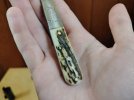
I recently re-covered this knife in stag, and you can see that accumulation of polishing compound on the very edge of the bolster where the stag is a hair below flush.
After noticing I used a pick to remove it, and the black line is now gone.
I recently re-covered this knife in stag, and you can see that accumulation of polishing compound on the very edge of the bolster where the stag is a hair below flush.
After noticing I used a pick to remove it, and the black line is now gone.

dsutton24
Gold Member
- Joined
- Apr 9, 2018
- Messages
- 2,165
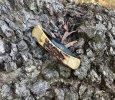
Whatever it is, it's not marrow, antlers have pith, but no marrow. It could be a spacer, a gap, black Epoxy, grime, or staining from polishing the bolsters. It's also not common. at least as you describe it. A quick run-through of a bunch of stag knives I've looked at don't show the line.



Will Power
Gold Member
- Joined
- Jan 18, 2007
- Messages
- 33,879
Not seen it on my Stag knives  It might be on cheaper finished knives where the slabs are ill fitted that the gap has been sealed with something ? Or, dry conditions may cause Stag to shrink a little ?
This early GEC 25 has it running under the bolster not a line.
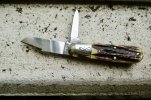
No gaps on this Italian
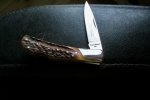
Maybe the answer lies in going for Shadow ?
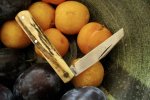
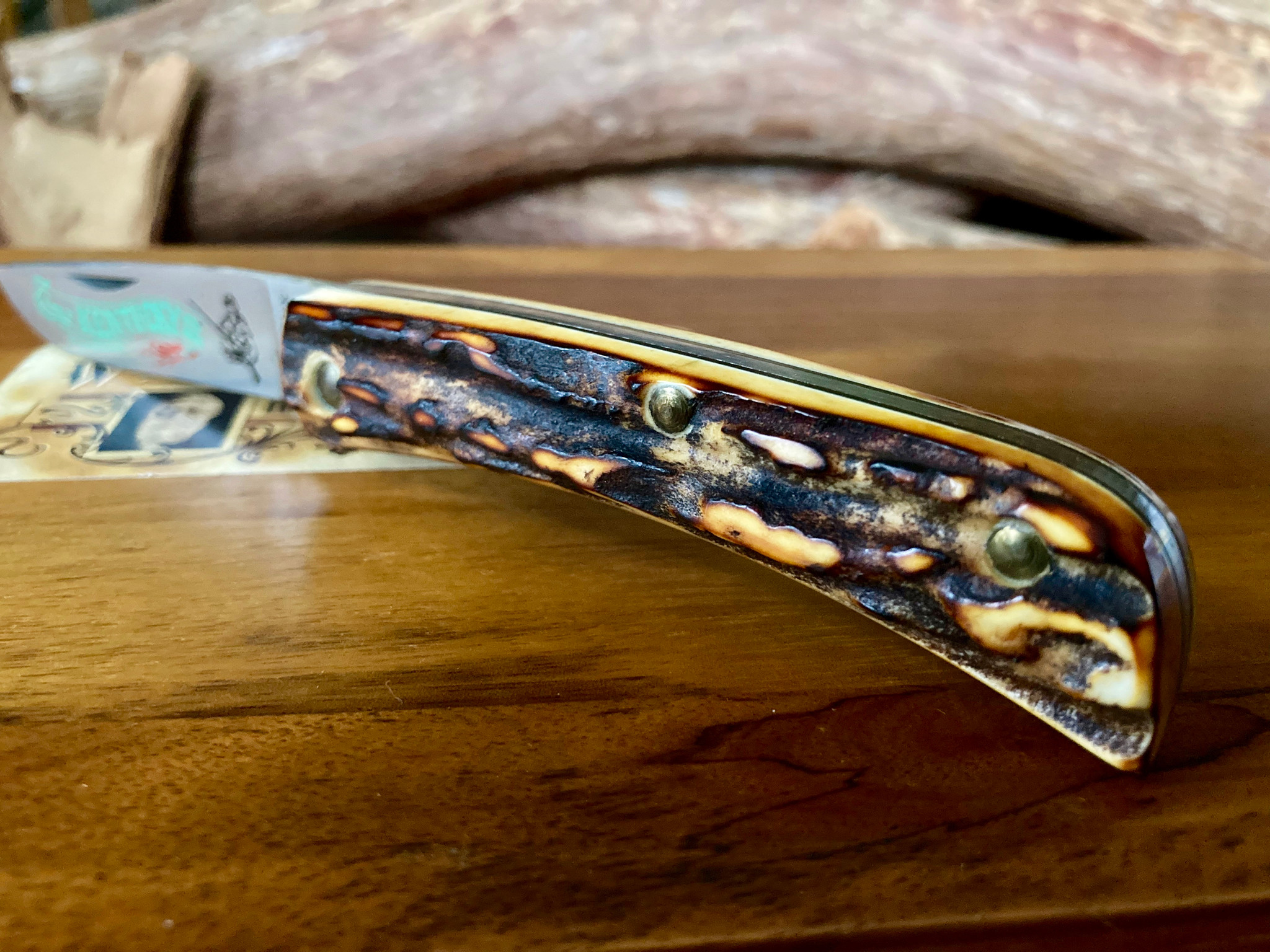
It might be on cheaper finished knives where the slabs are ill fitted that the gap has been sealed with something ? Or, dry conditions may cause Stag to shrink a little ?This early GEC 25 has it running under the bolster not a line.
No gaps on this Italian
Maybe the answer lies in going for Shadow ?
Last edited:

- Joined
- Jul 30, 2006
- Messages
- 44,862
After some web searching, I discovered that not all stag is the same.
Summary:
Sambar stag has little pith and is very dimensionally stable with environmental changes.
Other types of stag have a lot more pith and are therefore less dimensionally stable.
So, my guess would that for the stag handled knives which do not utilize sambar stag, the maker needs to leave a bit of a gap to allow the stag to expand and contract with the environment. If the maker does use actual sambar stag, then they don't need to leave gaps.
Handle question
When makers say they they are using “stag” handles, which particular species would they normally be talking about?
knifedogs.com
Summary:
Sambar stag has little pith and is very dimensionally stable with environmental changes.
Other types of stag have a lot more pith and are therefore less dimensionally stable.
So, my guess would that for the stag handled knives which do not utilize sambar stag, the maker needs to leave a bit of a gap to allow the stag to expand and contract with the environment. If the maker does use actual sambar stag, then they don't need to leave gaps.

Horsewright
Knifemaker / Craftsman / Service Provider
- Joined
- Oct 4, 2011
- Messages
- 13,944
Use to be so, just not so much anymore.. Many Sambar sheds have quite a bit more pith than they use to. It's a thing. I use to use a lot of sambar. Enough that I was importing it myself from India. So I kinda saw it go from one narrow vein hole to lots more pithy while I was doing this. With scales as thin as are used on a folder ya not gonna see a lot of pith regardless of the animal it came off of. So I'm just not sure on the stability thing. How long has the shed aged I think is more important to the stability.After some web searching, I discovered that not all stag is the same.
Handle question
When makers say they they are using “stag” handles, which particular species would they normally be talking about?knifedogs.com
Summary:
Sambar stag has little pith and is very dimensionally stable with environmental changes.
Other types of stag have a lot more pith and are therefore less dimensionally stable.
So, my guess would that for the stag handled knives which do not utilize sambar stag, the maker needs to leave a bit of a gap to allow the stag to expand and contract with the environment. If the maker does use actual sambar stag, then they don't need to leave gaps.
I'd agree with Hickory that some of those black lines look like buffing gunk getting down in there.
I don't make folders just fixed blades . But I also don't put a handle material on a knife with a bolster without using a spacer. To me the spacer is kinda like an expansion joint on a sidewalk. Kinda gives room for some expansion and contraction and natural materials are gonna move.