Need a new angle guide.

Joined
Jan 19, 2010
Messages
2,312
I've been using my DMT angle guide for a while now, and while I do like the results, I'm getting sick of finagling with it. The fact that it uses an adjustable prop means I have to keep finding spacers to set underneath to get it at the same angle it was before I flattened my stone, and now my stone is so thin that some of the lower settings won't even properly touch it.

That's not even mentioning the problems I've been having sharpening hollow ground knives in it.

I'm trying to find an angle guide that secures to the spine of the knife and rests on the stone. I've seen a couple of them in pictures, but I'm not sure if they're custom made or what, the only commercially available option I can find is one from Razor Edge Systems Inc., and I'm not sure if I'll have the same issue with hollow grinds with that.
 
I would just start free handing at this point, from using the aligner you have created muscle memory as to how to move the blade so all that's left is for you to hold the blade steady and follow the same motion. With your preset bevels you should have no problem feeling the bevel "lock" onto the stone. Holding the exact angle every time is not important, blending all the angles is.

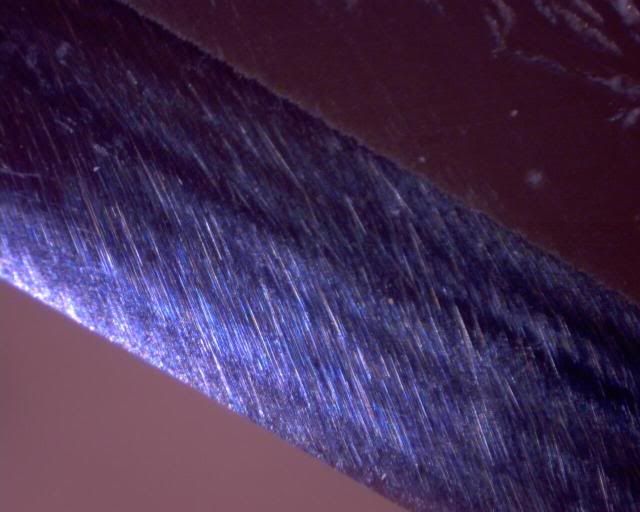
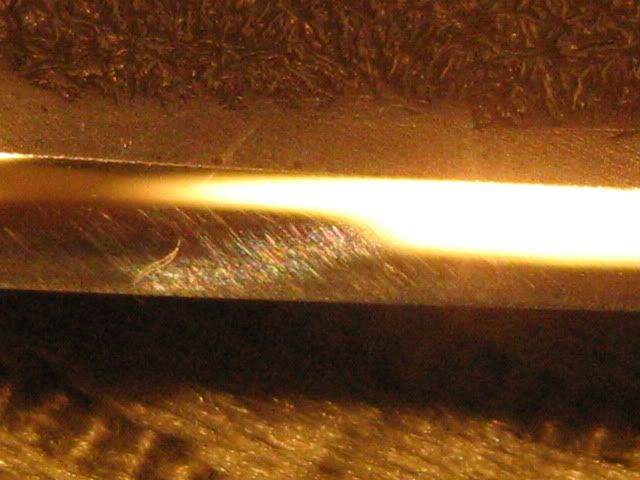
It creates a small convex to the edge but one that can hardly be seen. It also improves cutting ability when compared to a bevel created by a fixed guide.

Here is a example.
PIC073.jpg


Notice all the lines that run parallel to the edge?

Now this is what is looks like a little more backed out.
Picture1151.jpg
 
I'm trying to find an angle guide that secures to the spine of the knife and rests on the stone. I've seen a couple of them in pictures, but I'm not sure if they're custom made or what, the only commercially available option I can find is one from Razor Edge Systems Inc., and I'm not sure if I'll have the same issue with hollow grinds with that.

Guides like the Razor Edge are good for learning freehand sharpening. It will teach you the proper movement of a knife over the stone. But it has its limits. Your basically limited to one angle... you can adjust it a bit by moving the clamp around, but only a few degrees. The angle also depends on the height of the blade... it's not something you can 'set'. Repeatability is another... getting it set the same every time. The clamp also wears over time. Consider it only if you're looking to eventually sharpen freehand. If you feel the DMT guide has given you a good idea of freehand sharpening, it's probably not be worth it. It has its place... but the fact that you've made it to a sharpening forum means you'll probably quickly outgrow it.

cbw
 
Guides like the Razor Edge are good for learning freehand sharpening. It will teach you the proper movement of a knife over the stone. But it has its limits. Your basically limited to one angle... you can adjust it a bit by moving the clamp around, but only a few degrees. The angle also depends on the height of the blade... it's not something you can 'set'. Repeatability is another... getting it set the same every time. The clamp also wears over time. Consider it only if you're looking to eventually sharpen freehand. If you feel the DMT guide has given you a good idea of freehand sharpening, it's probably not be worth it. It has its place... but the fact that you've made it to a sharpening forum means you'll probably quickly outgrow it.

cbw

I do like the idea of being able to free-hand a blade to be sharp. I can do that fairly well too, but I pretty much can't get a free-hand blade to be as perfect as one I do on a guide. There's always something that's wrong with it, and sometimes even when there's not, it's just not as sharp as an edge I did with a guide.

In the end though I'm being pretty stupid though, because when I say it's not "as sharp" I'm basing this off of the idea that it doesn't push cut through paper quite as cleanly as the blades I did in a guide. Whereas I can do several pieces of paper with a knife I did in a guide before I get a tear, with a knife that I free hand I'm lucky if I can do several slices before a tear. In the end this is completely impractical since I don't have a job slicing piece of paper in half, so I shouldn't really use this as my criteria for which is sharper.

I think I'm just caught up on the "bragging rights" concept and just want to keep using a guide so I can have these really nice edges.

My big wonder with the Razor Edge Systems one is whether or not it will even clamp down holly ground blades more effectively.
 
I do like the idea of being able to free-hand a blade to be sharp. I can do that fairly well too, but I pretty much can't get a free-hand blade to be as perfect as one I do on a guide. There's always something that's wrong with it, and sometimes even when there's not, it's just not as sharp as an edge I did with a guide.

In the end though I'm being pretty stupid though, because when I say it's not "as sharp" I'm basing this off of the idea that it doesn't push cut through paper quite as cleanly as the blades I did in a guide. Whereas I can do several pieces of paper with a knife I did in a guide before I get a tear, with a knife that I free hand I'm lucky if I can do several slices before a tear. In the end this is completely impractical since I don't have a job slicing piece of paper in half, so I shouldn't really use this as my criteria for which is sharper.

I think I'm just caught up on the "bragging rights" concept and just want to keep using a guide so I can have these really nice edges.

My big wonder with the Razor Edge Systems one is whether or not it will even clamp down holly ground blades more effectively.

Dude, I SOOOO understand everything you are saying and getting at.

Here is my advice. PRACTICE!

If someone hands you a black box to which you insert your knives and out the other end pops you knives with edges that you can use as signaling mirrors while you do scrimshaw on mosquitoes teeth, are you going to be happy? Perhaps...BUT what if you practice for a few weeks (possibly months) and then develop the skills to do this sort of thing without the black box? My bet is you will appreciate it that much more.

Another suggestion is use a wedge to help you set your stones at the angle you need/desire. You saw the thread, build a wedge (or have some one with the right gear rip a 15 degree wedge out of a 4x4x12 block of wood), then practice.

May be I am all wrong, but it sounds to me like you are right on the cusp of really breaking into some phenomenal results freehand if you just practice a bit more. I think aligners are fantastic, but I think you might appreciate the edge you pushed yourself to achieve a little more...

Whatever you choose, have fun, stay relaxed, and enjoy the ride!

Edit to add:

I once talked to a custom builder that explained "perfection" to me in his terms. He basically said that near perfection can often be achieved with mechanical devices (mills, guides, computer welders, CNCs, etc), but in the end the true aficionado will always prefer the less perfect (whatever) example that shows signs of being made by an imperfect human...but done so REALLY REALLY well. Not sure if that helps or makes sense, but I think it gets to the heart of explaining the difference between passion/art and raw functionality. In the case of functionality, you probably exceeded your edge needs for a "functional" knife a long time ago.

 
Last edited:
My big wonder with the Razor Edge Systems one is whether or not it will even clamp down holly ground blades more effectively.

The clamp has worked with the various knives I've used it on (within the confines of what I previously posted)... this shouldn't be an issue.

I agree with the others though... see if you can improve your freehand skill to meet your need. Other than that, I would recommend looking at something like an EdgePro... way better in the guided sharpening realm.

cbw
 
Well, I took your guys advice, and I'm practicing free-handing.

I'm still cheating a little bit though. I took a McDonald's straw ( the thin type, with the red stripe down the middle ) and cut it in half down the stripe. I stuck this around the spine of the blade so I could have a "reference" of what angle I'm working on. It's up to me to actually hold it still and what not, but the straw helps me keep track of where to set the angle.

Think I should figure out another way or keep using the straw? I'm not sure it's exactly up to par with my guided edges, but it's way up there, so I think it'd be a good trade off.
 
Well, I took your guys advice, and I'm practicing free-handing.

I'm still cheating a little bit though. I took a McDonald's straw ( the thin type, with the red stripe down the middle ) and cut it in half down the stripe. I stuck this around the spine of the blade so I could have a "reference" of what angle I'm working on. It's up to me to actually hold it still and what not, but the straw helps me keep track of where to set the angle.

Think I should figure out another way or keep using the straw? I'm not sure it's exactly up to par with my guided edges, but it's way up there, so I think it'd be a good trade off.

Use the straw if you like...whatever works and the fact that you invented your own method is cool in its own respect. I bet in time you will evolve into other tools and refine your talents. As long as you are learning and/or improving...you are on the right track. It really is all about enjoyment IMO.
 
Well, I took your guys advice, and I'm practicing free-handing.

I'm still cheating a little bit though. I took a McDonald's straw ( the thin type, with the red stripe down the middle ) and cut it in half down the stripe. I stuck this around the spine of the blade so I could have a "reference" of what angle I'm working on. It's up to me to actually hold it still and what not, but the straw helps me keep track of where to set the angle.

Think I should figure out another way or keep using the straw? I'm not sure it's exactly up to par with my guided edges, but it's way up there, so I think it'd be a good trade off.

Free-handing it is probably the ultimate goal for most purists, but there's nothing at all wrong with using the straw or any other creative solution you can think up. Personally, that's the kind of thing that makes this all so very interesting & fun for me. If you can come up with 3 or 10 or 25 different ways to accomplish the task at hand, it keeps your mind engaged & focused on the craft. It's what real 'problem solving' is all about. That's a very good thing.

Think how boring & frustrating this would all be if there were only ONE correct way to do it? :)
 
I have never been able to get close to the edge acheived with a guide by freehanding. You just can't maintain an angle to 1/10 of a degree by eyeballing. I mark the position of my guide on the blade with a diamond glass cutter so the guide always returns to the same place. In order to get a consistent edge without guides, I mount my stone at the desired angle and point the blade perpendicular to the ground while pulling it across the stone. This approximates a crock stick but removes much more material. This technique is not as accurate as a guide, but it is much faster and not as messy.
 
Back
Top