Need advice on my Greco folder

Joined
Apr 8, 2006
Messages
130
About a year ago I bought a John Greco folder. The steel is listed as 8670 German steel. At first I was uneasy about using a carbon steel folder as an EDC, but my fears were unfounded (until now, that is). The Greco makes an excelent carry, it rides flat in the pocket, locks like a tank, and has a .2" thick blade that I do not feel unconfortable in using it hard.

It was never a great cutter, though. When I first got it, I rebeveled it, and it improved somewhat. Anyway, after carrying it for a year, the blade started showing rust spots. This alarmed me, since rust was never a problem with this knife. I rebeveled it again, something I had already been set on doing, and ground off the rust. Then I cleaned the blade, coated it in Militec, and did not carry it for a week.

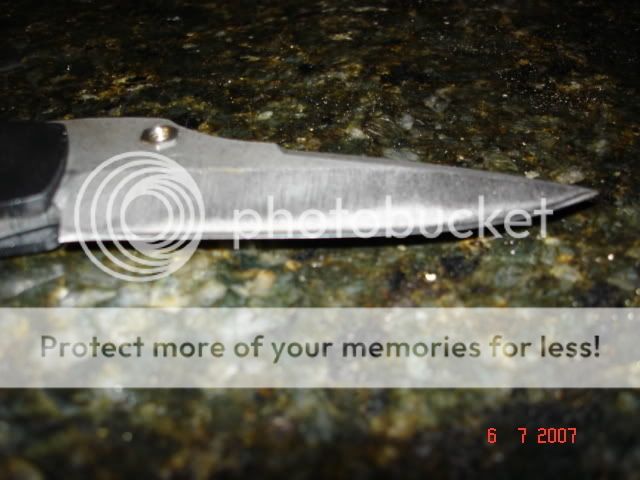
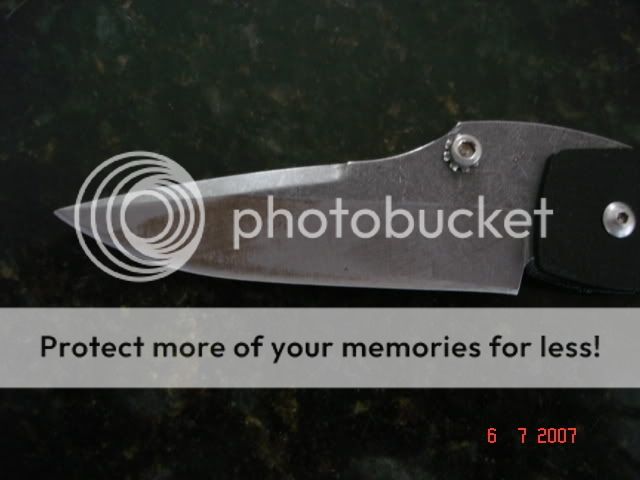
When I examined the knife yesterday, I was surprised to find this:
DSC04977.jpg

I don´t know what to do to prevent this situation. I can´t comprehend how this knife suddenly went from a rust-free EDC to a knife that rusts just from sitting oiled in a drawer for a week. I need some advice.
 
When you re-bevelled the knife you removed the coating that John applies to the blades. Try Sentry Solutions Tuf-glide (Tuf-Cloth) instead of Militec. Personally I've found that Tuf-Glide is a better protectant while Militec is a better lubricant.

David
 
I have several Greco knives, and among them a Falcon which is a folding model similar to your whisper there. John uses a type of clear coat on his blades to protect them from rust, and when you ground off the rust spots my guess is that you ground off the coat. Use will remove this coating too, so this really isn't something to worry about. 8670 appears fairly similar to L6 in composition, and is very similar in use, at least in my own experience. Very tough, very rust-happy, and low machineability (hard to sharpen).

If there were acids or other corrosive agents on the blade before you put the oil on--like from your fingers--then oil likely went over the top of them instead of cleaning them off. I really recommend not just wiping over knives/tools/whatever with oil when you're about to store it but really scrubbing the exposed steel with your oily rag, or better yet, cleaning with something that won't leave a residue (mineral spirits, etc.) and then putting oil on.

Something you can do which will be more permanent--and was a favored trick of old timers with their non-stainless slipjoints--is the apple trick. Stick your knife into an apple and let it sit overnight. Then, pull it out and clean it up well to get all the residue off with soap and water. You may want to follow up with some mineral oil on very fine steel wool. What you'll end up with is a darkened blade (the parts that are uncoated) that will have slightly more rust protection than it did when bare.

The other thing to realize is that surface rust is really more of a cosmetic than functional issue. I know the fear is of rust climbing deeper and deeper into the steel and destroying the blade, but somebody else on these forums made an excellent point awhile ago which I now shamelessly steal---the Titannic is an ENORMOUS pile of non-stainless steel that has been sitting on the bottom of a saltwater ocean for 95 years now, and it still has enough structural integrity to remain ship-shaped despite the pressures that the water exerts upon it. I'm not telling you that there's no point trying to keep your knife rust free, but don't let it keep you up nights. If you use it at all, it'll rust and stain, and get beaten up---clean it up, touch it up, and slip it back in your pocket. Rust on the edge is the only performance detractor you'll notice. I tend to keep non-stainless edges in wax when not in use, and this is easy to do even when you're out and about. My lips don't really chap but I keep a little generic tube of beeswax chapstick in my pocket, and when I have finished using my knife I clean the edge off with a few strops on my jeans and pull it through the wax a couple times. It then has a wax coat that does a pretty reasonable job of protecting it until the next use. This isn't absolutely necessary, of course, but I notice that when I do it my non-stainless knives stay hair-popping sharp for longer.

I always reprofile Greco edges as well, but as you mentioned it's still not the easiest steel in the world to get sharp. I find that a coarser edge works best--I usually do a high polish on the main edge and then a coarse microbevel; usually a few swipes with a red DMT or medium waterstone. The good news is, once sharp, it seems to keep its edge well under a wide variety of uses.

Best o'luck--I'm sure others will chime in here with some ideas before long.

Edit--heh, told you there'd be others. :D
 
When you re-bevelled the knife you removed the coating that John applies to the blades.
I had re-beveled the knife shortly after I got it, and it didn´t rust until now. To add to the strangeness of it, one side of the blade gets the bulk of the rust. The other side of the blade is not that bad.
DSC04983.jpg


Try Sentry Solutions Tuf-glide (Tuf-Cloth) instead of Militec. Personally I've found that Tuf-Glide is a better protectant while Militec is a better lubricant.
I think I have a Tuf-Cloth bag around here, it´s been laying around for a year or more, I got it as a gift. I´ll give it a shot. BTW David, how does the Tuf-Cloth fare on firearms? Do you have any experience in that regard?

If there were acids or other corrosive agents on the blade before you put the oil on--like from your fingers--then oil likely went over the top of them instead of cleaning them off. I really recommend not just wiping over knives/tools/whatever with oil when you're about to store it but really scrubbing the exposed steel with your oily rag, or better yet, cleaning with something that won't leave a residue (mineral spirits, etc.) and then putting oil on.
Thanks for the detailed response, t1mpani. After I ground off the rust a week ago, I cleaned the blade with hot water, then wiped it with a clean cloth, then applied the Militec with a cotton swab. I was careful not to touch the blade before applying the oil. Then I let the knife in a drawer for a week. Rust crept in.

Something you can do which will be more permanent--and was a favored trick of old timers with their non-stainless slipjoints--is the apple trick. Stick your knife into an apple and let it sit overnight. Then, pull it out and clean it up well to get all the residue off with soap and water. You may want to follow up with some mineral oil on very fine steel wool. What you'll end up with is a darkened blade (the parts that are uncoated) that will have slightly more rust protection than it did when bare.
That´s interesting, I had never heard of this trick before.

The other thing to realize is that surface rust is really more of a cosmetic than functional issue. I know the fear is of rust climbing deeper and deeper into the steel and destroying the blade, but somebody else on these forums made an excellent point awhile ago which I now shamelessly steal---the Titannic is an ENORMOUS pile of non-stainless steel that has been sitting on the bottom of a saltwater ocean for 95 years now, and it still has enough structural integrity to remain ship-shaped despite the pressures that the water exerts upon it.
I could be wrong, but maybe the tremendous pressures help the ship retain its structural integrity on the bottom of the ocean. Even then, I would be willing to bet the steel is actually much weaker than it was 95 years ago. I see your point, though.

I'm not telling you that there's no point trying to keep your knife rust free, but don't let it keep you up nights.
I confess I cursed the carbon molecules in the steel when I found rust on the blade. I considered EDCing a safequeen I have and letting the Greco knife die a slow death in my drawer. I can´t bring myself to do it though, the Greco has served me fine. It has been quite a beater, sometimes I use it as a fixed blade, and the pivot and lock are still as tight as they were on the day I bought it. Until now I only had the best things to say about this knife.

I always reprofile Greco edges as well, but as you mentioned it's still not the easiest steel in the world to get sharp. I find that a coarser edge works best--I usually do a high polish on the main edge and then a coarse microbevel; usually a few swipes with a red DMT or medium waterstone. The good news is, once sharp, it seems to keep its edge well under a wide variety of uses.
My experience is similar to yours, it takes a while to get the Greco sharp, but when it does, the edge lasts a long time. No matter how much I tried, I couldn´t get a hair-popping edge on the Greco. Right now, it shaves if I press it against the skin with a slight amount of force, and that´s enough for my everyday tasks. I use one of those run-of-the-mill 2 grit stones you can get at the supermarket, clean and dry. I also have a sharpmaker, but the Greco seems impervious to it.
 
Back
Top