I'm usually not in this section of BF but today I am, I usually carry benchmades and spyderco's, as well as other high end tactical folders, but lately folks; I've been craving a slipjoint to carry along side my normal folder: I have very few traditionals + slipjoint knives... and not really any high quality ones, unless of course you want to count my trusty buck 110 as a traditional lockback, which I suppose it is.
I'm having a strong pull towards the black synthetic Case sod buster, and it's because of it's extremely simplicity, (thinner, one blade, elegant looking) yet functional.
Does this sound like the right choice for someone who doesn't normally collect traditionals to start out, or is there an even more simplistic and classic design that I would be missing out on for a first purchase?
Open to any suggestions and thanks in advance.
EDIT: Almost forgot to add, I like the douk douk knives too, but IDK where to find them online especially the stainless bladed "chrome" verison. Which is the one I'd want. So if anyone knows hit me up.
My nephew asked me recently to give him suggestions about traditional knives and I put the following overview together. It's my view of the world and it may not makes sense to anybody else.
Given that you've been carrying expensive tacticals I should add this comment about traditionals... IMO, one of the things about many (not all) traditionals is that they emphasize functionality over excellence in production. Many traditionals were meant to be inexpensive knives for workers and there is a degree to which (again, imo) talking about perfectly executed traditionals is sort of like putting chrome wheels on your pick up. Some folks do and like it and that's really the bottom line. If you read through the (very long) overview that follows you'll find out that my pick is an Opinel #8 that can be purchased for about $15. You can easily spend 10x that amount. Depends on what makes you happy.
Pinnah's overview of traditional knives:
Several things that should be mentioned:
+ Where the knife is made and by whom
+ The kind of steel used in the blade
+ The four major styles of pockets knives
+ Every Day Carry (EDC)
MANUFACTURERS - Where a knife was made and by whom may be a consideration. Just as some people like Fords because they are Fords, some people prefer Buck knives because they are Bucks. England and Germany had long traditions in knife making and as people came to the US, they brought those skills here. Many small knife companies started in the late 1800s and early 1900s. Among others there were: Providence Cutlery Company and Imperial from Providence, RI; New York Cutlery, Ulster, Camillus and Schrade in New York; and Buck, Queen and Case from Pennsylvania. As industry moved west, so did some of the knife makers. Buck moved to California and Platts & Sons Cutlery Company moved from New York to Boulder, Colorado and became Western Cutlery. Some of these names just disappeared. Others like Camillus and Schrade purchased up smaller companies and lasted till the 1990s/early 2000s before closing their doors (and later being reborn as seller of Chinese made versions of their old designs). Some companies like Queen have survived by sticking to their guns and in some cases, traditional knife towns have given birth to new manufacturers such as Great Eastern Cutlery in Pennsylvania. And of course, Buck and Case have survived and thrived by offering a mixture of US made and imported knives in a range of designs from traditional to very modern. Lastly, there are brands that make traditional style knives overseas - mostly from China. Rough Rider and the new versions of Schrade and Camillus are in this group.
BLADE MATERIALS - There are 2 basic choices of blade material: carbon and stainless. Carbon steel is the most traditional. Over time, carbon steel discolors with normal use - something that is called patina. (see patina.jpg) The patina actually helps protect the blade and opinion varies about it. Some folks like shiny blades and others prefer the look of patina. Patina announces to all who look at it that the blade is traditional, well used carbon steel. If you nervously fuss over things used regularly (I do) it's pretty easy to keep a carbon blade shiny. If you use a knife on a regular basis and don't mind patina, it will take care of itself. But, if the knife is going to be dropped in the bottom of a tackle box or left on-board a boat for prolonged periods of time, the blade can outright rust and become damaged. Carbon steels are known for being durable and being able to be sharpened easily. For day to day use, carbon is my preference.
Stainless steel won't discolor or rust easily. If a knife is going to be left in rough conditions, stainless makes a lot of sense. Knife nuts compare various flavors of stainless like wine tasters think of wine. I think there are 3 basic groups: garbage, good enough and top-shelf. The garbage stainless steels are cheap, hard to sharpen and loose their edge quickly. This is a very, very crude statement but if the knife is new, cheap and made in China it's probably cheap stainless. If you need a cheap knife to be left in a glove box of your car that will be rarely used, this is fine. As a rule of thumb, if the knife is made in the US or Europe, costs $20-$50 and comes from a manufacturer you've heard of, you can probably assume the stainless is good enough. If you're paying more than $50, you're starting to move into the top shelf territory. I prefer stainless for my hunting and backpacking knifes that I don't use very often (and hence don't keep maintained as fastidiously) and for my low-brow tastes, good enough stainless is good enough.
STYLES - I think of pocket knifes as fitting into 4 major groups: slip-joints, locking hunters, farmer's or peasant knives and Swiss Army Knives.
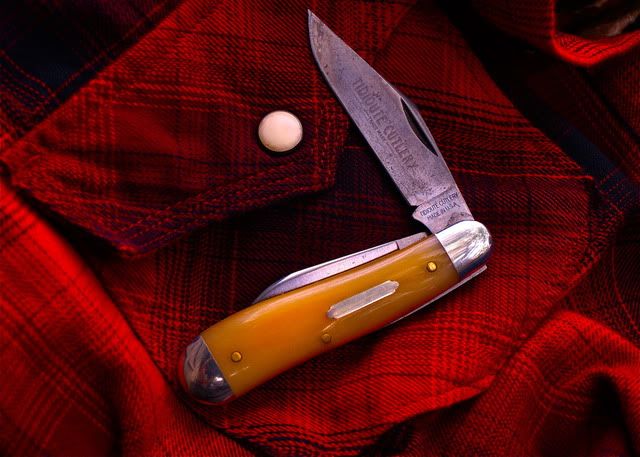
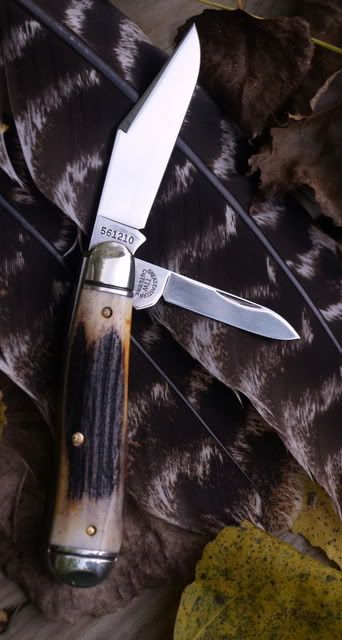
The most common pocket knife is the slip-joint, which means that the blade opens and closes under pressure from a spring. Slip joints tend to be well under 4" when closed but can be a bit on the heavy side. There are a gazillion different patterns and blade styles and many of them grew out of different working traditions. (see: slip-joints.jpg) If slip-joints appeal to you, it's worth spending a bit of time looking at the different patterns to get a better idea of which style appeals to you. Both the Buck and Case web sites are good places to start.
The Buck 110 was introduced in the 1960s and attempted to provide the durability of a fixed blade knife in a folding style. These are big knives and are meant to be carried in a belt holster. The Buck 110 became hugely popular among workmen and was widely copied by many US makers such as Kabar and Schrade. The blade locks into position with a sturdy "lock-back" design which requires your thumb to unlock. Over time, smaller versions of the folding hunter became available. Those that are in the 4" range when closed become usable as pocket knifes, but there is a quite a range available from thin to thick. (see bucks.jpg)
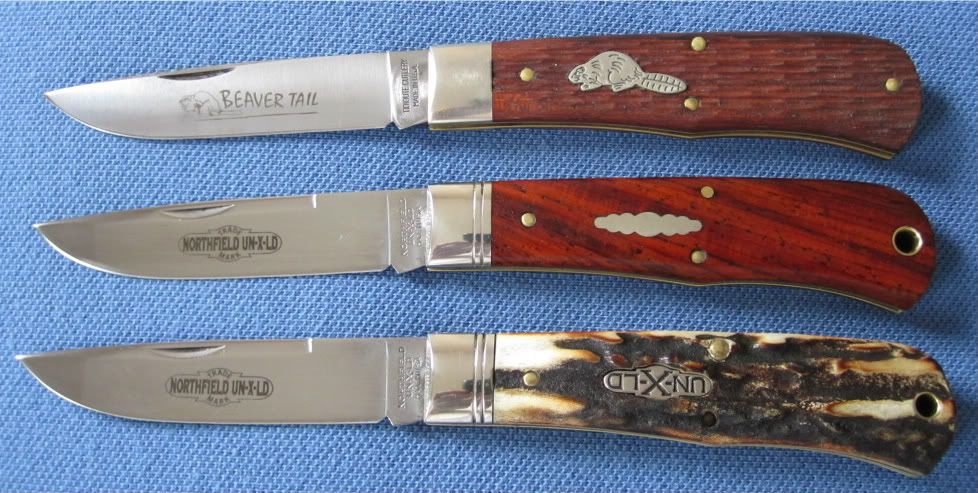
Somewhere in between the small slip-joints and the big folding hunters are the farmer's or peasant's knives. The two most prominent examples are the French Opinel and the US "Sodbuster". (see opinel.jpg and sod-busters.jpg) Generally these are about 4" when folded. Their blades tend to be bigger than those found on most slip joints but their joint isn't as tough as brass bolstered folding hunter. They are also known for being light and arguably, they give the most cutting for the least weight of all of the traditional designs.
Lastly, there is the Swiss Army Knife (SAK). I'm including them for completeness. They are generally slip-joints but there's so many of them and the fans are so loyal, they're worth mentioning separately. (see: sak.jpg)
EVERY DAY CARRY (EDC) - If you're not used carrying a knife on a daily basis, it may take a couple of weeks to get used to it. My suggestion is to keep a knife by your car keys or wallet so that you remember to carry it and to consciously seek out opportunities to use it. After a bit, you'll stop noticing it in your pocket and you'll probably find you get frustrated when you reach for it and don't have it. At that point, you're hooked.
When considering a knife for daily pocket carry, you need to think about length, weight, shape and people friendliness. I find that around 4" is the longest knife I care to carry in my pocket. This depends a great deal on the style of pants. I also don't like small knives because my hands are so big. Others prefer tiny little things. To me, weight matters. Above 3 ozs I start to feel the knife and above 4, I find them heavy. Weight is somewhat related to the sturdiness of the knife. I prefer lighter knives to heavier knives and am willing to give up some amount of ruggedness. In terms of shape, thinner, flatter knives don't show as much in the pocket compared to wider, rounder knives. Also, the more rounded the ends and edges are the less noticeable they are. I prefer larger, wider knives though, again because they fit in my hand better. Lastly, the overall look and size of the knife will generate different reactions with people when you use the knife. A lot of people are scared by knives and the bigger and scarier the knife is, the more people react to it.
MY PICK - My choice in knife should not be your choice but I'll mention it anyway. I currently prefer my Opinel #8 above all others I've used as my day in, day out every day carrying knife. They are insanely light and their slightly larger size fits my hands better. They are also very people friendly. But, I own and enjoy carrying a variety of others. It's a highly personal choice.