Need Help With DC Motor Controller Settings

Joined
Dec 7, 2000
Messages
5,179
My natural state of confusion really blooms when it comes to electrical
stuff. I bought this DC motor controller off eBay and really want to get it
hooked up to my 2hp AmeriSci motor... But there's conflicting info on its
setup.

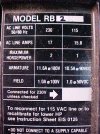
Here's the deal: The plate (image attached) on the outside of the
controller would seem to indicate the controller is set up for 220V (which
is what I want) since the "unless" box isn't marked. But the auction text
stated its last application was at 120V with a 3/4hp motor.

I went to the manufacturer's website looking for a manual for this
controller and it's clearly outdated - the only manuals available were for
newer models whose schematics do not match the board on mine. I wrote the
manuf asking about a manual for my model but they have blown me off.

In the following post I'll show the current board setup.
 

Attachments

  • bfplate.jpg
    bfplate.jpg
    47.7 KB · Views: 57
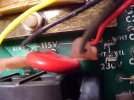
So looking at the board, I'm pretty convinced it is in fact set up for 120V.
The Yellow and White wires are on the posts that appear to be for the 115V
option (see attachment). You can't see it clearly in the pic but there are
lines going from the "115V" text to each of the posts, which are marked YEL
and WHT. Off to the right are two more posts also marked WHT and YEL, just
above the text "230V."

This makes me think it is set for 120V...
 

Attachments

  • bfyellowwhite220.jpg
    bfyellowwhite220.jpg
    29.7 KB · Views: 48
seem to indicate the controller is set up for 220V (which is what i want)

why would you want it to be for 220. i thought the AmeriSci motors were only 120 volt?
 
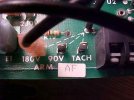
Now the stumper... When I checked what appears to be the armature setting
for 180V or 90V DC, which should be related to 220V and 120V respectively,
the jumper is on the 180V post...

Crimeny! How is an electrical simpleton like me supposed to interpret that?
If this were last used in a 120V application, shouldn't this have been set
on the 90V post? (See the plate pic above.) Of course it's possible that
either the guy in the shop where this was last used is as dumb as me, or
there was a legitimate reason to set it there, or it really is set for 220V
input and I'm looking at the wrong part of the board to set the input
voltage...

Keep in mind the pictures of the newer model controllers do not match mine,
but they are in roughly the same place on the board.

My instinct is to move the Yellow and White wires to the 220V posts and go
with it. But this thing cost me $120 and I really don't want to fry it.
What recommendation would you folks make? I appreciate any ideas, the more
they are all in agreement the better I'll feel. :)
 

Attachments

  • bfarmjumper.jpg
    bfarmjumper.jpg
    27.3 KB · Views: 26
ok, i guess i was just confused. i thought you had to have a DC motor rated for 180 volts or more to run it off of a 220 AC.

my mistake
 
Dave,

Those pics really help.

OK, Here's what I think.

Since those terminals are clearly marked for 220 and 180, then use 'em.

The reason for the mis-match is probably what you guess: somebody wanted to use the controller at 120vac and just switched those leads. That story squares with what the eBay seller said. He said it was running at 120 and the wires are set at 120.

If it were me - I'd swich those leads to 220 hook up the motor and plug it in. Also, set the speed at minimum and watch the voltage with a volt meter. Speed up the motor while watching the voltage and don't go past 120vdc.

Are there any other jumpers, terminals, or switches on there?

Steve

PS You might want to post the manufacturer and model number in case someone on this forum owns one.
 
I can't be for absolute sure. Looks like its hooked up for 115 AC and 180 DC out. What the manufacturer. I see RB 2 on the label.

rlinger
 
Well Duh...

The manufacturer is Boston Gear, it's a Ratiotrol Beta contoller, model RB2. They currently make BetaPrime and BetaII (RB2?), I think they're called.
 
Dave.

For me that's a tuff one. I want to stand by my observation based on your pictures. I will say this: If its hooked for 115 and you put 230 to it - good chance of poof. That could blow a transformer primary winding for one thing. If its hooked for 230 and you put 115 to it - much safer gamble. Not much help so far. If I didn't have a lot in it I'd go with my guess and JUMPER THE OUTPUT FOR 90 volts and put 115 to her. The smoke test will tell and I hope the line input is fused.

I'll be checking back to this thread to see if its tears or cheers.

Roger
 
Thanks everyone, I'm going to follow Steve's idea and my own instinct, and put the wires where it looks like they should go. This will be a few days as I'm going to be very busy with other stuff this weekend, but I'll try to work it in. I want to get that motor running too!

Eventually mine will be a disk grinder that I can switch between vertical and horizontal. If anyone knows of anyone else who has done this I'd like to see their work; maybe they'll save me doing something else the hard way. :)

Dave
 
You furriners talk all thet furriner talk stuff. The only english I picked up was hook the thingy up to the thingamajig and watch for fire and smoke. Can we aim that thing at Iraq? Looking forward to seeing you tomorrow, Dave. Sorry I am no help with alien planet stuff like your electrical problem.
 
I REPAIR INDUSTRIAL CONTROLS FOR MY BUSINESS.
I CAN GET A MANUAL FOR THE RB 2 IF YOU NEED ONE
PHIL
 
Phil, yes please! I hooked it up the way I thought it should go, and it just blows the breaker. I sure can't get this thing working, so would greatly appreciate that manual. The plate specifies "Instruction Sheet EIS 0126". Thanks for any help! The company sure blew me off.

John, this stuff is totally alien to me too, I'm a complete ignoramus when it comes to electicity and plumbing. If I touch it, it either causes a flood you cannot turn off, or a big explosion followed by fire. Very hard on the ego.

Dave
 
Hi Dave and Group,

I'm new here - a metalworker looking at buying an RB II (wired for 220) and I would rewire it for 110. I'm curious if Dave ended up just rearranging the jumper wires and was OK with 220? Put another way, is the RBII able to be either 110 or 220 according to the user needs and defined by the jumper arrangement?

Many Thanks, Bill C.
 
Bill this is not gonna help - I ended up sending the controller to Roger Linger, who found a problem with one of its circuits and fixed it for me. I'm running it off 220 now though and wouldn't go any other way. Good Luck!
 
Dave, Thanks. I have an RB1 that I use on my metal lathe and like it very much. Dave - you have a great website - I like the photos of homemade tools!

Does anyone know where to get the EIS 0126 instruction sheet? I tried the Boston Gear website but they only have the big manual - which does seem to indicate that the RB2 could be either 110 or 220 - I was just hoping for confimation from a real life user. Thanks, Bill.
 
Back
Top