New Blade Project

Stacy E. Apelt - Bladesmith

ilmarinen - MODERATOR
Moderator
Knifemaker / Craftsman / Service Provider
Joined
Aug 20, 2004
Messages
38,479
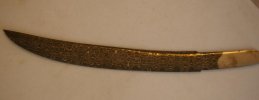
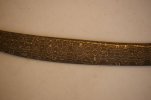
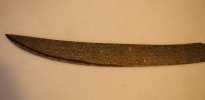
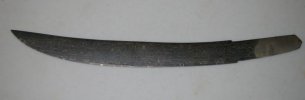
At Ashokan, I traded Delbert Ealy some handle material for a piece of damascus. I took it to the forge yesterday, and forged this tanto. I cleaned it up to 120 grit and gave it a 5 second dip in FC to see what we had. I think this will end up stunning....Thanks Delbert.

The style will be osaraku-tsukuri tanto ( long pointy blade). I will flatten the curve toward the kissaki (tip) as drawn on with a sharpie. I always forge in extra, and take it off a little at a time in togi ( shaping and sharpening)....you can't put any back on.
The yokote ( place where the tip meets the main edge of the blade) will end up about the center of the blade when done. The grind will be sort of hira-tsukuri, with a small shinogi-ji.....really more of a steep mune ( nearly a full height main bevel, with a "V" shape spine).

The handle I have in mind will reflect the blades activity. I will make a same' wrapped tsuka ( sting ray covered handle) and do the tsuka-maki in black ito (wrap it in black silk ribbon). Before the wrap, I will silver leaf the same' to make it show through the ito as silver lines...just like the blade pattern. I will make a mokume'-gane habaki and small tsuba ( brass/silver collar and guard). I think some of my really black/grey buckeye burl will be good for the saya ( sheath).
 

Attachments

  • blade 001.jpg
    blade 001.jpg
    11.6 KB · Views: 152
  • blade 002.jpg
    blade 002.jpg
    15.4 KB · Views: 132
  • blade 003.jpg
    blade 003.jpg
    35.1 KB · Views: 170
  • blade 004.jpg
    blade 004.jpg
    20.8 KB · Views: 140
Sacy,
you are welcome, I am about to use some of the wodd I traded you for.
The blade looks good.
Thanks,
Del
 
Very cool! I can't wait to see what you do with the ray skin.
 
Cool looking blade. however, you might want to invest in a community college English language course. ;)
 
kissaki = tip
ha = edge
ha-mon = "line along the edge"
mune = spine
machi = notch
tsukura/zukura = "shape" of the blade. It usually referrs to the main bevel/flat. Thus, shinogi-tsukura = bevel to a center ridge line (sabre grind); Hira-tsukura = blade bevel all the way to the spine ( full fllat grind).
shinogi = ridge line where the edge bevel meets the blade fllat from the spine.
ha-machi = shoulder or notch on edge side at handle, where the tsuba is. The habaki stops against this notch and the mune-machi. In some cases, the guard stops against the notches
mune-machi = shoulder or notch on the spine side at handle.
yokote = the place where the tip curve/angle meets the straight edge.
tsuba = guard
tsuka = handle
sun = 1/10 foot, or 1.2"
shaku= 1 foot ( ten sun to one shaku)
ito = the flat ribbon used to wrap a handle
maki = "wrap"
tsuka-maki = "handle wraping"
"O" = long
Chu = medium
Shoto = short
habaki = blade collar where the tsuba is. It makes the blade fit the saya, and protects the blade from scratches.
saya = sheath
fuchi = bolster
kashira = end cap/pommel
koshirae = all the fittings on a knife handle - habaki, guard, bolster, pommel, decorations, misc. fittings.

There are hundreds of other words to describe every variation of every spot on a blade...but these twenty will describe 95% of all blades.
Understanding the base words allows some indication of other words. Most terms starting with "O" mean a "long"version of whatever part or object is deing described. Osoraku-tsukuri means a very long tip meeting the main bevel in the center of the blade.

ichi =one
ni = two
san = three

Ichi-ban = "Number One!" or "The Best"
ni-bu = two part, two piece
san-mai = three layer


Got it now?
 
thanks, Stacy. I'm saving this . :) And now I also know why the absolutely fantastic Japanese Steakhouse we go to is named "Ichi-Ban's" now.

randy
 
To me what you have already done and your discription of what is to come makes it very special ! I'll certainly be watching this all the way. Thanks for showing ! Frank
 
Very cool project! cant wait to see it when it's finished. I have a Noob question... I understand it's a Japanese styled blade...but why are the parts referred to in japanese, instead of just translating it in the first place? some sort of elitist thing? I understand using the proper nomenclature for things, but why not just say the guard, or the tip, etc. I apologize if it sounds accusatory, I dont mean it to be. It's meant in the most humbleist of terms. just wondering WHY is all

Jason.
 
This will be interesting to see. I am finishing up an osoraku style piece so I will be particularly interested to watch yours unfold.
 
Jason, that is a good question. Sometimes I write the description as I see it in my head. I often put the English term in parens. Bladeforums is an educational site, so learning a few new terms is always a good thing.

Some see the terminology as elitist, but the folks who appreciate a Japanese blade will want to hear the description in the proper terms. They will be the likely buyers, after all.

One of the problems with trying to describe a Japanese style knife in western terms is that there are maybe ten ways to say things in English, and one hundred in Japanese.
I could say the knife will be pointy with a 9" blade and 14" OAL, but that would not tell a person much about it. Also, many Japanese terms have no English equivalent. Hamon is hamon, habaki is habaki, osoraku is osoraku, yokote is yokote, etc.

The Japanese descriptive terms will draw a picture of the blade and the fittings in ones mind. The principal has been used for hundreds of years before photography and the internet existed. A person could read a description and imagine the knife without seeing it. When the knife arrived arrived, it looked pretty much as imagined. The modifiers ( O,Chu, Shoto, etc.) are like the tools in a CAD program. You start with a knife style ( tanto)...stretch/shrink it with the modifier, and embellish it as described in the koshirae.

I guess the final comparison would be to describe a pretty girl in terms used to describe football players.
If the following were dating adds:
Female,Light weight, about 5'6", I'm not muscular, and I'm not a good runner. I don't play football.
Or-
Slender lady, just the right height, built like a GBSH, and I wiggle when I walk. I'm into full body contact sports of a different nature, IYKWIM.
If the two were posted on Match.com , which would you resound to?
 
Thanks for the lanquage info. Had seem many before and didn't know what they meant. I like your concept of drawing a pic with the words. Helps to understand.
 
5'6"......sound cute. I haven't got past Dels Damascus yet! Stacy, I'm subscribing to this one. You make the coolest stuff.
 
Thanks for that Stacy, I knew some of the lingo from Wally Hayes' dvd, but it's good to have some perspective on it and lots of examples :P Also eager to see how these turn out!
 
Back
Top