New burner design?

Joined
Dec 1, 2006
Messages
58
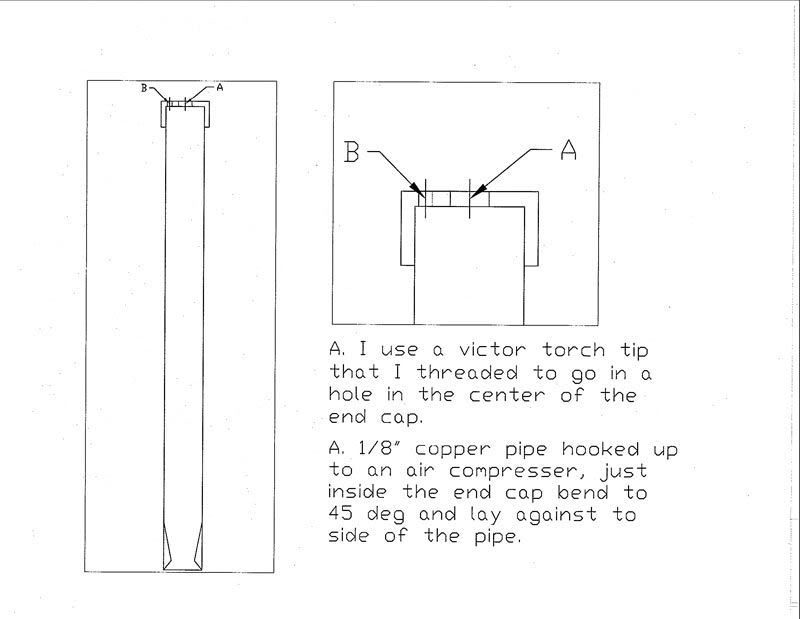
Ok, while building the burner to my forge I had an idea. What if instead of putting a bell fitting on the intake side I put an end cap? Then drill a center hole, thread it and put in the gas line (I use used victor gas cutting tips from where I work because I can get them in any size and they are brass, what’s not to love?) and then next to that you put in a 1/8” or 3/16” copper line connected to your air compressor.
I think that it would give you a better burn and more predictable temperatures if you control exactly how much air and fuel go into the forge.
Has anyone done this? Would it work?

click to enlarge
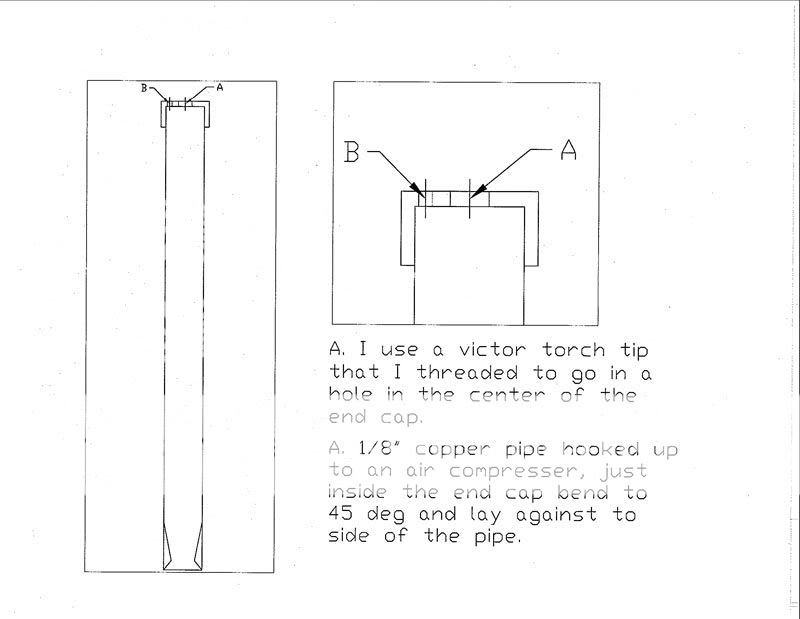
 
I must say- that's a great idea. It's essentially the same thing as a blown burner, but more control. One issue that might arise is the Fuel/Air mix, because both of them will be running in a stream, the reducer bell at the end should help. Are you using that 45 degree bend to try and get the air going around the inside of the nipple- I'm not quite catching what the intent is with that part.

The thing that really gets me about your diagram is the end flare. Narrowing it, thus speeding it up, and then slowing around the initial speed at the end, causing a mix but still keep velocity... or atleast I think that's what you're going for. I'm curious to see how it would work out.

I'd say give it a try- if you already have the line and the compressor you should be fine. The tips and pluming shouldn't run more than an hours worth of time and $20.

Good luck!
 
What you have designed is a blown burner,with a compressed air supply.The thing you want in the air flow on a blown forge is steady volume control at varying pressures. An air compressor will give you high pressure and high velocity,both in amounts more than needed. A lower pressure medium volume flow,not a lot more than the amount a hair dryer puts out, is all that is needed. An actual forge blower is much more expensive than a squirrel cage blower due to its ability to maintain volume at lower pressure ( they use a different shaped fan). This is more of a need for running a coal forge than a blown burner forge.There are a lot of good blowers available cheap,that will work fine on a gas forge. All you need is to add a shutter plate on the intake (to limit pressure),and a large gate valve on the air supply pipe (to limit volume) to the burner(s).Places like Centaur Forge sell true forge blowers,and Ebay sells good,but inexpensive ,squirrel cage units.
Let us know how it works.
Stacy
 
^^^Good point.
When I need to reach welding temps I hook a hairdryer up to one side of my t, put a choke on the other side (my air comes from either side of the T), and let it rip. As of right now I use duct tape to secure it in place (working on an alternative method atm). I'm still rather keen on the idea for the flare- anyone else tried that?
 
What you have designed is a blown burner,with a compressed air supply.The thing you want in the air flow on a blown forge is steady volume control at varying pressures. An air compressor will give you high pressure and high velocity,both in amounts more than needed. A lower pressure medium volume flow,not a lot more than the amount a hair dryer puts out, is all that is needed. An actual forge blower is much more expensive than a squirrel cage blower due to its ability to maintain volume at lower pressure ( they use a different shaped fan). This is more of a need for running a coal forge than a blown burner forge.There are a lot of good blowers available cheap,that will work fine on a gas forge. All you need is to add a shutter plate on the intake (to limit pressure),and a large gate valve on the air supply pipe (to limit volume) to the burner(s).Places like Centaur Forge sell true forge blowers,and Ebay sells good,but inexpensive ,squirrel cage units.
Let us know how it works.
Stacy

I would use a regulator on both the air and gas. I have been looking at air regulators that go down to 1 PSI, with that going through a 1/8" pipe would be able to let the burner idle down to a little less than 2 PSI of gas.
Thoughts?
 
check out the Chile Forge products. They are atmospheric, but use chokes on the burners. I just got one and it seems to work very well.
 
I'm still rather keen on the idea for the flare- anyone else tried that?

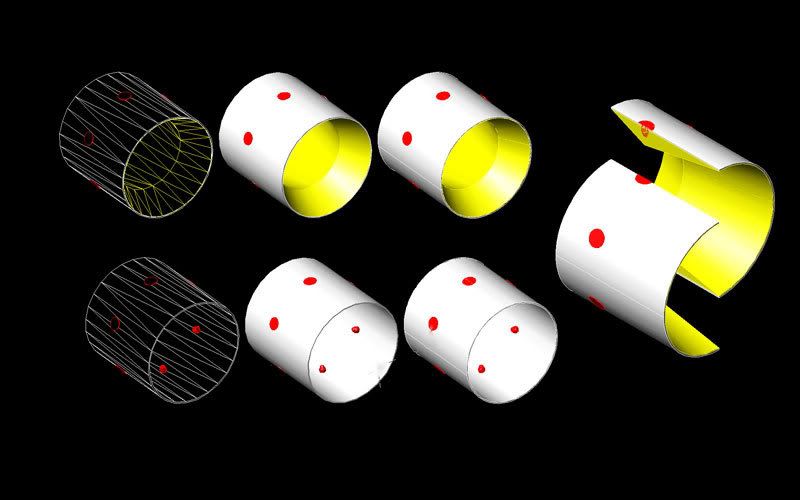
If anyone wants to know what it looks like and how I would build it ...

click to enlarge


The top row is the completed project rendered a few different ways, the bottom row is just the sleeve, the last image is a slice of the completed showing the cross section.

The white is flashing that is rolled to the size of the burner, the red is rivets (used both to secure the flashing and to give the clay or refractory to the flashing) Yellow is the flashing.
the whole thing is only about an inch and a half long with the widest part being just 1/4" from the end of the flare.

If anyone needs more views, angles or measurements just send me an email :)
 
That showed it plenty clear- thanks.
I can't wait to hear the results of this style of flare.
 
Back
Top