Nitrogen blade steel surface film?

MicroAlign

Gold Member
Joined
Feb 1, 2004
Messages
508
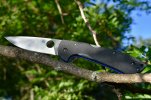
I've tried performing a forum search for this topic, but I never found any answers. For you steel experts out there, does anyone know what the weird surface film on the surface of steels like LC200N is? My thought is that it must be some sort of reaction the steel has to the atmosphere, resulting in a corrosion/breakdown of the steel, or material is collecting on the steel generating the "film". Am I totally off base on this subject? I'm hoping that material is simply collecting on the surface with use.
 
While I am certainly no expert in the field of metalurgy, I suspect what you are seeing with this steel (aka Z-finit) is indeed surface oxidization. While not your typical "rust" in the sense of iron oxide, it is more of a subdued hazy sheen that develops after exposure to air. Sort of like aluminum. Aluminum forms a microns-thin aluminum oxide coating that is very transparent, yet hazy enough to be visible when compared to protected or recently sanded aluminum.
 
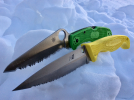
My LC200N when subjected to below freezing temps, the colder the blade gets, the darker it gets. Goes away once it warms up. On a colder humid morning with a high dew temp, my LC200N will get a hazy smoky color, goes away once the blade warms back up. Body heat seems to add to the effect when subjected to the sudden cold temps too.

I know the Fish Hunter is H1, but it was together in the photos and had very similar darkening too. Another member also commented that his LC200N did the same kind of color change as mine when subjected to cold.DFF2B66E-BBEE-4603-A7A2-3A26D56DA445.pngEE3BFE5F-8512-4A22-9C7C-A08D108A0D8A.jpeg
5175D372-EF6F-4E74-A9C9-8F77A926FFE2.jpeg
 

Attachments

  • AFF2DFB8-F2CA-4A23-92A4-12351F7976B8.jpeg
    AFF2DFB8-F2CA-4A23-92A4-12351F7976B8.jpeg
    312.1 KB · Views: 0
The basic mechanism of stainlessness is that the free chromium in the steel reacts with the the oxygen in the air to form a very, very, very thin layer of Chromium Oxide (Cr2O3). It can technically be called "corrosion" because there is an oxidation reaction going on. However, once that layer of chromium oxide is formed, the reaction stops. There is no additional accumulation of chromium oxide after that initial layer unless there is a physical action that removes the layer. If that layer is removed, the oxidation occurs and another layer is formed and the oxidation reaction stops. Mind you, this is on a microscopic level with around a 10 nanometer layer thickness. I'm pretty sure it's imperceptible on the macroscale (to give an idea of scale, the oxidation layer that you see during HT is in the micrometers level of thickness; 1000 nanometers = 1 micrometer).

Are you sure it's not just residual oil (either from handling or application)? The surface finish can certainly play an effect on stuff "sticking" to the metal.

More knowledgeable people, please correct me if I'm wrong.
 
Last edited:
I think Spears is spot on with ordinary stainless steels. After sharpening or grinding, they quickly get a layer of chromium oxide that prevents further corrosion. That corrosion degrades and widens the apex by 0.04 microns within 2 hours, which knocks off 20 points of Bess, according to Dr. Vadim Kraichuk, author of Knife Deburring: Science behind the lasting razor edge.

Of course, further corrosion is also possible because stainless is not stain-roof.

However, I think nitrogen steels that the OP refers to are different. In high-alloy steels they stop corrosion by a different or more complex mechanism that I don't understand.

I do have a lot of experience with Vanax, a nitrogen steel that is very close to stainproof.

Hopefully, Larrin or Bluntcut or some other expert can weigh in.
 
Thanks for all the information. That color change in cold weather is very odd......almost seems like the the chemical reaction of gun bluing. I'm just curious if any of these weird nitrogen steel behaviors compromises the performance of the steel in any way.
 
Larrin Larrin

Larrin would be the one to ask, but my understanding of nitrogen steels is that nitrogen replaces carbon as the hardening agent. So less carbon is added to the alloy. The result is a "low carbon steel" that can still be hardened to high hardness.

Carbon is galvanically dissimilar to iron, so if you reduce the iron content, you improve the corrosion resistance.

Also, if you reduce the carbon content, there is less carbon to form chromium carbides. Chromium bound to carbon does not provided chromium for the protective chrome oxide layer. So by adding nitrogen and reducing carbon, there is effectively a higher chromium content in the alloy. This pushes the formation of the chrome oxide protective layer.

The actual protection mechanism remains the layer of chrome oxide on the surface. It becomes more effective as there is less dissimilarity to protect and as there is more chromium not locked up as chromium carbide.
 
Any stainless steel, whether alloyed with nitrogen or not, forms an invisible chromium oxide layer which prevents corrosion. I do not know what "film" is being described with this particular LC200N knife. If you can see it, then it isn't related to the chromium oxide layer or corrosion protection from chromium or nitrogen. You would have to look into other possibilities such as some mentioned in the thread so far like oils, etc. As a side note, there is no nitrogen addition to H1 so that would not be another example of a "nitrogen" steel showing odd behavior.
 
I agree about the mystery "substance" on the blade of my SpydieChef. Kind of a hazy uneven smeared oil look. It doesn't wash off. I always assumed it was a lc200n issue and kept on cutting without worry. I run and mow with it just about daily in the summer, it lives a salty life. I've corroded the stop pin and detent ball, it's a first generation model. (Off topic, but the lock has held up great.)

I am guessing corrosion of some type. When I cut bags of chlorine open, the film seems to worse for a few days until it wears down.
 
I agree about the mystery "substance" on the blade of my SpydieChef. Kind of a hazy uneven smeared oil look. It doesn't wash off. I always assumed it was a lc200n issue and kept on cutting without worry. I run and mow with it just about daily in the summer, it lives a salty life. I've corroded the stop pin and detent ball, it's a first generation model. (Off topic, but the lock has held up great.)

I am guessing corrosion of some type. When I cut bags of chlorine open, the film seems to worse for a few days until it wears down.
It's probably just oils that made it into the surface layer by way of the grind, like people were seeing with the coarse satin finish WE was using on the Massdrop Falcon and Crux. Where it caused a little discoloration for a few people but for most it just behaved like a regular coarse satin finish that you can spend a lot of time wiping if you're so inclined.
 
Back
Top