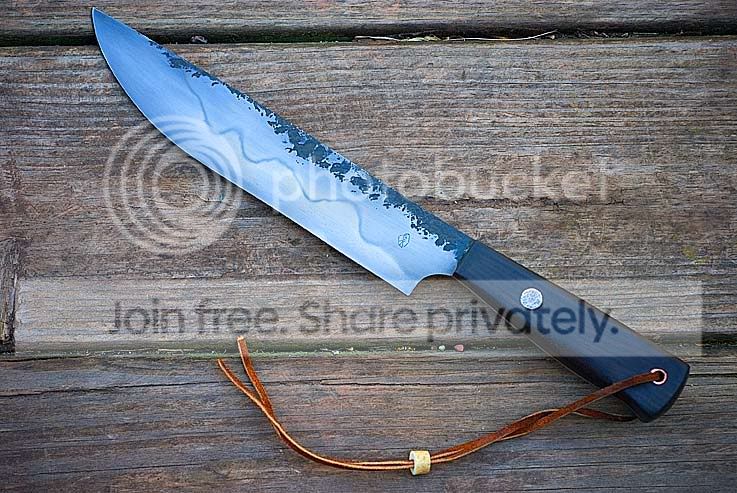
No hamon on Bighorn Camp Bowie: Aldo's fault.

Joined
Jan 10, 2010
Messages
1,818
So this is the first blade I've clayed in my new vertical blown air forge AND the first one I've done since getting my Houghton quench K. It is forged from Aldo's 1084, a steel in which I usually get excellent patterns....although all the previous blades were quenched in Canola and heat treated with my venturi forge... a forge that I can use to concentrate my heats more in the blade area. This vertical forge definitely soaks the entire blade more thoroughly! But this thing has no pattern AT ALL! I figured I would get a different pattern... or a weaker pattern.. but none? It hardened just fine. I know these things are complex and that is why I'm blaming it on Aldo (I know he is somehow behind it).

Anyway... this knife is a directly inspired by Jason Knight's (maybe he is the cause?) Sooke Mountain Chopper. I don't usually do direct copies of people's profiles, but that knife haunts me. This thing is 13" total with sheephorn, red spacers, copper and rawhide. A full 1/4" spine with some distal taper.
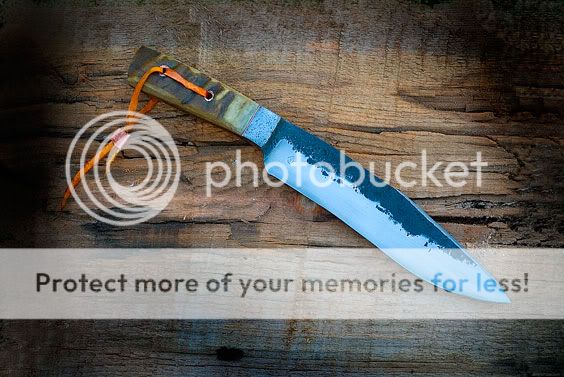
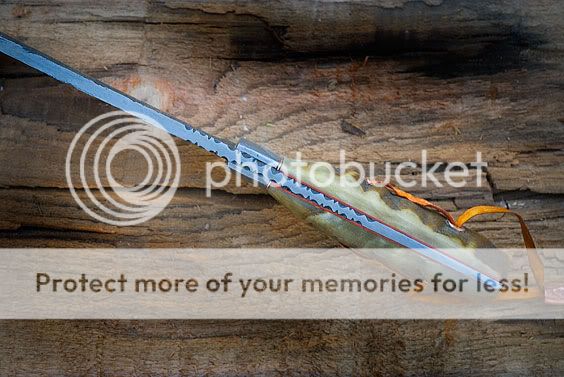
bighornchopper_web.jpg


bighorn_filework.jpg


So have other folks experienced no pattern whatsoever when doing this?
 
Gorgeous , what are the red line where horn meets the metal, I usually get glue line there
 
thanks guys.

That red line is just spacer material you can get from any knife making supply. It can be useful for hiding bad glue lines too.
 
Aldo's 1084 is a deep hardening steel, when properly heat treated you will get no hamon at all.If you want a hamon use 1095 or W2 which are shallow hardening steels
-Page
 
I understand that completely. Although not everyone would agree that 1084 is true deep hardening steel. Borderline shallow it has been called as well. But really? no hardening line at all? when you say properly...do you just mean evenly up to temperature across the whole blade?

I've seen lots of 1084 knives shown with 'hamons' or hardening lines, etc. This is one of mine and I tested the bejesus out of it...

blackwood.jpg
 
Most 1084 is sort of a medium hardening steel....Aldo's 1084FG has grain refiners and extra alloy ingredients to make it forge better and harden deeper. It produces little or no hamon if fully heat soaked and quenched in fast oil. It will get good and hard, though.
 
Here are a few possibilities. If you clay back these the veturi concentration was bringing the edge up before the material under the clay came up to temp. Thus you got a quench line rather than a hamon. When you went to the blown forge the even soak brought all the blade up to temp and thus a full quench.The type K might be a much faster oil than canola. The faster quench transformed all of the blade rather than the desired edge portion. Did you make this from a new bar of steel or was it one that you have used for previous blades you were able to get a good "Hamon " on? If it was a new bar it may have been mixed up with another type of steel. Have you done any testing on this blade?? There are sooo many variables in getting a good and true hamon that one minor change will prove disastrous. Either a partial or no hamon at all.
 
thanks folks... yes... I was wondering if the full soak was the issue. This was from a new bar of steel. I've also tried to be careful not calling my 1084 patterns 'hamons' because of that distinction. But often it's just easier.

Yes... I tested this blade. I heat the house with oak and went out today and really hacked. Before that I hacked on the old brass rod and tested for edge geometry, etc. That blackwood blade was done in my venturi and I always quench only when the edge comes up to temp. I haven't figured out how to do that with the blown forge yet.
 
Aldo's 1084 is a deep hardening steel. It has Manganese and vanadium to sweeten it. By properly I do indeed mean bringing it all up to austentizing temperatures and using a real quench oil

-Page
 
Moss,

I see a shadow along the edge of your picture. Is that really there or is it a photo anomaly. If it is there it might be a very shallow hard area. Have you checked the hardness of the back? If it is hard then the shadow is probably just that a shadow. If it is soft you may have not brought the blade up to full temp. Just a possibility.
 
I think the Manganese content of Aldo's 1084 is a little high to try and get a decent looking "hamon" IF you manage to get the most from your heat treat process.

I can get a fairly decent hamon with 1084 by slightly lowering the austenizing temps and not soaking at temps quite as long, but I somehow feel that I have cheated myself by not getting all that is available with 1084 steel.

My "Old Man" advice would be to get the most from your steel by using proper heat treat methods. There is a fine line between "looking pretty" and "performing great". If you want a pretty hamon, use steels that favor the development of the "elusive" hamon.

Robert
 
thanks for all of this fellas. I'm still relatively new at this... so if I was getting my hamon, or quenching pattern, or however you want to call it... with Aldo's steel with my previous process which was using my venturi forge, getting the edge (to the middle of the blade) up to temperature and quenching in Canola... why would I not be getting the most out of the steel? I'm not trying to argue... I just want to understand. Are you saying that if the whole blade doesn't soak at the proper temperature, the edge isn't going to get as hard (or perform as well) as it possibly can?
 
oh... and Chuck... I haven't really checked the hardness of the back, but I did notice that the swedge was pretty hard when I was working on it.

I believe that shadow is an anomaly.
 
Hamon or no hamon... I like it! Nice looking knife Scott! One of these days I'll get around to experimenting with the 10XX steels and Hamons. It sounds like it can be almost as troublesome and addicting as making "Damascus". :)

Rick
 
Thanks guys....

Well, I did just pick up some W2 from Aldo, so I will probably start using that rather than my 1084 since it now looks troublesome with my new forge and oil. And I won't have to wonder what to call the dang line.

My next challenge is to start getting a hamon on my wrought iron/15n20 san mai. :D
 
Hamons are more addictive than damascus. They are also much more elusive. Even a minor deviation will mess them up. Some can slather clay on a blade and get a cool hamon almost every time. I normally have to redo at Least 50% of my attempts. Just get the good material and it will be much easier. I think you might get frustrated with the 15n20. Good luck anyways.
 
By the way........ I forgot to tell you......... That is one more fine looking knife.:thumbup: I hope I can do half as well when I grow up.

Robert
 
Back
Top