
-
The BladeForums.com 2024 Traditional Knife is available! Price is $250 ea (shipped within CONUS).
Order here: https://www.bladeforums.com/help/2024-traditional/
You are using an out of date browser. It may not display this or other websites correctly.
You should upgrade or use an alternative browser.
You should upgrade or use an alternative browser.
Norfolk history?
- Thread starter jackknife
- Start date
The Norfolk pattern was Joseph Rodgers signature pattern back in the mid to late 1800's. They would stamp "NORFOLK KNIFE" into the wharncliffe master blades -- named no doubt for their primary factory and showroom at No 6 Norfolk Street, Sheffield (stamped into most of their knives). Their enormous and never since equaled 1851 Crystal Palace Exhibition Knife was called the Norfolk Knife -- and yes, it was of this same pattern, just ginormous with many incredibly ornamented blades with unbelievably *massive* magnificent carved pearl scales.
They had a wide range of Norfolk Knives patterns -- a number of 2, 3, and 4 bladed variations and even some large multiblade sportsman patterns. They *always* had rounded bolsters, a wharncliffe main blade, and a slightly larger bolster at the main blade end. They will also almost always have fully sunk joints with nail ease notches -- they were always very high quality knives.
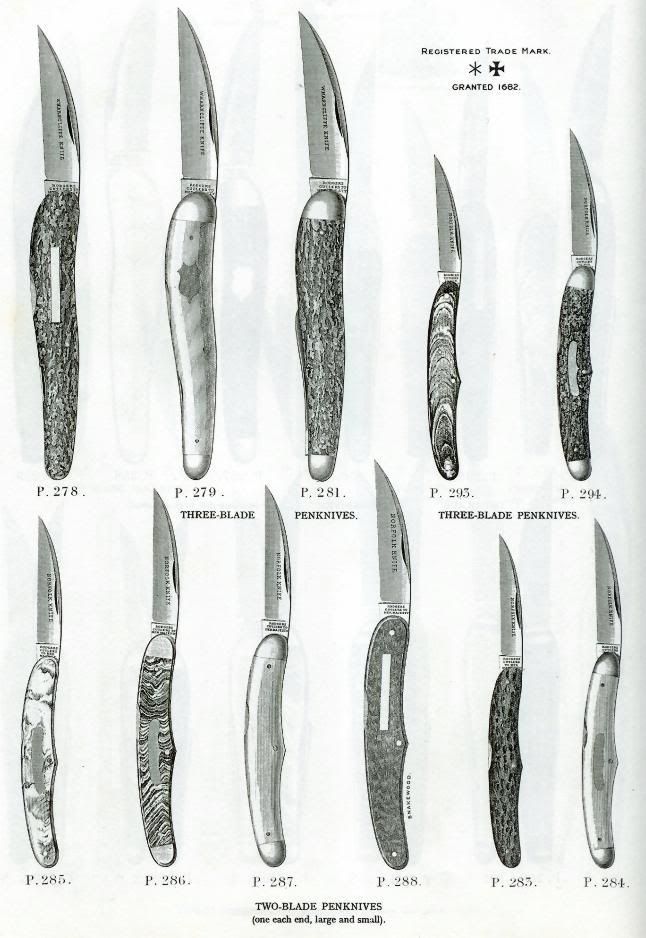
Note the ones with Norfolk Knife stamped on their blades. These days, getting one of the original Rodgers Norfolk pattern knives has become nearly impossible.
Check out Mick's awesome Joseph Rodgers Norfolk whittler in ivory:
http://www.bladeforums.com/forums/showpost.php?p=7587467&postcount=141
http://www.bladeforums.com/forums/showpost.php?p=7587866&postcount=144
-- Dwight
They had a wide range of Norfolk Knives patterns -- a number of 2, 3, and 4 bladed variations and even some large multiblade sportsman patterns. They *always* had rounded bolsters, a wharncliffe main blade, and a slightly larger bolster at the main blade end. They will also almost always have fully sunk joints with nail ease notches -- they were always very high quality knives.
Note the ones with Norfolk Knife stamped on their blades. These days, getting one of the original Rodgers Norfolk pattern knives has become nearly impossible.
Check out Mick's awesome Joseph Rodgers Norfolk whittler in ivory:
http://www.bladeforums.com/forums/showpost.php?p=7587467&postcount=141
http://www.bladeforums.com/forums/showpost.php?p=7587866&postcount=144
-- Dwight
Last edited:

Will Power
Gold Member
- Joined
- Jan 18, 2007
- Messages
- 33,568
Thanks zerogee for the information and a nice old catalogue picture. Does anybody have a picture of this Great Exhibition knife from 1851? Is it still in existence?Or was it broken up like the original Crystal Palace...
- Joined
- Dec 7, 2007
- Messages
- 350
I've been lucky enough to see the Norfolk knife a few times, it's on permanent display at the Cutlers Hall in Sheffield, the thing is indeed awesome  , no question the finest knife ever made.
If no one can find a pic I will find and post one tomorrow.
Mick
, no question the finest knife ever made.If no one can find a pic I will find and post one tomorrow.
Mick

black mamba
Gold Member
- Joined
- Oct 21, 2009
- Messages
- 23,559
Found this website on the Norfolk Knife. There is a picture of it on display. It says it has over 70 blades!
http://www.cutlers-hallamshire.org.uk/html/heritage/collections/cutlery/
http://www.cutlers-hallamshire.org.uk/html/heritage/collections/cutlery/

- Joined
- Jun 6, 2009
- Messages
- 2,966
Found this website on the Norfolk Knife. There is a picture of it on display. It says it has over 70 blades!
http://www.cutlers-hallamshire.org.uk/html/heritage/collections/cutlery/
I would love to see a larger picture of that if Mick or anyone else has one.


- Joined
- Jan 17, 2004
- Messages
- 1,189
Wow, this would be a nice weekend project for Kerry. hehe. I would love to have one.
God Bless
God Bless

Huh, ok, learned something -- according to http://www.cutlers-hallamshire.org.uk/html/heritage/collections/cutlery/ the Norfolk Knife was named in honor of the Duke of Norfolk, Lord of the Manor of Hallam -- this probably shouldn't be taken as kissing up to any particular Duke of Norfolk, as there are a number of centuries of history involved with Sheffield and the surrounding areas and the various Dukes of Norfolk and is no doubt why Norfolk Street was named Norfolk Street to begin with.
Mick, I would love to see some good pictures of the Norfolk Knife - especially ones that show the relief carving of the pearl handles and the etching of the blades.
Mick, I would love to see some good pictures of the Norfolk Knife - especially ones that show the relief carving of the pearl handles and the etching of the blades.
The Norfolk pattern ..........
They had a wide range of Norfolk Knives patterns -- a number of 2, 3, and 4 bladed variations and even some large multiblade sportsman patterns. They *always* had rounded bolsters, a wharncliffe main blade, and a slightly larger bolster at the main blade end. They will also almost always have fully sunk joints with nail ease notches -- they were always very high quality knives.
...........
-- Dwight
Dwight,
What is the difference between the 278, 279, 281 Norfolks and A S&M Dogleg Whittler.
They look the same
- Joined
- Dec 7, 2007
- Messages
- 350
What is the difference between the 278, 279, 281 Norfolks and A S&M Dogleg Whittler.
They look the same
The three, 278, 279 & 281 are not Norfolk knives, the Norfolk pattern always has a double hollowed back.
The "Norfolk Knife" is displayed in it's own special period mahogany glass case and stands on a fancy cast base, the knife measures about 34" opened out, it's huge !. The whole knife is of astonishing quality, the Levesly carved pearl scales have a boer hunting scene one side, a stag hunting scene on the other, the bolsters show mythical Greek face masks, they are made of chased bronze and have been gilded in 22 crt gold, every blade and article is different, the springs have superb detail, everythings expertly worked, inside and out, shiny, the blade etches are extraordinary, York Castle, Windsor Castle, Chatsworth House, Taj Mahal, Washington's White House, and so on, the knife has to be seen to be believed.
To see the knife, and other interesting things, you have to go on a tour of the Cutlers Hall, these take place about once or twice a month. The taking of photographs is forbidden, unfortunately.
Mick
Dwight,
What is the difference between the 278, 279, 281 Norfolks and A S&M Dogleg Whittler.
They look the same
Those are Wharncliffe knives - they just happen to be on the same catalog page as some of the Norfolks. If you expand the image you'll see that they're stamped WHARNCLIFFE KNIFE -- although we call them whittlers now, note that they're called "three-blade penknives" here - the "whittler" construction was simply how they made the typical 3 blade knife back then. Much like the Norfolk patterns, Rodgers made Wharncliffes in all sorts of variations too - they had 2, 3, 4, and 5 blade versions plus large multiblade sportsman models.
Last edited:
Will Power
Gold Member
- Joined
- Jan 18, 2007
- Messages
- 33,568
Thank you Mick for all that background.
Imagine oiling the joints on that lot

I wonder if the museum has its own detailed photographs available? It's a masterpiece, behemoth too:thumbup:
Imagine oiling the joints on that lot
I wonder if the museum has its own detailed photographs available? It's a masterpiece, behemoth too:thumbup:

- Joined
- Nov 11, 2006
- Messages
- 2,697
Here is a link to a photo of the Norfolk Knife in its case.
http://farm1.static.flickr.com/10/15246556_ae75365164.jpg?v=0
http://farm1.static.flickr.com/10/15246556_ae75365164.jpg?v=0
I knew I had some at least decent pictures of some of the Norfolk Knife -- in "The Sheffield Knife Book" by Geoffrey Tweedale on pages 96-98 it gives some better images, especially of one of the scales and bolsters, still not like I'd like to see though. Unfortunately I cannot scan them right now. One thing that's mentioned is that the highly detailed acid etched images on the blades will shift from black on white to white on black as you move around the knife to different angles.