

daizee
Knifemaker / Craftsman / Service Provider
- Joined
- Dec 30, 2009
- Messages
- 11,173
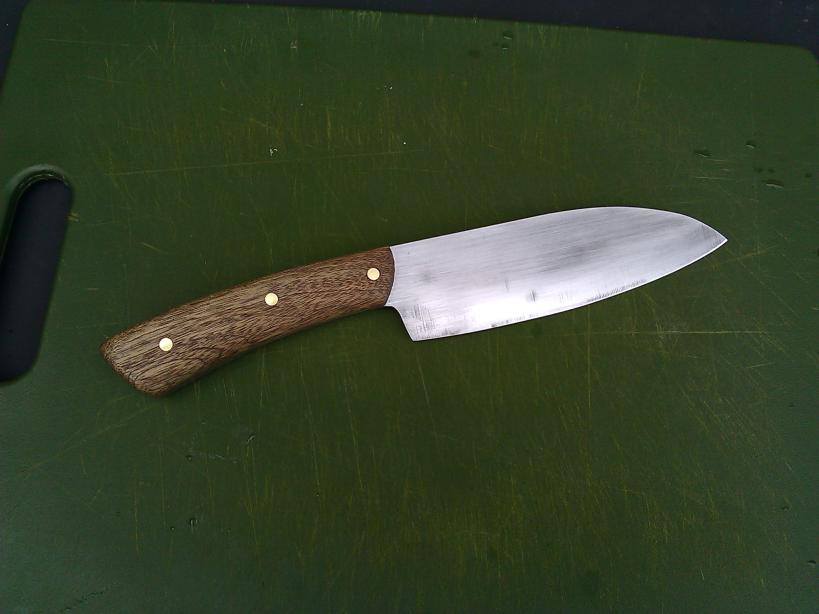
This kitchen knife was an experiment, approached as such, that taught me some really useful stuff. I'd like to share for the benefit of other novices.
Specs:
1/16" 1095
OAL 10"
blade: 5.5"
handle: unknown wood (see other thread, maybe someone will know)
3/16" brass pins
tru-oil and Flitz gun wax finish
I knew 1/16" was thin, but the material was cheap and doing a big knife starting thin instead of grinding tons of expensive material away seemed like a good idea. I approached it all without a great deal of emotional investment or plans to make something utterly beautiful. The idea was to play around and learn something. I did:
Lessons
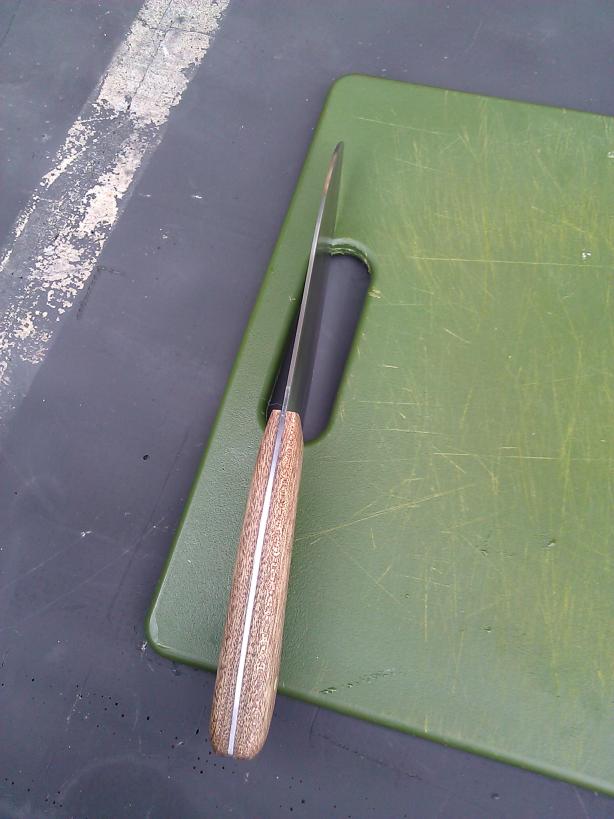
#1: My skills do not yet extend to symmetrically grinding 1/16". The angles are just too shallow.
#2: chisel grinding 1/16" is perfectly reasonable
#3: hollow grinding 1/16" is particularly stupid (for me)
#4: long, wide blades are harder to keep flat against the belt, causing all kinds of horrible divoting. Then there's not much metal left to sand things flat when you're done. Match grinds to thickness to skill.
#5: for long thin material like this with an obvious weak point, through-harden to produce stiffness at the neck. This knife was pushing the limits of the 2-brick forge.
#6: the angle btw the edge and handle is critical to getting the entire blade onto the block for a kitchen knife. I knew this going in, and it was borne out in practice. As is it works pretty well, especially if you work towards the edge of the counter. But it's right on the boundary of being not quite right. Allocate more angle or blade height in the future.
Happy Lessons:
#1: this unknown wood makes a decent handle
#2: use 3/32 next time and don't be afraid to go for it. It's totally achievable
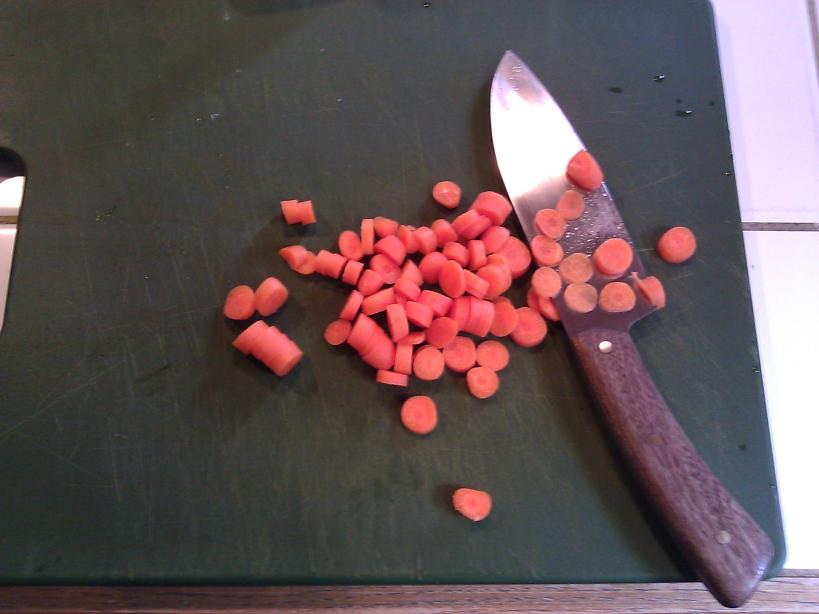
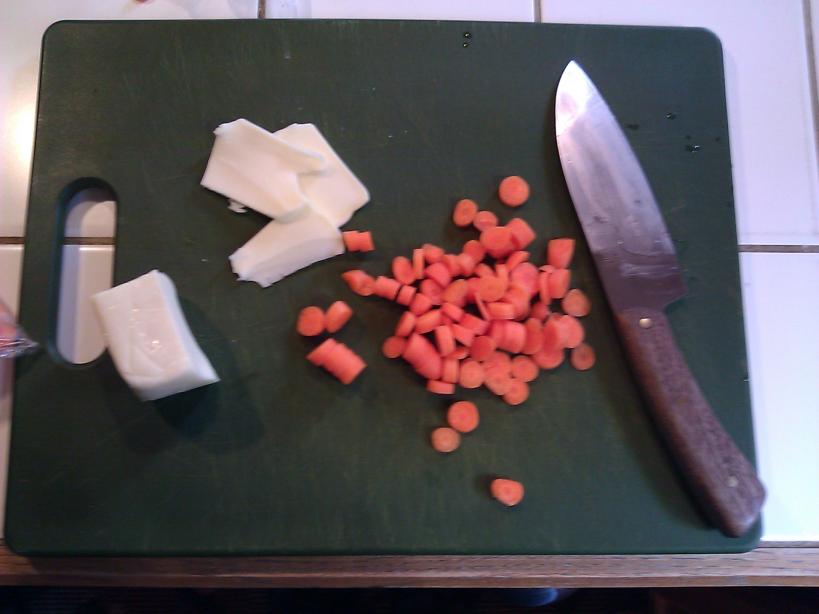
#3: even an ugly-ground barely finished homemade kitchen knife can out-finish, out-handle, and out-perform my old decommissioned crappy Chicago Cutlery! Woo! This one is going in the block with the Henckels. Get that useless Chicago chef's knife outta here!
Specs:
1/16" 1095
OAL 10"
blade: 5.5"
handle: unknown wood (see other thread, maybe someone will know)
3/16" brass pins
tru-oil and Flitz gun wax finish
I knew 1/16" was thin, but the material was cheap and doing a big knife starting thin instead of grinding tons of expensive material away seemed like a good idea. I approached it all without a great deal of emotional investment or plans to make something utterly beautiful. The idea was to play around and learn something. I did:
Lessons
#1: My skills do not yet extend to symmetrically grinding 1/16". The angles are just too shallow.
#2: chisel grinding 1/16" is perfectly reasonable
#3: hollow grinding 1/16" is particularly stupid (for me)
#4: long, wide blades are harder to keep flat against the belt, causing all kinds of horrible divoting. Then there's not much metal left to sand things flat when you're done. Match grinds to thickness to skill.
#5: for long thin material like this with an obvious weak point, through-harden to produce stiffness at the neck. This knife was pushing the limits of the 2-brick forge.
#6: the angle btw the edge and handle is critical to getting the entire blade onto the block for a kitchen knife. I knew this going in, and it was borne out in practice. As is it works pretty well, especially if you work towards the edge of the counter. But it's right on the boundary of being not quite right. Allocate more angle or blade height in the future.
Happy Lessons:
#1: this unknown wood makes a decent handle
#2: use 3/32 next time and don't be afraid to go for it. It's totally achievable
#3: even an ugly-ground barely finished homemade kitchen knife can out-finish, out-handle, and out-perform my old decommissioned crappy Chicago Cutlery! Woo! This one is going in the block with the Henckels. Get that useless Chicago chef's knife outta here!


