
Oh no another patina thread!

Joined
Oct 9, 1998
Messages
490
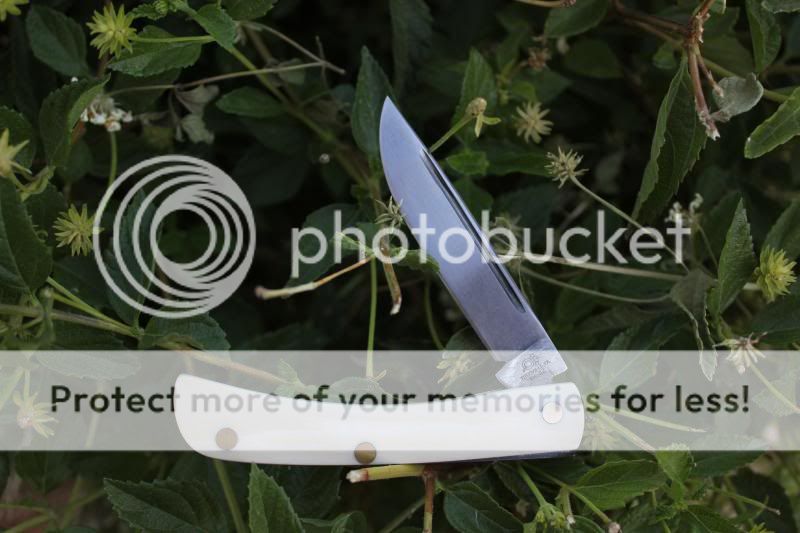
I've been using my Queen D2 Country cousin for a few months now, and food prep has really created an interesting patina on the blade. As you can see from the glamour shot I took yesterday there is a definite line of transition about 2/5's up the blade where the patina gets dark- it looks the same on the other side of the blade as well.

Any ideas as to why this occurs? Is this an effect of tang annealing on the steel structure?
 
That's kind of interesting. I've read that the heat-treat of a particular steel can, to some small degree, change or affect the steel's sensitivity to corrosion or oxidation. If so, it seems 'logical' to my otherwise uninformed mind (;)) that annealing the tang might also have an effect. But that's just 100% pure speculation on my part.

That's a good-looking CC there. I haven't seen it in that handle color, nor with the long pull on the blade. :thumbup:


David
 
I don't know the answer to the patina, but it certainly looks like differential tempering.
Please tell me - when was that knife made, and what is the handle material.
I like that looooong pull!!
 
hmmm that is weird. can't imagine the tang anneal would go that high on purpose.

I'd noticed in the 'How It's Made' episode featuring Case's manufacturing, the annealing process they use extends considerably far above the tang on their knives too. On a small blade like the sod buster, it becomes much more obvious and covers a larger portion of the blade. The machine they use anneals a fixed span of every blade, held magnetically on a large wheel and then rotated into/underneath the heat source.

A trio of screen-captures from the video (
):


David
 
Last edited:
Please tell me - when was that knife made, and what is the handle material.
I like that looooong pull!!

Looks like a mod job. Unless my eyes are deceiving me, those are ivory covers on that knife.

- Christian
 
thanks for that. Somehow never managed to watch that video. I aee that only the tang was cherry red and i wonder where the scale comes from since it didn't appear to be an oxidizing environment. maybe some kind of quench?


also saw the blade blanks are black again before grinding.
 
Last edited:
thanks for that. Somehow never managed to watch that video. I aee that only the tang was cherry red and i wonder where the scale comes from since it didn't appear to be an oxidizing environment. maybe some kind of quench?

So far as I assume (based on what I see in the video), the annealing is done in an open-air factory setting, which I assume would be the oxidizing environment.


David
 
Sorry for the confusion fellas, it is indeed a mod- original thread here.

David, I think your screenshot makes this likely to be due to the annealing, thank you for the effort.

Thanks for the kind words on the long pull Charlie, I added it a few weeks ago- it was a bit hairy to do with a shaky micro mill, dremel cut off wheel and then a round sanding stone. If you look at the pic closely you can see a black line in the pull near the tip- the remants of the original nail nick. I didn't think I could bottom out the long pull without punching through the backside of the blade.
 
So far as I assume (based on what I see in the video), the annealing is done in an open-air factory setting, which I assume would be the oxidizing environment.


David
I've seen that step at the Case factory. It occurs in a vary large area, so access to air is no problem.
 
Sorry for the confusion fellas, it is indeed a mod- original thread here.

David, I think your screenshot makes this likely to be due to the annealing, thank you for the effort.

Thanks for the kind words on the long pull Charlie, I added it a few weeks ago- it was a bit hairy to do with a shaky micro mill, dremel cut off wheel and then a round sanding stone. If you look at the pic closely you can see a black line in the pull near the tip- the remants of the original nail nick. I didn't think I could bottom out the long pull without punching through the backside of the blade.

Very cool, Greg. Nice work! :thumbup:


David
 
Yeah I guess I should have said other than air. looking again the scale isn't really, just discoloration. you would think that would draw the temper, but maybe its before heat treat?
 
Yeah I guess I should have said other than air. looking again the scale isn't really, just discoloration. you would think that would draw the temper, but maybe its before heat treat?

That's essentially what annealing is. After heat-treat & quench, the blade is re-heated to a somewhat lower temperature. I think this is often done to de-stress the steel, which otherwise might be prone to cracking after the quench. Manufacturers do it to soften the tang for stamping the mark on it, OR for making the blade receptive to crinking/bending for final fitting (I think this is why Case does it). This is why it's best to avoid testing RC hardness on or near the tangs of blades, because they'll often be unrealistically softer than the rest of the blade.

(I'm not an expert, but this is hopefully what I've learned in reading about these things. To any real bladesmiths who might read this, my apologies if it's in error. And please don't be shy about correcting me if I'm not explaining it accurately. :) )


David
 
Last edited:
My queen canoe has a similar patina on the main blade. The serpentine jack also seems to be darker near the tang. Both D2..
 
I am aware that annealing is the removal of any effects of heat treatment or other hardening processes (which could include cold work when the sheet is rolled and forge work when the blank is stamped). It would make most sense to anneal the tang after all heat treat, but there are other possibilities I suppose. annealing may require cherry red, which seemed pretty clearly limited to the tang in the video. otherwise it seems case is endangering the temper of a useful part of the edge. surely not.


I was interested to see that the video said that the nicks and stamp were made during the blade stamping operation. I think you want a soft tang to keep it from eating the pin and for strength at a highly stressed area, or perhaps i should say toughness.
 
Last edited:
I've seen that step at the Case factory. It occurs in a vary large area, so access to air is no problem.

Umm... I think that isn't what he meant, Charlie. Access to air is usually not desirable for hot steel. It can cause corrosion issues. Heat treaters typically wrap blades in stainless steel foil, dip them in special gunk, or use an inert atmosphere in the furnace in order to protect them from air at elevated temperature. At what temperature the issues actually start I do not know.

As far as that interesting picture goes:
I had an interesting email conversation with Marcie Tully of WR Case about the softening process. She wrote that
  • the post tempering hardness of a CV blade is 58 to 61
  • the tang of an un-crinked blade is softened to ~ 46-51
  • the tang of a crinked blade is softened to 34 to 41.

If the heating and softening truly extends as far up the blade as that staining pattern, that would explain a lot as far as the hardness Case says CV has after tempering vs the performance of Case CV when compared to that of GEC 1095. This is something which has puzzled me, since GEC says they run their blades at ~58. GEC 1095 holds an edge noticeably better than Case CV.
 
Umm... I think that isn't what he meant, Charlie. Access to air is usually not desirable for hot steel. It can cause corrosion issues. Heat treaters typically wrap blades in stainless steel foil, dip them in special gunk, or use an inert atmosphere in the furnace in order to protect them from air at elevated temperature. At what temperature the issues actually start I do not know.

As far as that interesting picture goes:
I had an interesting email conversation with Marcie Tully of WR Case about the softening process. She wrote that
  • the post tempering hardness of a CV blade is 58 to 61
  • the tang of an un-crinked blade is softened to ~ 46-51
  • the tang of a crinked blade is softened to 34 to 41.

If the heating and softening truly extends as far up the blade as that staining pattern, that would explain a lot as far as the hardness Case says CV has after tempering vs the performance of Case CV when compared to that of GEC 1095. This is something which has puzzled me, since GEC says they run their blades at ~58. GEC 1095 holds an edge noticeably better than Case CV.


And I have had the feeling that several of my Caae knives get sharper in the belly nearer the tip than at the base. I was attributing it to an oddity in my sharpening stroke. Hmmmmmm.
 
Back
Top