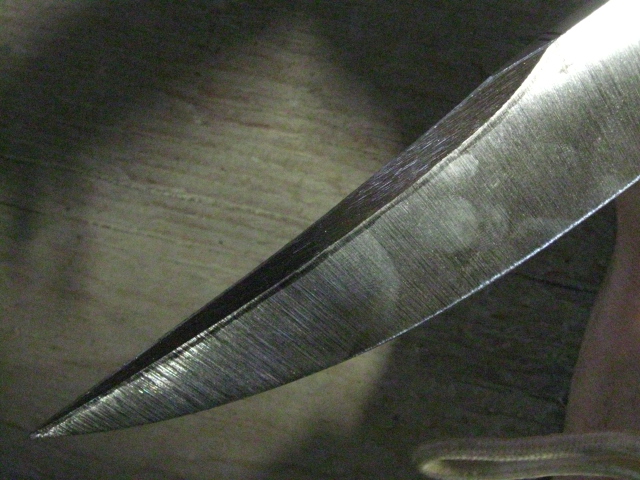
ok help me figure out clip grinds

Joined
Mar 3, 2011
Messages
1,010
Ive seen several knives and cant figure these grinds out. How do they grind the clips and make then transition into the spine smoothly.

Examples

m_mamba_0002.jpg


2rmbc77.jpg


In my mind it seems like some sharp angles to keep them shallow because it looks like they are maybe 1/4" from the spine but still cant picture exactly what it would take to do these grinds. Guess Ill pic up some mild steel I have for practice grinds and see if I can figure them out but any advice would be helpful.
Thanks in advance.
 
ok - I am editing to add that I think I may have answered the wrong question the first time. So, below I give a lot of info about getting a crisp junction of the false edge with the main bevel. The trick to getting the clip to transition with the spine is either raise the clip or pick an angle to grind or file it that lets you just run right off of the edge of the blade as you grind or file from point toward ricasso.

other answer below - hope this helps someone (oops).


my advice, or what works for me with both knives and swords when I do this (and I do back edges a lot on swords because they are pretty standard on my favorite type - the dao).
Lay out the line with dykem. Center line just like for the other edge and also where you want the clip to stop. Remove most of the metal with either a platen or griding vertically against a contact wheel. Keep the angle as constant as possible. Especially as you get closer to the lines. Once you have reached the edge line and most of the way to the stop line on the side of the blade, switch to either a sen style scraper or a mill bastard file. Drawfile, with the file held at a constant angle so that the whole bevel is flat. You can, if you need to, get a bevel that goes from "line to line" first with file and then just keep drawfiling at a constant angle until the whole thing is flat. This will make for a seriously crisp transition line with the other bevel.

then switch to smooth cut file, then stones up through 400 grit, then paper backed by something hard. It will keep the lines from washing out. Even if you have a convex bevel on the clip, filing the area just at the transition line and then stoning prior to final sanding will really sharpen the lines. That is one way to save lines that have gotten blurred, too.
kc
 
Last edited:
Here's a clip or two of this style that I've ground.

IMG_6093.JPG


IMG_5818.JPG


IMG_5936.JPG

They were achieved much as Kevin describes- ground in vertically before heat treat on an 8" contact wheel. I marked out where I wanted the line to be on the already flat ground blade, then ground to the line, sighting down the vertically held blade and keeping the angle even on both sides. Strong light at the grinder helps big time.

They were roughed in at 50 grit, finished at 220 grit on the wheel. Then, hand sanded with a narrow micarta block with a lightly convex face.

It's not too hard, try it and it will make sense. Just a little practice and you'll have it.
 
I don't know why i didn't even think of vertical grinding. I'm off work tomorrow might give it some practice tries and see. Thanks guys!
 
Harvey Dean's flatgrinding DVD shows grinding that bevel vertically as well, if you want a visual aide.
 
Back
Top