- Joined
- Mar 21, 2005
- Messages
- 3,355
It's been way too long since I checked in here but while I've got a little time I wanted to share this one with you guys. I've had it on loan from a relative for cleaning and researching its age.


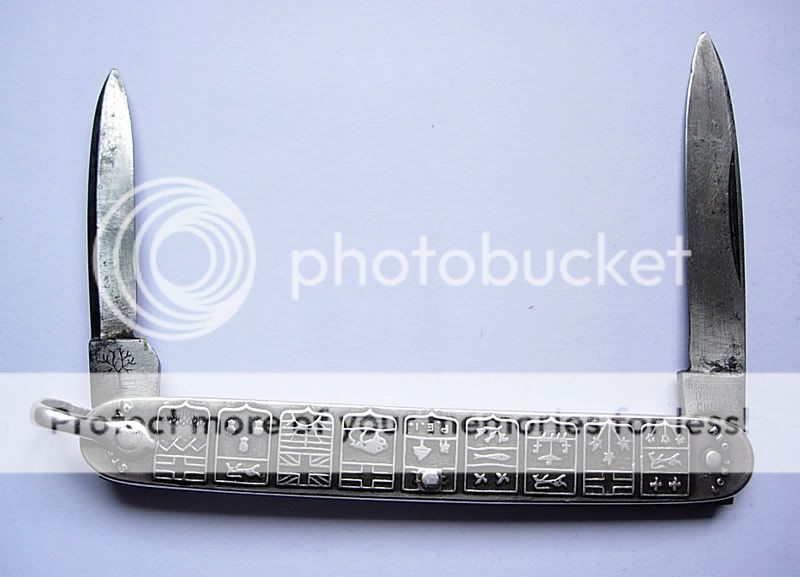
It's just about 3 3/8" closed. Four blades - a main that I presume was originally a spear point, two pens and a file with small portion of blade at the tip.


All of the blades are marked with H. Boker & Co's Improved Cutlery on one side and the tree logo on the other side. The main blade has Germany stamped under the tree.


The pearl is worn a bit at some of the edges but there are no significant cracks.


Nice detail on one of the springs inside where it was cut to make room for the main blade. Not of necessity anymore because of how much it's been sharpened down.

The feature of greatest interest to me is the center bolster. I'm curious if it was more common on a knife of this length compared to something smaller. Perhaps it was easier and more durable to mount two shorter pieces of pearl per side than one longer one?

There's some nice color to the pearl as well.


The reference material I've looked at indicates 1891 as a "no earlier than" date based on the Germany mark. There was a stretch of time where Boker was simultaneously using the H. Boker & Co's Improved Cutlery mark on knives made in Germany and the USA. So is the Germany mark a clear sign this knife was German-made? The tree marks have some variations among them but, generally, they look like the 1907 example. A person could go crazy trying to inspect and interpret all of branches and their orientations from one stamp to the next.
I guess that covers it for now. Any comments or opinions are appreciated.
It's just about 3 3/8" closed. Four blades - a main that I presume was originally a spear point, two pens and a file with small portion of blade at the tip.
All of the blades are marked with H. Boker & Co's Improved Cutlery on one side and the tree logo on the other side. The main blade has Germany stamped under the tree.
The pearl is worn a bit at some of the edges but there are no significant cracks.
Nice detail on one of the springs inside where it was cut to make room for the main blade. Not of necessity anymore because of how much it's been sharpened down.
The feature of greatest interest to me is the center bolster. I'm curious if it was more common on a knife of this length compared to something smaller. Perhaps it was easier and more durable to mount two shorter pieces of pearl per side than one longer one?
There's some nice color to the pearl as well.
The reference material I've looked at indicates 1891 as a "no earlier than" date based on the Germany mark. There was a stretch of time where Boker was simultaneously using the H. Boker & Co's Improved Cutlery mark on knives made in Germany and the USA. So is the Germany mark a clear sign this knife was German-made? The tree marks have some variations among them but, generally, they look like the 1907 example. A person could go crazy trying to inspect and interpret all of branches and their orientations from one stamp to the next.
I guess that covers it for now. Any comments or opinions are appreciated.


 The catalog is from an old Montreal hardware giant and dates from 1901 to about 1907 with added updates like seen in a couple of these pics. One of these days I'll get all the pages scanned, there are over 100 pages of knives in the catalog which is well over 1000 pages. Enjoy.