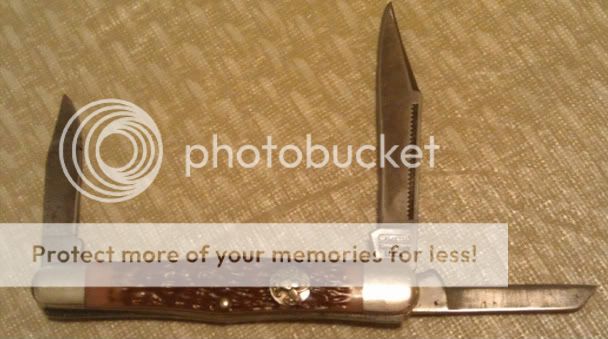
For most of the past year, I've been touching up my pocket knives and kitchen knives on my old Boy scout stone. I found it last year up in the attic in a box of stuff from very long ago. It's one of those gray carborundum pocket stones in a well worn leather case made for carry in the pocket. About an inch and a half wide, about three inches long. I don't know what grit it is, but I am curious. I think it was a bit of nostalgia that got me to use it, but over the past several months I've come to some conclusions.
For many years now, I've used the Eze-Lap diamond hones, like the model L in the 600 grit red plastic handle. But now my knives seem to remain sharper, and cut better when I use the old scout hone. I have no idea what grit the stone is, but it is a course one. I remember when I was a boy scout, that's all we had to sharpen out scout knives and hatchets, but it worked back then. This was way long before there were diamond hones, ceramic stones, and gizmos like sharpmakers, edge makers, or what ever. Yet our hatchets and knives were sharp enough to satisfy our scoutmaster, an old hard corps U.S. Marine named Mr. Van. He was not easy to satisfy.
Now it looks like I've come around in a full circle again. I'm wondering if I will ever go back to a modern sharpener or just stay with my old boy scout carborundum stone. It works better than most things at keeping my knives sharp, and it's field portable. I like to know if I don't make it home, I can resharpen anywhere in a few minutes.
And I like the course toothy edge the stone puts on my knife. I think like a lot of knife nuts, I got carried away for too long on shaving sharp edges that whittled hair. The problem is out in the real world, I'm not whittling hair or push cutting tissue paper. I'm cutting jute or manila twine, breaking down cardboard boxes after shopping trips to Sam's Club, opening plastic bags of mulch or bird seed or dog food, or the once in a while UPS box. Real world stuff. I had forgotten how sharp and grabby an edge you could get a knife with those old stones.
Carl.
For many years now, I've used the Eze-Lap diamond hones, like the model L in the 600 grit red plastic handle. But now my knives seem to remain sharper, and cut better when I use the old scout hone. I have no idea what grit the stone is, but it is a course one. I remember when I was a boy scout, that's all we had to sharpen out scout knives and hatchets, but it worked back then. This was way long before there were diamond hones, ceramic stones, and gizmos like sharpmakers, edge makers, or what ever. Yet our hatchets and knives were sharp enough to satisfy our scoutmaster, an old hard corps U.S. Marine named Mr. Van. He was not easy to satisfy.
Now it looks like I've come around in a full circle again. I'm wondering if I will ever go back to a modern sharpener or just stay with my old boy scout carborundum stone. It works better than most things at keeping my knives sharp, and it's field portable. I like to know if I don't make it home, I can resharpen anywhere in a few minutes.
And I like the course toothy edge the stone puts on my knife. I think like a lot of knife nuts, I got carried away for too long on shaving sharp edges that whittled hair. The problem is out in the real world, I'm not whittling hair or push cutting tissue paper. I'm cutting jute or manila twine, breaking down cardboard boxes after shopping trips to Sam's Club, opening plastic bags of mulch or bird seed or dog food, or the once in a while UPS box. Real world stuff. I had forgotten how sharp and grabby an edge you could get a knife with those old stones.
Carl.
Last edited:


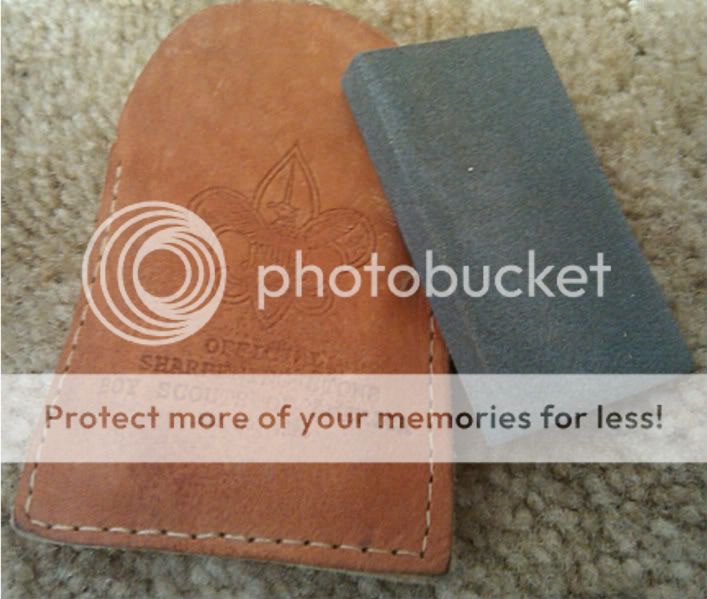
 I pulled the stone back out and turned the case over. A little yellow piece of plastic that I had never seen before fell out. Turns out it was an angle guide that I hadn't noticed in the 15+ years that I've had it.
 I'm guessing they didn't include those back when you got yours.