Old Frosts Laminated Hunter

Jack Black

Seize the Lambsfoot! Seize the Day!
Platinum Member
Joined
Dec 2, 2005
Messages
71,489
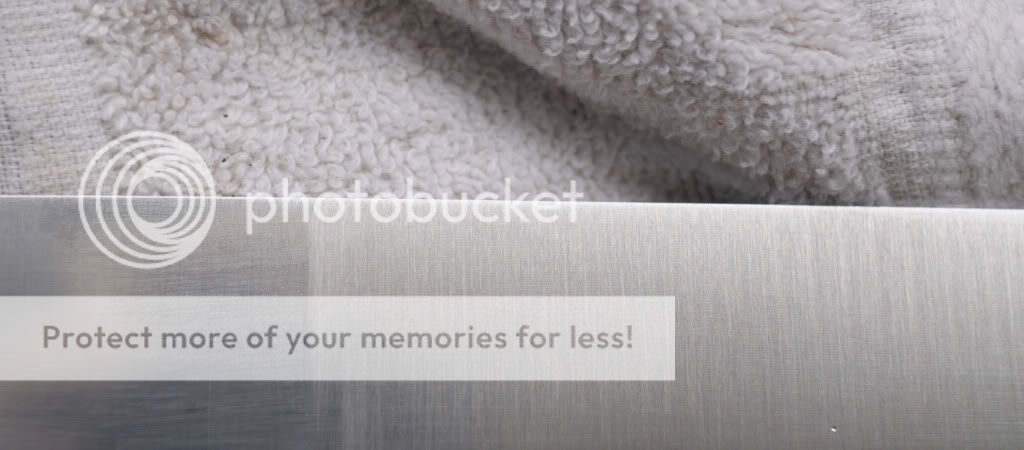
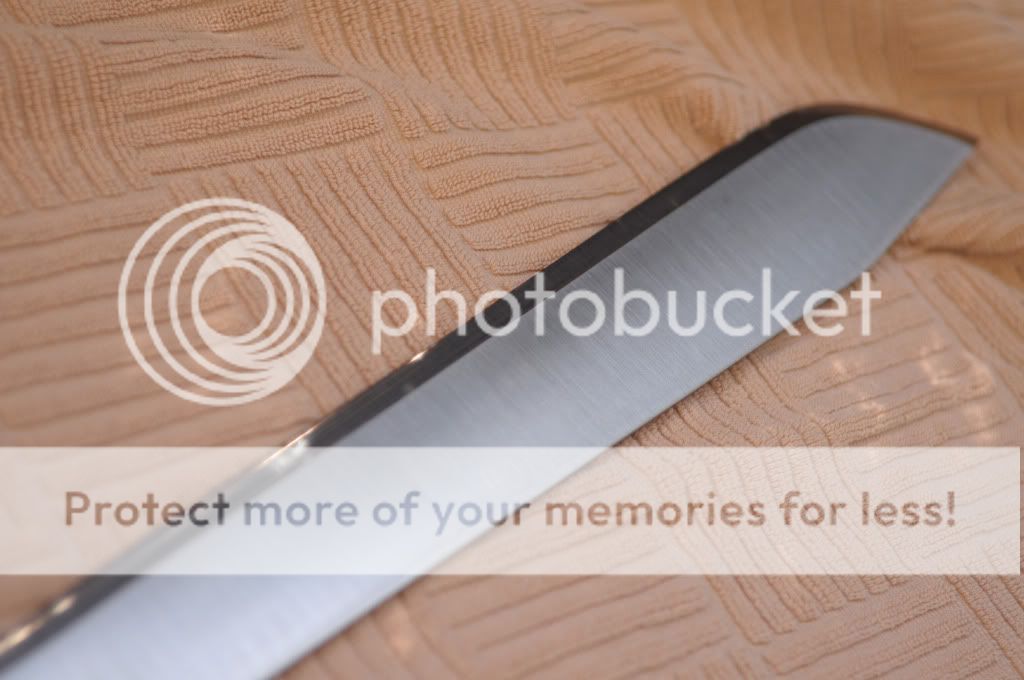
Just in the early stages of trying to clean up this old Frosts hunting-knife. It has a laminated blade, and any tips to save me elbow-grease would be appreciated. So far I’ve mainly just used a green pad, and it’s slow going. I also tried some ‘Super’ polishing paste, but it didn’t seem to have a lot of effect at this early stage.


Come on fellers, I just know you have some tips! ;)


Are you looking to completely remove the black(ish) areas, including the pitting? If so, some heavy sanding is likely needed. I'm assuming some or most of those spots are probably pitted, so to remove the pitting, you'll have to sand/grind down the surrounding steel. If that's the goal, then I'd use a firm block (such as wood) with wet/dry sandpaper (silicon carbide) wrapped around it. Something like 400 grit to start off, which should remove metal pretty quickly. If it's still going slowly, drop down to 220/320 grit, then follow & refine with 400 and up, taking it as high as you prefer, according to desired finish.

Not sure what the 'Super' polishing paste is made of (abrasive-wise), but you might try some Simichrome or Flitz polishing pastes instead. They both use aluminum oxide abrasive, which is much better at cleaning black oxide from steel. If removing the black oxide only is the goal, without otherwise altering or sanding out the pitting, that may be worth a try, first thing. Apply the paste liberally, and scrub with a cloth or maybe even a toothbrush. The pitting will remain, but the black oxide should come off to reveal clean steel underneath. May still not get it all; some of the 'black' areas may be deep pits in the steel (hard for me to tell by the pics).

 
Last edited:
Are you looking to completely remove the black(ish) areas, including the pitting? If so, some heavy sanding is likely needed. I'm assuming some or most of those spots are probably pitted, so to remove the pitting, you'll have to sand/grind down the surrounding steel. If that's the goal, then I'd use a firm block (such as wood) with wet/dry sandpaper (silicon carbide) wrapped around it. Something like 400 grit to start off, which should remove metal pretty quickly. If it's still going slowly, drop down to 220/320 grit, then follow & refine with 400 and up, taking it as high as you prefer, according to desired finish.

Not sure what the 'Super' polishing paste is made of (abrasive-wise), but you might try some Simichrome or Flitz polishing pastes instead. They both use aluminum oxide abrasive, which is much better at cleaning black oxide from steel. If removing the black oxide only is the goal, without otherwise altering or sanding out the pitting, that may be worth a try, first thing. Apply the paste liberally, and scrub with a cloth or maybe even a toothbrush. The pitting will remain, but the black oxide should come off to reveal clean steel underneath. May still not get it all; some of the 'black' areas may be deep pits in the steel (hard for me to tell by the pics).

Many thanks David, that's really helpful. Sorry about the quality of the pictures (I'm starting to realise from this forum that I need to stop spending all my spare cash on knives and buy a better camera)! There isn't too much pitting, mainly just heavy staining. The 'Super' paste contains ammonium hydroxide, I've read good reviews, but it doesn't seem to help much in this case. I'll see if I can get hold of something with aluminium oxide in. Thanks again :)

Jack
 
another vote for Flitz - or Peek, both excellent polishes.
otherwise, if you have an auto parts store handy, you might try some valve lapping compound.
 
another vote for Flitz - or Peek, both excellent polishes.
otherwise, if you have an auto parts store handy, you might try some valve lapping compound.

I'd never thought about valve lapping compound (though it's 35 years since I last used it)! I'll try and get hold of some Flitz. This is the Super paste I got:

3857.jpg


"Super Premium Polishing Paste is a premium quality polishing paste which removes oxidation, tarnish, surface rust, water spots, tars and oils, and leaves a brilliant, protective coating that lasts for months. Perfect for cleaning, polishing and protecting any metal surface – brass, silver, gold, chrome, copper, pewter, nickel, stainless steel, aluminium, magnesium and many other hard, non-porus surfaces such as – porcelain, fiberglass plexiglas, hard plastics and painted surfaces."
 
Actually doesn't look too bad in those additional pics. I don't see any red rust(?) anywhere, and the black oxide won't harm the steel by itself (some would say the 'patina' adds some character to a working knife ;)). Still, if you want to clean it up further, I think the Flitz should help.

That's a nice knife. :thumbup:
 
Mother's polish is oxalic acid in a paste form and is also known as wood bleach... I use it in the restoration of vintage bicycles and it works wonderfully to clean up metals.

It is a fine looking knife and the blades do not get much better than these.
 
Thanks again guys, there was some red rust initially, but I managed to get rid of that fairly quickly. I do think a patina adds character, but in this case it's very inconsistent because of the laminated steel. I'll keep on at it as long as my ageing elbows can manage! I think Frosts stopped making this style of knife in the early 1990's. It reminds me of a Buck knife, and certainly isn't a traditional Swedish style. Perhaps it was an attempt to break into a wider market. It needs a good sharpen, but I'm sure it'll take a good edge. The sheath is a bit marked and scuffed, but should clean up OK. Not really my kind of knife, but worth cleaning up I think. Thanks for your comments and advice, which as always, are greatly appreciated.

Jack
 
Hi Jack, man...i was about to comment - what a shame-as thats a nice knife-but Wow!...you have done a great job, probably some of the better steel you would get so I have heard!
The only thing with using Wet and Dry paper is keeping the lines sharp on the knife-too many guys soften them-...and the knife never looks any-good.
 
Hi Jack, man...i was about to comment - what a shame-as thats a nice knife-but Wow!...you have done a great job, probably some of the better steel you would get so I have heard!
The only thing with using Wet and Dry paper is keeping the lines sharp on the knife-too many guys soften them-...and the knife never looks any-good.

Thanks Duncan, but it's probably more luck than any kind of skill, I've just been rubbing away at it! :) I'm going to stay away from the wet and dry I think, the early photos probably made the knife look worse than it actually was (though it did look bad when I first saw it). It's cleaning up OK, I'll have another go today. Looking forward to sharpening it :)

Hey, did the Dean's book mean anything to you, I heard they were popular in NZ years ago. I posted it with you in mind, but perhaps I was misinformed - or you're too young! :)

Jack
 
Can't go wrong with a bench grinder then a spot of buffing wheel torture....:D:D:eek:

It looks very decent now, well cared for user. You know, sometimes that Elbow Grease gear is the best thing....
 
Can't go wrong with a bench grinder then a spot of buffing wheel torture....:D:D:eek:

It looks very decent now, well cared for user. You know, sometimes that Elbow Grease gear is the best thing....

Thanks :) I'd settle for a grinder and buffing wheel! :D
 
Very nice knife- if you don't use it afield you'll find it useful on the workbench, I'm sure.
Is that blade chrome- plated? Those often give way to localized rusting like you had there.
 
Nice restoration Mr B.

I expect that'll be as good as you get now...BUT you could try camellia oil. I've found it can lift staining/patina quite well...perhaps not in this more 'set in' circumstance though.
 
Hi Jack,

A few years back I was really focused on learned to make fixed blade knives. In my trials I practiced a lot of different finishing techniques. My favorite, and one you could use for this, is cork belts with compounds. I like them better than scotchbrite/similar and better than buffers.

You can mirror polish with them.

You can do various levels of satin finish (here are a couple options on one piece of steel - quick dirty work):

Satin320Cork.jpg


Duncan is correct it is hard and takes skill to work up crisp lines:

MacheteSatin6.jpg


Almost finished:

MacheteMicarta1.jpg


I would give cork belts a try. These photos were from my first trials about 3 years ago and since then I have gotten even more comfortable with them :)
 
Very nice knife- if you don't use it afield you'll find it useful on the workbench, I'm sure.
Is that blade chrome- plated? Those often give way to localized rusting like you had there.

I think it's a laminate 'sandwich' which was originally mirror-polished. On some pf the photos you might just be able to make out the line where the steels meet. The worst corrosion and staining was along the carbon-steel edge and where the leather sheath fit tightest I think. Looking at the sheath it also appears as if it may have been damp at some point.

Nice restoration Mr B.

I expect that'll be as good as you get now...BUT you could try camellia oil. I've found it can lift staining/patina quite well...perhaps not in this more 'set in' circumstance though.

I think you might be right, my elbows have just about had it! Thanks for the tip. I spent on small fortune today on different (UK) metal polishes/pastes, scouring pads, and toothbrushes, and the only thing which proved much good were the scouring pads! :D If I get time later I might have a go at sharpening it. It's completely blunt at the moment. I think the edge may be as hard as 61RC, but I think it's good steel that will hold a good edge. I have a number of other Frosts knives (though none use laminated steel and are a little softer) and they get sharp :)

Hi Jack,

A few years back I was really focused on learned to make fixed blade knives. In my trials I practiced a lot of different finishing techniques. My favorite, and one you could use for this, is cork belts with compounds. I like them better than scotchbrite/similar and better than buffers.

You can mirror polish with them.

You can do various levels of satin finish (here are a couple options on one piece of steel - quick dirty work):

Satin320Cork.jpg


Duncan is correct it is hard and takes skill to work up crisp lines:

MacheteSatin6.jpg


Almost finished:

MacheteMicarta1.jpg


I would give cork belts a try. These photos were from my first trials about 3 years ago and since then I have gotten even more comfortable with them :)

That's a great tip, thanks :thumbup: Very nice work too :)

Much appreciated everybody. Thanks a lot :)

Jack
 
Thought it might take a while to sharpen this knife, with the edge being so hard, and it being completely blunt. In fact, it didn't take long at all to get a reasonable edge, just ran it up my forearm and it went up there like a lawnmower! I need to do something with the sheath now and it should be OK :) A big thanks (as always) for the help and encouragement gentlemen :thumbup: :)
 
Back
Top