"Old Hickory 1095"

Joined
May 25, 2010
Messages
58
I have had these since 75. They could be made super sharp and seemed to hold up very well. Left them in the RV and forgot about them while I chased around with my wallet buying stainless alloys that never satisfied for the past 20 years. Of course I never did buy the S30V I truly wanted but still. So I did a search for 1095 and they still make the identical Old Hickory I bought so long ago and I bought again yesterday on line.

I know that like everything else that 1095 has a wide range of Rockwell C ratings as a potential. Some say over 62 is realistic but most say the edge will chip unless it is kept to below 58C. Does anybody have any experience with Old Hickory or know what Rockwell they use?

$30 was a price I couldn't resist, as well.

Thanks,

John
 
Some say over 62 is realistic but most say the edge will chip unless it is kept to below 58C

Who says this, exactly? 1095 is tougher at 62 than it is at 58.

As for Old Hickory, I have no idea how hard they run their steel, but in my experience it's softer than GEC runs theirs but overall just fine for their intended purpose.
 
Last edited:
This goes against all logic. Where did you get the values that show that?

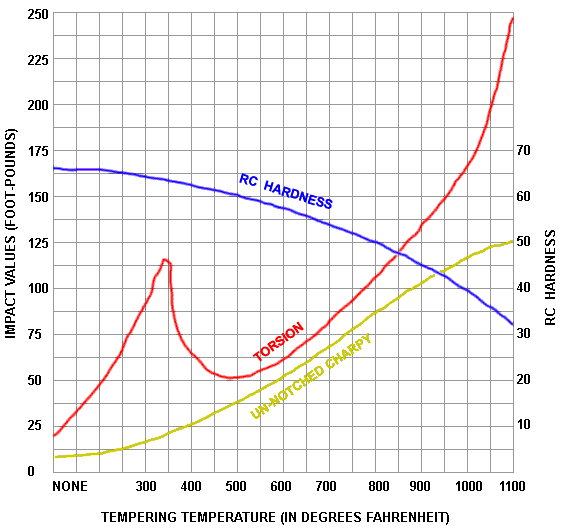
Here is the figure I'm used to seeing, but now I can only find a very low quality version (you can still read the text if you look closely enough):

gwKXfiP.jpg


Here is a reproduction that's easier to read and has the same info:

1095.gif
 
Last edited:
I am no expert but the folks at Becker, ESEE and plenty of other places are. They run their 1095 lower than 62 and I'm pretty sure it's due to toughness.

After looking at that graph again, I stand completely corrected and the experts show why they're experts.
 
Last edited:
Graphs like that are wonderful items, but it would be nice to explain what it all means relative to the subject matter.
 
Graphs like that are wonderful items, but it would be nice to explain what it all means relative to the subject matter.

It graphs hardness and two measures of toughness against temper temperature. Basically the Charpy and torsional impact values (different measures of toughness) tend to increase as HRC decreases except for a big spike in torsional stability around 68HRC. I apparently remembered the graph incorrectly. The torsional stability values aren't all that much different but the Charpy values are significantly higher at 58HRC vs 62HRC.

I think what must've stuck in my head was, "big peak in torsional stability at 68HRC" and "1095 retains good toughness into the low 60s" and over the years it got a bit distorted.
 
Last edited:
Thanks Carboniferous. I wasn't familiar with the charpy term. Looks like a RC around 63 is optimium for toughness. Tempering at around 350 degrees F would result bring you into the RC area.

My impression is that Old Hickory RC's are fairly low on their kitchen knives. Will have to get one out and sharpen it, but they get dull relatively quickly with use. My oldest "good" kitchen knives were made by Case (carbon steel) which I purchased at about the same time as the OP. I know they aren't great knives, but I like them. The one that gets used the most is a boning knife mostly for general cutting in the kitchen.
 
Thanks Carboniferous. I wasn't familiar with the charpy term. Looks like a RC around 63 is optimium for toughness. Tempering at around 350 degrees F would result bring you into the RC area.

My impression is that Old Hickory RC's are fairly low on their kitchen knives. Will have to get one out and sharpen it, but they get dull relatively quickly with use. My oldest "good" kitchen knives were made by Case (carbon steel) which I purchased at about the same time as the OP. I know they aren't great knives, but I like them. The one that gets used the most is a boning knife mostly for general cutting in the kitchen.

I wrote CASE a couple of years ago and they denied making a carbon steel, no chrome plated kitchen knife! Here is another user. We had a set that was passed down from Great Grandfather, to Grandfather, to parent, to me. They were the sharpest in my kitchen. Finally I had to discard them because they were worn out due to so many years of sharpening.

Back to the Old Hickory, I think they are in the mid 50's or a tad higher. They are easy, very easy, to sharpen, but the edge does not last beyond a couple of roasts.
 
Tru-edge, Ontario Old Hickory - I bought a new set 3 years ago (IIRC) for testing purposes.

I just tested... Boning knife hardness readings on the flat part near the spine: 52, 55, 55rc
 
I wrote CASE a couple of years ago and they denied making a carbon steel, no chrome plated kitchen knife! Here is another user. We had a set that was passed down from Great Grandfather, to Grandfather, to parent, to me. They were the sharpest in my kitchen. Finally I had to discard them because they were worn out due to so many years of sharpening.

They say Case XX on them. The cardboard sleeves said Case on them too. What can I say?
 
Here is the figure I'm used to seeing, but now I can only find a very low quality version (you can still read the text if you look closely enough):


Here is a reproduction that's easier to read and has the same info:

1095.gif

Ok, maybe I am reading this wrong but at an Rc of 63, the Charpy value is 25 ft lbs, while at an Rc of 57-58, the toughness is 52 ft lbs or double which is logical. So from how I am reading that chart the toughness goes up as the hardness goes down which is logical.
 
Ok, maybe I am reading this wrong but at an Rc of 63, the Charpy value is 25 ft lbs, while at an Rc of 57-58, the toughness is 52 ft lbs or double which is logical. So from how I am reading that chart the toughness goes up as the hardness goes down which is logical.

That's also how I'm reading it, I just hadn't looked at it for a long time and didn't remember the significance of that peak in torsional impact toughness around 68HRC.
 
They are good knives for a cheap price.
Not fancy, but very good workhorse knives.
 
That's also how I'm reading it, I just hadn't looked at it for a long time and didn't remember the significance of that peak in torsional impact toughness around 68HRC.

ok, got it. I like that graph, shows a lot
 
While it is sometimes counter intuitive, lower hardness does not indicate higher toughness. Various forms of temper embrittlement see to that. The graph above is specific to 1095, but the same trend is fairly common in the tempering range for cutting tools and knives. What that graph shows is the tempered martensite embrittlement in the lower range of tempering temperatures. ESEE tempers high enough to avoid it, though the hardness is lower. A handful of makers temper at or near the peak, and have a higher hardness than normally thought adequate. What the graph also shows is the lack of sensitivity of the Charpy impact test at detecting the embrittlement in high carbon steels tempered for cutting tools. As carbon goes up, toughness goes down, generally. As the toughness goes down, these variations become more difficult to detect, and different tests become preferred.
 
Also, I have a relatively new blade from OH (5 years) and have done quite a bit with it. It will pass the 2x4 chopping and shave test with no trouble. I know it will do 2, but have never tested how far it would go before stopping shaving my arm.
 
Also, I have a relatively new blade from OH (5 years) and have done quite a bit with it. It will pass the 2x4 chopping and shave test with no trouble. I know it will do 2, but have never tested how far it would go before stopping shaving my arm.

So it was 1095 at what hardness? Is it their butcher knife?
 
It's 1095 I'd guess. Also, I'd guess its in the mid 50s hardness. It was a butcher pattern. I'm planning on reworking it into a different t shape soon.
 
Back
Top