Old Purners... why are there so many?

Joined
Dec 22, 2005
Messages
814
I live in the Midwest and it seems to me that there are more surviving old Hawk bills or Pruning knives than any other pattern. At least at the auctions and shops I frequent. Has anyone else noticed this?

If so ... to what would you attribute this phenomena? Was it the vast numbers of them that were made? Or the strength of the pattern? Or maybe it is that they weren't carried on a daily basis. I'm anxious to hear your thoughts!

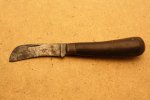
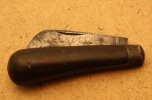
Here's and example of a nice old pattern that I picked up today.

attachment.php

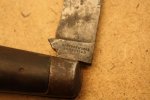
Thomas Turner Compy with the Suffolkworks Sheffield stamp
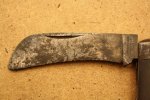
wIMG_8933.jpgwIMG_8935.jpgwIMG_8936.jpgwIMG_8931.jpg

It has integral steel bolsters and liners... I'm thinking around 1830's.... What do you think?

I hope I didn't get skinned.... I gave a whole $40 dollars for it!
 
Last edited:
Could it be that they are kept in the gardening shed or stationary tool box and not carried? That's my guess.
 
I worked in a wholesale nursery, and Tina (German) makes great high quality pruning, grafting, and budding/grafting knives. The hawkbill pruner was still used quite regularly by the field workers who pruned, staked, and shaped plants for market. The blades are disinfected after each plant to eliminate vectoring viruses on certain species that are vulnerable to such. Gardening in this way is a couple of generations old, and I love using my hawkbill.
 
Just a guess but I would say that our society was much more rural then and tools of that sort were needed. I think this also means that these pruners were not carried around in ones pocket day and night and found there way into a tool box or shed etc. Like I said just guessing.
 
My guess would be that since it would take an outlandish amount of laborers to farm the fields, all those workers would need a knife and this pattern is best suited for their needs.
Just my thoughts, could be completely wrong.
 
Thanks for the responses guys. I had never thought of the fact that the work this pattern was created for required the knives to be cleaned frequently.... Great point!

All of your reasons seem to hold merit. I'm not a huge fan of the pattern but I do appreciate the craftsmanship that went into making these brutes. Thanks for the comments. Hopefully, others will reply.
 
Back in High School I worked every summer for 4 years on a peach orchard. Peaches were, and still may be, a big part of agriculture in South Carolina. One (more like 2) generations removed cotton was king. The odd thing is I've never seen one of those "cotton knives" that I see advertised on some sights.

In my experience, when the peaches were harvested pruning the orchards was taken very seriously. We never used pruning knives. All pruning was done with loppers and we never cleaned them. In fact, I have never seen a pruning knife in use at all though we all carried a knife. A pruning knife would have been far too slow for the work required. These look to be the kind of specialized tool that would have been supplied by the owner of a farm or nursary.

I'm guessing that some of the reason these pruners keep showing up is likely a bi product of the local crops grown in the region at the turn of the 20th century.
 
Back
Top