Opinel vs water

Joined
May 7, 2011
Messages
3,426
Hi guys,
I know this thing has been discussed here before, but the thread was more than one year old, so I thought it would be better to start a new one.
So, today I was dragging another person to the world of knives (one more woman with a Vic Classic on her keyring...thanks to their new "fashion" designs) and I saw something that caught my eye and that I may decide to buy...but before I do, I want to ask for some suggestions here.
I'm thinking about buying a set of Opinel steak knives, but I'm having second thoughts about the handle.
As for any kitchen/food knife, they will face quite a lot of water and juices.
I do have a folding Opinel but I never really cared alot about the looks of the handle, I put some mineral/vaseline oil on the pivot but never cared if the handle got wet or oiled. But for steak knives, I would like them to stay as pristine as possible. I love the natural look of wood on Opinels, and I wouldn't want to change them, but without any treatment, I know they will eventually get "stained" and I would have no way to bring them back to the original colour, so I need to prevent this from happening.
In the old thread I read about line seed oil being effective in making the knife more or less water resistant, but I have no idea of how the handle will look after that treatment. I thought about vaseline too (my guess is that it will affect the looks of the wood a bit less than line seed oil) but I would like to get some opinions.
I know there might be better options with mineral oils, but since I'm going to use these knives just for food, I wish they never got any smell/taste of mineral oil.
Thanks for your suggestions.
:cool:
 
A prominent online Opinel dealer indicates that the Opinel steak knives are dishwasher safe (I'm seeing this description for oak, olivewood, birch, ebony and 'stamina wood' handles). I'd assume that means they're stabilized or otherwise sealed.
 
Thanks for the info David. Hope they're sealed well enough to resist less hydrophilic liquids.
Maybe I will buy one, use it, and see how it goes (even tho it might feel weird to buy one steak knife :) )
It's been some time since I wished for some plain edge quality steak knives, and Opinel does look like a very good choice.
:cool:
 
Thanks for the info David. Hope they're sealed well enough to resist less hydrophilic liquids.
Maybe I will buy one, use it, and see how it goes (even tho it might feel weird to buy one steak knife :) )
It's been some time since I wished for some plain edge quality steak knives, and Opinel does look like a very good choice.
:cool:

I'd be shocked, frankly, if they didn't hold up. A steak knife, after all, is made to get wet, one way or another. Opinel's reputation is pretty solid, so I wouldn't worry too much about it. And these are quite a bit pricier than the 'simple' beech/carbone folder, so I'd expect the build quality to be first-rate.

Don't be shy about posting a review, if you try one out. I'm sort of curious about these too. :thumbup:
 
They are made to get wet for sure, I just hope they resist oil/blood/sauce without changing their colour or getting stained.
They're not that pricey after all (6 euros each at the store, maybe the whole series could cost a bit less, they're sol in boxes of 4), considering the steel and so on. The knives I've seen (and that I will buy, at least as a sample trial) are the "office 112" in olive wood.
Anyway, when I get the "sample" one, and try it, I'll let you know
:cool:
 
I use a Opinel paring knife daily and it has even went through the dishwasher a few times by mistake. Handle still looks new. Slices better than any other, higher priced, paring knife I have used and is easy to get very sharp.
 
Thanks for your feedback Tomsch.
I love the slicing ability of Opinel's, and it's been long since I decided I want some plain edge knives for meat/steak. Also, I have learned and improved my (still not good but new and improving) sharpening skills on an Opinel, so that's a plus for sure (even tho I was sharpening a carbon steel blade, and of course steak knives are stainless which - as David already wrote on another thread - is a bit harder to sharpen).
Guess tomorrow I'll get the sample one :rolleyes:
:cool:
 
Thanks for your feedback Tomsch.
I love the slicing ability of Opinel's, and it's been long since I decided I want some plain edge knives for meat/steak. Also, I have learned and improved my (still not good but new and improving) sharpening skills on an Opinel, so that's a plus for sure (even tho I was sharpening a carbon steel blade, and of course steak knives are stainless which - as David already wrote on another thread - is a bit harder to sharpen).
Guess tomorrow I'll get the sample one :rolleyes:
:cool:

I went about sharpening both of mine (stainless and carbon No. 08 models) in such a way as to take a good bit more time. I thinned & polished most of the blade with sandpaper, to a zero grind at the edge. Had to work a bit more at the stainless. But, relative to the time spent on the carbon model, it wasn't much longer. If one were to simply take the factory edge to a Sharpmaker or something similar, I have no doubt you could put a very sharp edge on it quite easily. I've even used my Sharpmaker to touch mine up. Don't worry about the stainless being that difficult. In fact, it's quite easy, and produces an excellent edge on these knives.
 
Not worried at all :) cause my skills are slowly improving, and also, I would never prefer a carbon steel blade over a stainless for a kitchen/food knife.
Also, I think that Opinel made a winning choice when they decided to use Sandvik steel for their knives. It seems like the best choice they could make.
:cool:
 
Well... on a regular Opinel you could leave the knife in a car on a hot day or three till it get floppy loose. Then you could up end the knife in a cup with a bit of mineral oil so that just the joint gets soaked for a long time. It will absorb oil there and tighten up again and not change the finish elsewhere on the knife. A bit of oil would ooze out for a short time then stop. I don't think you would get any taste in your food.

I've never seen the steak knives. Could you post a link?


Hi guys,
I know this thing has been discussed here before, but the thread was more than one year old, so I thought it would be better to start a new one.
So, today I was dragging another person to the world of knives (one more woman with a Vic Classic on her keyring...thanks to their new "fashion" designs) and I saw something that caught my eye and that I may decide to buy...but before I do, I want to ask for some suggestions here.
I'm thinking about buying a set of Opinel steak knives, but I'm having second thoughts about the handle.
As for any kitchen/food knife, they will face quite a lot of water and juices.
I do have a folding Opinel but I never really cared alot about the looks of the handle, I put some mineral/vaseline oil on the pivot but never cared if the handle got wet or oiled. But for steak knives, I would like them to stay as pristine as possible. I love the natural look of wood on Opinels, and I wouldn't want to change them, but without any treatment, I know they will eventually get "stained" and I would have no way to bring them back to the original colour, so I need to prevent this from happening.
In the old thread I read about line seed oil being effective in making the knife more or less water resistant, but I have no idea of how the handle will look after that treatment. I thought about vaseline too (my guess is that it will affect the looks of the wood a bit less than line seed oil) but I would like to get some opinions.
I know there might be better options with mineral oils, but since I'm going to use these knives just for food, I wish they never got any smell/taste of mineral oil.
Thanks for your suggestions.
:cool:
 
Well... on a regular Opinel you could leave the knife in a car on a hot day or three till it get floppy loose. Then you could up end the knife in a cup with a bit of mineral oil so that just the joint gets soaked for a long time. It will absorb oil there and tighten up again and not change the finish elsewhere on the knife. A bit of oil would ooze out for a short time then stop. I don't think you would get any taste in your food.

Linseed or tung oil are more like varnishes which soak in in a way than an oil. They are a finish and would change the finish on the knife.

I've never seen the steak knives. Could you post a link?


Hi guys,
I know this thing has been discussed here before, but the thread was more than one year old, so I thought it would be better to start a new one.
So, today I was dragging another person to the world of knives (one more woman with a Vic Classic on her keyring...thanks to their new "fashion" designs) and I saw something that caught my eye and that I may decide to buy...but before I do, I want to ask for some suggestions here.
I'm thinking about buying a set of Opinel steak knives, but I'm having second thoughts about the handle.
As for any kitchen/food knife, they will face quite a lot of water and juices.
I do have a folding Opinel but I never really cared alot about the looks of the handle, I put some mineral/vaseline oil on the pivot but never cared if the handle got wet or oiled. But for steak knives, I would like them to stay as pristine as possible. I love the natural look of wood on Opinels, and I wouldn't want to change them, but without any treatment, I know they will eventually get "stained" and I would have no way to bring them back to the original colour, so I need to prevent this from happening.
In the old thread I read about line seed oil being effective in making the knife more or less water resistant, but I have no idea of how the handle will look after that treatment. I thought about vaseline too (my guess is that it will affect the looks of the wood a bit less than line seed oil) but I would like to get some opinions.
I know there might be better options with mineral oils, but since I'm going to use these knives just for food, I wish they never got any smell/taste of mineral oil.
Thanks for your suggestions.
:cool:
 
Sure I can:

http://www.opiknife.com/proddetail.asp?prod=Paring-knife-Opinel-No-112.-natural-varnished-beechwood

These are the knives I'm talking about.
My goal, of course, is not oil joints or pivots like on a folding Opinel; I just want to make sure that the handle gets "water resistant" and does not change its colour, neither with blood/juices nor with anything I'm putting on it to avoid the first.
By the way, I will just give it a try without putting anything on it, and see what happens.
:cool:
 
Those!

Ya, love 'em, great knives. You can just let them "weather" and they look good to me. 'Course I go for carbon steel and a dark patina so's tastes may vary.

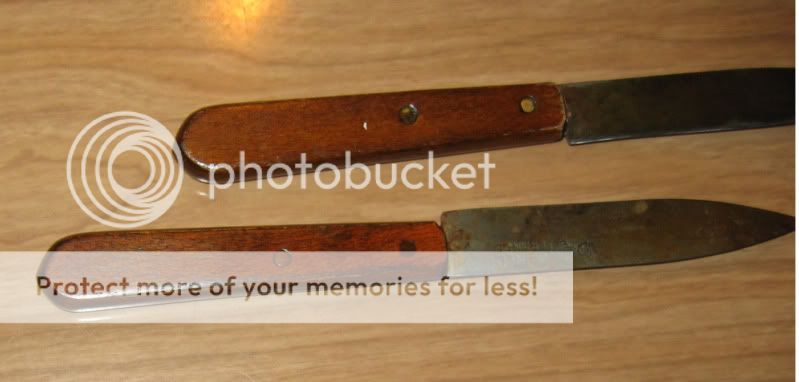
I personally sanded and stained and tung oiled mine (many coats). It darkened the finish, which I wanted, and they have looked that way for a year or two. The darker handle and a dark patina looks nice to me.

The finish is breaking down on the edges and I should reapply the tung but prolly won't.

In your case, a light sanding and occasional linseed or tung oil might work well. You could just rub them with beeswax or apply beeswax mixed with mineral spirits and let dry. It would change the finish just a bit in either case but preserve the wood.

Really, they'll look fine on their own.


Sure I can:

http://www.opiknife.com/proddetail.asp?prod=Paring-knife-Opinel-No-112.-natural-varnished-beechwood

These are the knives I'm talking about.
My goal, of course, is not oil joints or pivots like on a folding Opinel; I just want to make sure that the handle gets "water resistant" and does not change its colour, neither with blood/juices nor with anything I'm putting on it to avoid the first.
By the way, I will just give it a try without putting anything on it, and see what happens.
:cool:
 
Sure I can:

http://www.opiknife.com/proddetail.asp?prod=Paring-knife-Opinel-No-112.-natural-varnished-beechwood

These are the knives I'm talking about.
My goal, of course, is not oil joints or pivots like on a folding Opinel; I just want to make sure that the handle gets "water resistant" and does not change its colour, neither with blood/juices nor with anything I'm putting on it to avoid the first.
By the way, I will just give it a try without putting anything on it, and see what happens.
:cool:

Those ones (paring knives) are actually different than what I'd looked up. Good thing is, the handles are still described as 'stabilised beechwood'. Assuming it means what it usually does (wood impregnated with resin, under pressure), those should be about as waterproof as wood can get. Shouldn't need to treat 'em at all. Just wash & dry. :thumbup:
 
Last edited:

Yep, the ones shown in your first link are what I'd looked up:
Opinel-steak-knives-oak-handle-1.jpg


Whichever model it may be (steak knives, paring knives or the 'table knives'), it looks like they've got 'em all covered as 'dishwasher safe'. I'd assume that means they're all stabilised. It's good to know you were impressed with the paring knives, as seen first-hand. Based on the pics of those and the others, they all ought to be pretty nice.
 
Ya, at first I thought he was speaking of the folding steak knives also. Pricey aren't they? I would just get an Opinel #8 and try to mod it to be similar.

The paring knife is like the #8, a great knife for the price which anyone should have at least one of. They make nice gifts and people often tell you later that it is their sharpest knife. (I'm a carbon steel maven.)

Here is what mine look like now. The spots which look like rust are a trick of light. They are darker spots in the patina. The lower knife is newer and I've yet to turn the whole thing almost black like the top one.

OpinelHandles0011.jpg


Yep, the ones shown in your first link are what I'd looked up:
Opinel-steak-knives-oak-handle-1.jpg


Whichever model it may be (steak knives, paring knives or the 'table knives'), it looks like they've got 'em all covered as 'dishwasher safe'. I'd assume that means they're all stabilised. It's good to know you were impressed with the paring knives, as seen first-hand. Based on the pics of those and the others, they all ought to be pretty nice.
 
Are yours made of carbon steel? cause the ones I saw are made of the same Sandvik of the folding Opinel's, and the patina on your knives looks alot more like carbon blades..

David, I saw those paring knives casually and liked them. I admit that the fact that they are Opinel had some role on my initial impression. The ones you had seen may be more stylish, and also remind me of the folding Opinel classic (ring and everything). But for a relatively inexpensive and good quality food knife, I did like them alot. It's been some time since I wished for some plain edge knives for my table, and I'd love a set of steak knives handmade by some knifemaker here in our traditional blade shape pattern, but I have to deal with reality and spend way less. This might be the answer.
:cool:
 
I love carbon steel.

I think Opinel's carbon is a little better than their modified sandvik (which is still good).

Opinels are the knife to play with and modify to me. If I was going to go pricey I would prolly get a Laguiole.

The only bad thing about a plain edge steak knife is that you would have to sharpen/steel it a lot 'cause of hitting the plate. A serrated knife stays sharp down in the serrations since they don't hit the plate there.

Are yours made of carbon steel? cause the ones I saw are made of the same Sandvik of the folding Opinel's, and the patina on your knives looks alot more like carbon blades..

David, I saw those paring knives casually and liked them. I admit that the fact that they are Opinel had some role on my initial impression. The ones you had seen may be more stylish, and also remind me of the folding Opinel classic (ring and everything). But for a relatively inexpensive and good quality food knife, I did like them alot. It's been some time since I wished for some plain edge knives for my table, and I'd love a set of steak knives handmade by some knifemaker here in our traditional blade shape pattern, but I have to deal with reality and spend way less. This might be the answer.
:cool:
 
If you are going to oil them with linseed oil, use boiled linseed oil and soak them for a few days. Unboiled linseed oil takes weeks to cure after oiling. I usually use a 50;50 carnauba wax and beeswax mixture afterwards for added protection and a grippy finish.
 
Back
Top