OU31 and Co-Special steels

Joined
Apr 10, 2000
Messages
3,794
Hi All,

I've heard that Spyderco is planing on using Takefu Co-Special steel in mule project.
Takefu themselves, lists this steel on their page, however doesn't list its composition...
Is there a chance to get the composition of Co-Special steel, or is it a trade secret, etc?
I just want to add it to the steel composition chart.

While searching on the web for that steel composition I've stumbled upon OU31 steel, whatever I was able to dig up about it indicated that Spyderco once tested it for their knives, also found 1500$ SOG in that steel...
Composition of OU31 was asked many times and frequently this quote was the answer - It is a Japanese steel with .9 Carbon, 8.5 Cr, 2 Mo. Also has a sprinkle of Vanadium and a dash of (3%) Cobalt
I've added OU31 to the steel composition chart based on that, although I'd really love to know how much exactly is "sprinkle" for V and apparently it also has copper?
 
Gator, you know more about OU31 than I do now, and I own one.

I too would love some information on the co-special steel. Sal, is there anything you can share with us on this steel? It's the most intriguing to me. I typically like cobalt containing steels, just like I do Tungsten steels.

Thanks. Joe

edit: BTW, it's not that $1500 S.O.G. knife. It's a small utility knife done by the same guy and it came a whole lot cheaper. :)
 
Can anyone read Japanese?
ou31.gif

Ref:
http://web.archive.org/web/20080525131505/http://www.ktroad.ne.jp/~nissa/OU31.html

EDIT: :( it seems to be the same "info" as this http://www.japaneseknifedirect.com/user/OU-31 Steel.pdf
 
Last edited:
Well, here is a speculation:
In the link provided above (and elsewhere), you can notice Nippon Koshuha (NK) is the maker of the steel.

Maybe OU-31 could be somewhat similar to D2 (KD11, SKD11, KD11S, etc., see Gator's database). NK makes their "improved" version, as KD11S - http://www.koshuha.co.jp/eng/products/kd11s.html - but look at the quenching chart - note that it doesn't concur with the proclaimed hardness of OU31. So let's go on, there are three more steels under the "tool steel" option. RC55 is said to go "up to 55 HRC", that doesn't concur too, let's exclude it. KRCX "may be hardened in the same conditions as the SKD11 and SKS3" - therefore let's assume the similar quenching chart as with the aforementioned KD11S and the same outcome.

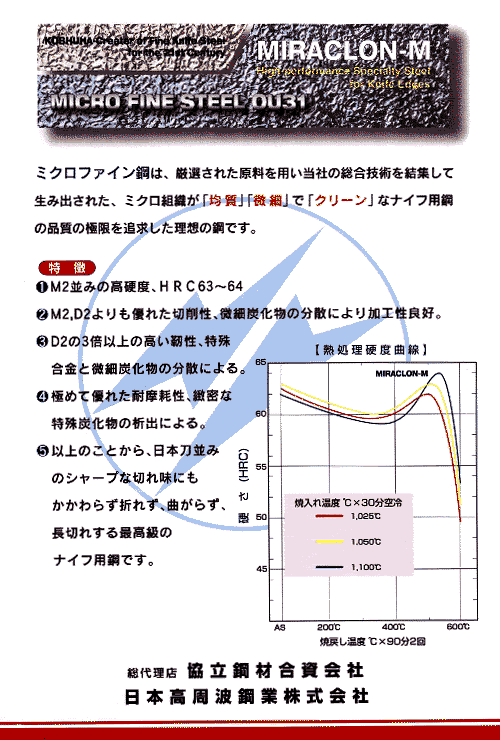
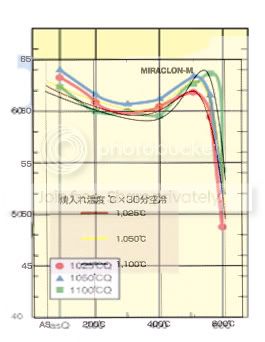
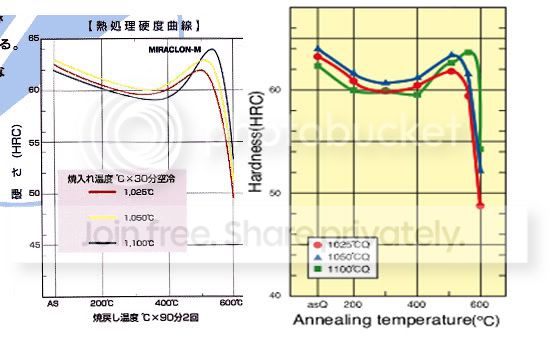
Then comes the KPS-6 - http://www.koshuha.co.jp/eng/products/kps6.html - apart from hints like "high tenacity" (OU31's "Toughness more than 3 times higher than that of D2") and similar hardness range, there is one interesting thing at that page, the quenching chart. If you compare it with the one from the pdf (or pic) above, there is obvious similarity.
I attempted to roughly scale the charts to the same dimensions:
ou31_1.jpg

Overlay of the two:
ou31_2.jpg


I think OU-31 is just fancy name, like "Tru-sharp" or "Carbon V", and maybe it might be worth trying to identify the composition of the KPS-6.


EDIT: because KPS6 is patented, it should be possible to find it here, at least in theory :):
http://www.ipdl.inpit.go.jp/homepg_e.ipdl (click on PAJ, in Patent&utility model)
However, it is almost impossible to know for sure.
Could it be this:http://www19.ipdl.inpit.go.jp/PA1/result/detail/main/wAAAV7aaKhDA419077442P2.htm ? (the fine carbides mentioned in the pdf?)
or this: http://www19.ipdl.inpit.go.jp/PA1/result/detail/main/wAAALtaWvkDA362056555P18.htm ? (note the cobalt and copper, "To develop and alloy tool steel combining high hardness and wear resistance with corrosion resistance and toughness by adding Cu and Co in combination and by increasing V content in a conventional alloy tool steel. " I would be inclined to this, but note the time stamp - it is from 1987 and patents last usually only 20 years...)
Who knows...
 
Last edited:
Nice detective work :) Except after digging the web for 3 hours I am unable to find KPS6 composition either.
So, now we have 3 unknowns...
 
I hate to do this guys but I am going to necromance this thread. It's a shame the thread ended with unfulfilled answers.

Question: When they say OU-31 is "3 times tougher than D2" what does that mean exactly? Does it imply it would yield 3 times the result of the charpy test for D2?
 
Alas, I've been periodically bothering makers and dealers about exact composition of the ou31, but no luck...
 
We tried to get OU-31 for a Mule Team run, but the foundry didn't stock it and a run would require far more than we could purchase.

sal
 
Takefu CoS (Cobalt Special)
C 0.95-1.15
Cr 15.00-17.00
Co 2.00-3.00
Mn 0.30-0.50
Mo 1.00-2.00
Ni 0.25
P 0.030
Si 0.60-0.70
S 0.010
W 0.20-0.30
V 0.20-0.30

Nippon Koshuha Steel OU-31
C 0.90
Cr 8.50
Co 3.00
Mo 2.00
V 3.00
 
Thanks Brian :) Finally I know how much V in OU31.

Also, it is CoS, or CoS3, earlier the name CoS3 was in circulation, CoS is just short name?
 
Hi Gator,

When we played around with OU-31 about 15 years ago, the "selling" feature was that they had added copper to the mix.

sal
 
What about cobalt specials properties. I picked up one of the Cos mule teams and I cannot find anything about this steel, other than what is posted here or on the Spyderco forum. How does this steel stack up against M4 or cst20cp in edge retention and toughness, etc. I have knives in those two steels so I have an understanding of what they can do.
 
I love steel junkie technical discussions. Must be the nerd in me (no slight intended to any steel junkies out there).
 
I have a knife from Kiku Matsuda which uses ou31 and his site says "OU-31 steel: It is a micro fine steel made by Nippon Koshuha Steel Co., Ltd. It features high hardness, HRc 64, and is 3 times tougher than that of D2. Reported to have 10 times longer edge holding than ATS-34 according to cutting tests." I hope this helps some one else cuz I don't know what it means
 
Hi Curnew,

Welcome to the Spyderco forum.

I hate to doubt what custom makers say, but 10 times sounds like a lot.

sal
 
Hi Curnew,

Welcome to the Spyderco forum.

I hate to doubt what custom makers say, but 10 times sounds like a lot.

sal


I agree, with that alloy content I don't see it happening, better yes, but not that much better and the carbon content seems to be on the low side.
 
Back
Top