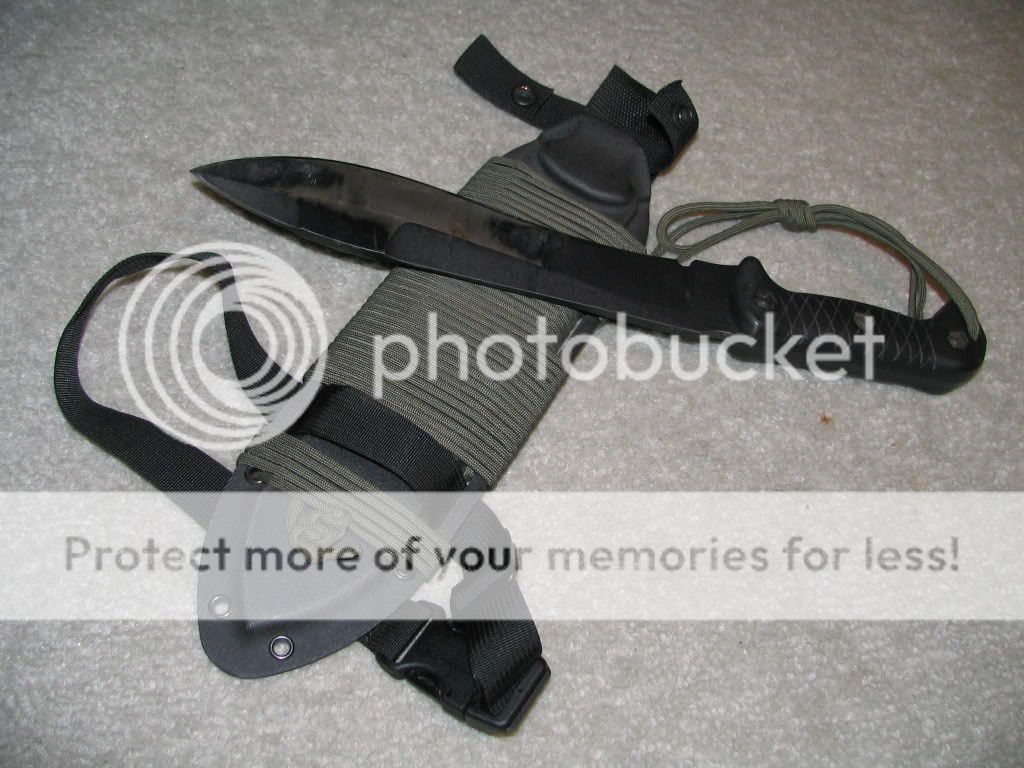
Here's a link and copied text to my old review of the Brute, as used in a wilderness setting. Loved it:
http://www.bladeforums.com/forums/showthread.php?t=90741
BKT Brute: 1st Impressions
I took my new Becker Knife and Tool Brute, produced by Camillus Cutlery, out into the woods to put it through some initial paces today. It was wet from rain, and cold. Not ideal conditions for a blade test, you say? Perhaps. But then, if you’re in a survival situation, you don’t have choice as to the conditions in which you may be forced to build your shelter, fire, get drinkable water, and procure food. You’ve got to get out there and do it, no matter what, or less than ideal conditions will claim you as the latest victim. So, for me, today was exactly the kind of day I was waiting for to try out this blade.
Before I get into the “first impressions” review, let me say a few things. In a survival situation, a blade is your primary tool to serve a purpose. It’s not simply about what the blade can do, but, in the context of an extended survival situation, how a blade will help you attain your goals of staying warm, dry, watered, and fed. Nothing else matters. It’s not important to me how well it can slice through free-hanging rope, hack a 2 X 4, or anything of that sort. After almost two decades of wilderness travel, I haven’t seen any free hanging rope, and if I did, I’d want to carefully take it down, keep it intact and cut it later as I need it to use for shelter construction, cordage for my fire bow, fish line, snares, etc. Therefore, my goal was to use the Brute in as real a way as possible, and see if it graduated to the next step. Well, so far, the Brute has performed beyond my expectations. It remained comfortable and efficient to use throughout my test, whatever the task. Next, I plan to "up the ante", and take it on a three-day, survival-style trip. Then, if it still works for me, I’ll be taking it to Idaho for an extended two-week expedition, to use as my primary blade for a survival film. We’ll be flown in by bush plane, at least 75 miles in any direction from civilization. That will be a true test – however, by then, I’ll know it will pass, or it won’t be going in the first place.
Shelter and fire are almost always your first priorities in survival. Today, my goal was to have the knife perform some of the initial duties of shelter construction, and cut firewood into manageable sizes for carry back to camp. Green oak and pinewood, pine boughs, and cedar deadfall were the materials I found to use. The Brute shaved pine sticks to make pitch sticks for easier fire start in wet weather. It was used to cut down the 2" thick oak saplings, score them, take off the bark, cut them to length, sharpen some into stakes, notch them to fit together into a frame, and dig post holes in which to insert them. I cut through forest duff on the floor to use as shelter insulation. And, using only this knife, I even split a 10” thick cedar log, notched it to make legs, smoothed the split surface (no splinters in this butt, thank you!) and made a nice bench by the fire. It was my striker for my magnesium fire starter, too.
Carrying the Knife:
Picking up the knife in its sheath, I felt the weight and heft (about 1 1/2 lbs.), and wondered if it would feel like a lead weight on my leg. What did I do? What I’d do in the woods: strapped this baby on my waist, strong side carry. My first reaction was of pleasure. Due to the sheath design and carry system, the blade rides at the perfect spot, with the pommel riding just below the bend in my waist, and the bottom of the sheath against the meat of my thigh, still well above the knee joint. In the woods, when I’ve lost my balance (we all do!), higher-riding blades have jabbed into my side, causing bruising to my ribs or torso. I don’t like that too much. The sheath, made of kydex, has a nylon web loop at the top, and a nylon leg strap, which makes it easy to bend over, walk, and squat without feeling like a stiff splint is on your leg. I forget it’s even there. It was even very comfortable sitting down, driving my Jeep. The sheath is ambidextrous, so you can carry it on either side, and the blade locks securely both ways. (If upside down carry on your pack strap is preferred, that’ll work just fine, too. I tried it, and after repeatedly jumping up and down hard, the blade stayed put. You have to pull hard to get it out, or use your thumb to push the kydex lip before pulling.). Score one for the sheath and carry system. Here is a carry picture, with my leg bent (more will be added later from the outdoors tests when I get them up online):
The Knife and Its Features:
Fit and finish were very high. Overall, the knife, as mentioned above, is heavy – good for chopping duties. The balance is nice, though – right where the blade meets the ricasso, about 1 1/4" from where my hand sat in the handle. It’s not blade heavy, nor is it handle heavy. This means you have less muscular stress on the upstroke, and can chop longer, while depending on the overall heft of the knife to accomplish your task. The balance point also meant that the blade was fast, safe, and easy to handle for smaller chores, such as whittling. It’s an easy knife to control whatever the task. The blade is powder coated, and the coating lasted fairly well, although was scraping off in places by the time I was done. Does that matter? Not to me. It doesn’t look as pretty, true, but performance was not affected at all.
The 9 1/2” carbon steel blade is reminiscent of a bolo. It has a long re-curve moving inside from the ricasso, gently sloping out towards the front, and finishing with a nice belly up to a drop point tip. It is 1/4" thick at its widest points, with an interesting pattern of stock removal. The spine starts at 1/4" where it meets the handle, and gets thinner towards the tip, except for an approximately 1 1/2” area near the tip, left full thickness, intended for use as a hammer. It is sabre-ground, with a beveled edge. While chopping logs for firewood, the angles from the 1/4” spine down towards the edge make it dig deep without binding. And the stout blade endured wicked lateral stress when it did bind on occasion: I just torqued/twisted it sideways very hard and out it popped with no edge damage or blade breakage. In other words, this baby didn’t blink an eye! The re-curve makes it widest at the front 1/3 of the blade, which gives it a nice “sweet spot” for chopping. It also puts the chopping area below the handle (when viewed on a straight plane), so you have increased power for your stroke, and less risk of hitting your knuckles on your work (which can happen when you’re exhausted in the woods). I chopped down the 2” oak saplings with one easy stroke each time. It also made for a nice makeshift shovel when holding the blade flat. I dug post holes for the shelter and the bench legs, in soft, wet dirt. It only took a few passes on a fine diamond stone to bring the edge back to almost shaving sharp (I don’t like a shaving edge on a chopper or any field knife – too fragile).
The 1 1/2” hammer area on the spine remains at the full 1/4” thickness, and worked superbly for driving stakes into the ground. It also functioned as an adjunct handle when I used the blade as a drawknife to remove bark and smooth out the cedar bench sitting area. I had a high degree of confidence that my hand would not slip while doing this, and it never did. The area functioned as a good target for the log I used to literally bash the knife lengthwise through cedar wood to split it. I also bashed on the handle at the other end to move it evenly through – and the handle didn’t flinch (more on the handle later).
A thumb/finger depression (like a reverse choil) on top of the blade made it easy to manipulate the blade for smaller tasks such as scoring wood stakes to cut them to length, and whittling the points on the stakes. The recurved blade style also makes it easy to whittle with a knife this large.
The Handle:
Ahhh, finally! Somebody came up with a very effective handle on a knife in this price range – a handle that ISN’T RUBBER! It is made of Swiss glass-filled polymer slabs, fitted with recessed bolts, and a fully exposed tang. The surface is smooth, and I felt no hot spots after over two hours of use. I wondered if it would slip easily, especially because it was wet out, but due to the handle shape, it never was a problem. The handle has a protrusion that extends down behind your pinky finger, and also down in front of the blade. It is a very secure fit for my hand. It’s a little thicker and wider than most handles, but I believe it helps for better grippage, to make up a little bit for the smooth surface. My hand never tired while doing extensive chopping and whittling, and, when held upside down for hammering, I had complete control of the movement of the blade. I could consistently strike the hammer portion on the target every time. I also, as mentioned above, beat on the handle, with a log, from the spine side and the pommel side to drive it through wood to split. It sailed through this with no visible damage.
All in all, so far I am amazed there’s a knife that performs like this for only about $100.00 retail. There’s more to be done, but I will continue to document and share the real field use and performance of the Becker Brute on my three-day trip, coming up in a week and a half.