Pinning and soldering a bolster?

Joined
Feb 12, 2011
Messages
2,520
I've recently finished 5 handles. 3 Pakkawood on Green River blades and 2 stacked leather handles on Mora/Helle blades. On the last one (Helle), the blade slipped while I was compressing the leather causing the bolster to be out of kilter.

So, I'm going to practice pinning and soldering bolsters.

I am going to order a couple of Green River boning blades and brass bolsters with the correct notch. I have some Sta Brite solder and zinc chloride flux and a small butane torch.

I am really concerned with making sure the holes through the bolster line up. this involves drilling through the tempered blade. I've read horror stories about trying to drill through tempered steel. Do I need to use a carbide bit or are there less expensive alternatives? Likewise, is there a good substitute for a pin reamer?

I've read 3 different schools of thought on soldering, the first being don't do it use epoxy instead.http://www.bladeforums.com/forums/images/smilies/smile.gif

The second and most popular was to apply flux to the clean joint, heat and apply the solder to the joint, allow capillary action to draw the flux into the joint. Do I need to worry about corrosion if I use zinc chloride as the flux? Will a potato keep the end of the blade cool or should I get some heat paste? Or is there another alternative?

The third suggestion was to tin the blade and the bolster, attach them, then heat to get the solder in the joint to flow and bind. This makes sense to me but I'm not sure if this will result in a dry joint? Are there any problems that I am not seeing with this method?

Thanks in advance for any help and advice.

Bo Thomas,
Hobbyist
 
Just clamp the blade in a vise to keep it cool. You will probably need a regular propane torch.
All surfaces to be joined must be clean and bright. Use Stay Clean flux, and a solder with 4-6% silver. Apply the solder from the rear of the joint, and pull it through with heat. You can use a soft lead pencil to keep the solder from flowing where you don't want it.
 
Thanks. It worked fairly well but I wasn't prepared when the solder started flowing and probably used 3x as much as I should have. I soldered this first one without peening the brass rods to see if the solder would flow along the brass rod to the side of the bolster and it did. I set the bolster close to the vise to maximize the heat sink and could not tell when the bottom of joint had been completely soldered. Is there an easy way to tell when you have used enough solder?
 
Use very little heat and even less solder.
It takes only a small torch to heat a bolster to 400F, and a very small amount of solder to flow into the joint. If you are having to pile up the solder,or use lots of heat, STOP. Clean everything up again, and start over. A dirty joint will not flow solder. The main cause of dirty joints is overheating. It causes the flux to burn as well as oxidizes the metals. Use just enough heat to slowly bring the bolster and tang area up to the melting point of the solder - around 400F. You do not want it hotter. Don't put the flame on the solder. Put the flame on the metal ,away from the joint, and touch the solder to the joint as the flux starts to bubble. In a few more moments it will flow right into the joint. A clean and proper temperature joint will suck it right through.

I find new makers do better with a small butane torch because it is less likely to overheat the joint. Some makers find a good heat gun is even better.

As far as keeping the blade cool, if the soldering is properly done, the blade will not go above tempering temps. To be safe, you can clamp it in a vise, which acts as a heat sink, or wrap a damp cloth or paper towel around the blade. Make the clamped/wrapped part 1" from the bolster. Any closer and it may make the joint too cool on the cooled side.
Potatoes are best left in the kitchen and cut up with the knife after it is done. Heat paste is a waste of money, as all it really is is a damp gel. A wet paper towel has as much heat sink ability.....maybe more.
 
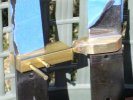
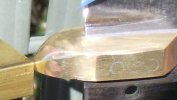
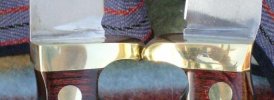
It looks like I got it hotter than necessary, probably 650 degrees Fahrenheit from the colors. But it looks like the joint is good. I took care to clean and flux the joint properly. I am really impressed with the way the solder flows.
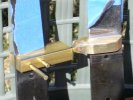
I soldered the bolster blade down. I think that I would have a better view if I soldered it with the knife held hoizonally. Any pros or cons with trying it that way on the next one?

bolsters1.jpgbolster3.jpg
 
Carbide bits aren't that expensive, hit ebay, second, don't worry about heat, Staybrite works at 410 degrees you could technically solder with an electric heat gun. the most important thing is a clean tight joint with no play before you solder. if you are worried about corosion boil the blade in water and baking soda for a few minutes.
 
It really doesn't matter what direction the knife is held. Use only enough heat for the solder to flow.
Peen your pins before soldering, or those silver rings will always be there.
Practice makes perfect.
 
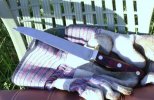
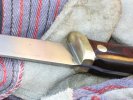
The knife is about 98% complete with some cosmetics left to clean up. I'll set the pins on the next one before soldering the bolster. I'll watch the heat more closely on the next one.


7-28knife2.jpg7-28knife1.jpg
 
You could have used less solder for a very fine line or wiped the wet solder with some steel wool. Even now if you want to lessen the visible solder use a sharp brass rod and shave the excess off. Nice job on the pins.
 
You could have used less solder for a very fine line or wiped the wet solder with some steel wool. Even now if you want to lessen the visible solder use a sharp brass rod and shave the excess off. Nice job on the pins.

Thanks. I took your advice and the solder line between the blade and bolster looks a lot cleaner.
 
If you get everything really flat. You don't need to solder. If you are worried about water intrusion. Spray it all will LPS #3 just before you peen the pins. It goes on very thin, then congeals, and prevent any possible intrusion. If everything is flat to start with, it will be a hundred years before there are any problems, if even then. Barring it might be a divers knife.
 
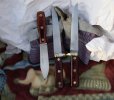
I finished up the first knife and learned a lot doing it. I retrospect I see how the pins need to be peened for a clean look. The second knife (on the left) has the brass pins peened and again I soldered the bolster for practice. Although the solder line isn't much better on the second knife, I spent about an hours less time working on it.

bolsters1.jpg3knives5.jpg3knives6.jpg


Thanks for all the help.
 
Wick, what is LPS #3?
If you get everything really flat. You don't need to solder. If you are worried about water intrusion. Spray it all will LPS #3 just before you peen the pins. It goes on very thin, then congeals, and prevent any possible intrusion. If everything is flat to start with, it will be a hundred years before there are any problems, if even then. Barring it might be a divers knife.
 
Ace used to carry it. My Ace had it the last time I was there. There is LPS #1, #2, and #3. #1 is a penetrator and much like WD-40. #2 is thin, but more oily like a good gun oil. #3 sprays on very thin, but thickens in a few minutes to like a soft wax. It first penetrates, then sets. #3 used to be rated as a good long term storage protector for guns, or other outdoor equipment. I would presume it still is.
 
Back
Top