-
The BladeForums.com 2024 Traditional Knife is available! Price is $250 ea (shipped within CONUS).
Order here: https://www.bladeforums.com/help/2024-traditional/
You are using an out of date browser. It may not display this or other websites correctly.
You should upgrade or use an alternative browser.
You should upgrade or use an alternative browser.
Pittsburg 1 1/4 Hatchet head grind question
- Thread starter austin37
- Start date

- Joined
- Mar 8, 2008
- Messages
- 26,274
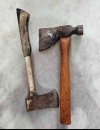
Should be more a matter of preference than anything else. A flat top like the lower one is easier to stand on its head, but beyond that it really comes down to what you plan on doing with it.
Can you tell me what the primary uses which hatchet was made to do and or what design is better for certian task? Given the head edge grind differenceShould be more a matter of preference than anything else. A flat top like the lower one is easier to stand on its head, but beyond that it really comes down to what you plan on doing with it.
- Joined
- Mar 8, 2008
- Messages
- 26,274
They're both general purpose designs. YOUR tasks are what determine which would technically by ideal between the two. If I was planning on modifying it for use as a carving hatchet I might go with the top one since the flared toe allows for some cuts that would be difficult without it, but for a piece that was used by a fireplace I might go with the bottom one because of the flat top allowing it to stand on end easier without inducing toe wear and the retaining cross pin gives extra security for other users if the head loosens from being near the fire. They have only slightly different features that yield different very slight situational advantages. But they aren't specific-built designs or anything; they're definitely general-purpose hatchets that will be able to do most things you might want to do with a hatchet. This is like choosing different hardnesses for the lead of a pencil--most people are not going to be able to tell the difference between a B, 2B, and 3B despite having used 2B their whole life. Only artists or drafters are going to need anything but a plain ol' 2B and the number of people deliberately selecting B or 3B probably have either very specific use cases or strong opinions on what hardnesses they use for what. For everyone else the difference is mostly academic.
Oh ok thank you. Would be using it mainly for small branches, small thin limbs, various species. Florida.They're both general purpose designs. YOUR tasks are what determine which would technically by ideal between the two. If I was planning on modifying it for use as a carving hatchet I might go with the top one since the flared toe allows for some cuts that would be difficult without it, but for a piece that was used by a fireplace I might go with the bottom one because of the flat top allowing it to stand on end easier without inducing toe wear and the retaining cross pin gives extra security for other users if the head loosens from being near the fire. They have only slightly different features that yield different very slight situational advantages. But they aren't specific-built designs or anything; they're definitely general-purpose hatchets that will be able to do most things you might want to do with a hatchet. This is like choosing different hardnesses for the lead of a pencil--most people are not going to be able to tell the difference between a B, 2B, and 3B despite having used 2B their whole life. Only artists or drafters are going to need anything but a plain ol' 2B and the number of people deliberately selecting B or 3B probably have either very specific use cases or strong opinions on what hardnesses they use for what. For everyone else the difference is mostly academic.
- Joined
- Mar 8, 2008
- Messages
- 26,274
For that work I'd probably opt for the top one simply because the bit is wider and will make it easier to land your blows on small targets. Whichever one you opt for it'll probably need the handle slimmed down and the bit ground thinner before it'll work well.

Slice-and-dice
Basic Member
- Joined
- Jun 20, 2023
- Messages
- 686
Hey
 FortyTwoBlades
- shout out to you for the great advice given in your replies. Well said.
FortyTwoBlades
- shout out to you for the great advice given in your replies. Well said.
FortyTwoBlades
- shout out to you for the great advice given in your replies. Well said.- Joined
- Jan 10, 2015
- Messages
- 1,152
Another thing to keep in mind is that a flat top head design ( not this particular flat head design though) is necessary for carpentry work where you need to pound nails with the poll in a vertical wall at the juncture with a overhead ceiling. A carpenters half hatchet head design is the one to use for this need.
If I did decide to go with the half hammer half hatchet carpenter … is there a certian brand that stands above the rest for quality? Vintage and or new by chance?Another thing to keep in mind is that a flat top head design ( not this particular flat head design though) is necessary for carpentry work where you need to pound nails with the poll in a vertical wall at the juncture with a overhead ceiling. A carpenters half hatchet head design is the one to use for this need.
- Joined
- Jan 10, 2015
- Messages
- 1,152
Some one else will need to answer that question. I have very little current info on new made tools. Of course you can not go wrong with American made Council tools. Most all of my tools were ones I used to make a living. I am currently preparing to downsizing my tools (orders from the wife) and have a contract seller selected to handle the sale. If any of you have a interest, stay tuned. I will give a heads up on this forum when it is about to happen.
Bernie
Bernie
- Joined
- Mar 8, 2008
- Messages
- 26,274
For a modern half hatchet Vaughan (now a sub-brand of Marshalltown) is pretty much your only choice.
 marshalltown.com
Part # : VN20520 - Standard Half Hatchet - MARSHALLTOWN®
The VAUGHAN® Standard Half Hatchet is the perfect tool for the construction trades and handyman.
marshalltown.com