Please Help Identify

scottshelli97

Basic Member
Joined
Dec 18, 2025
Messages
47
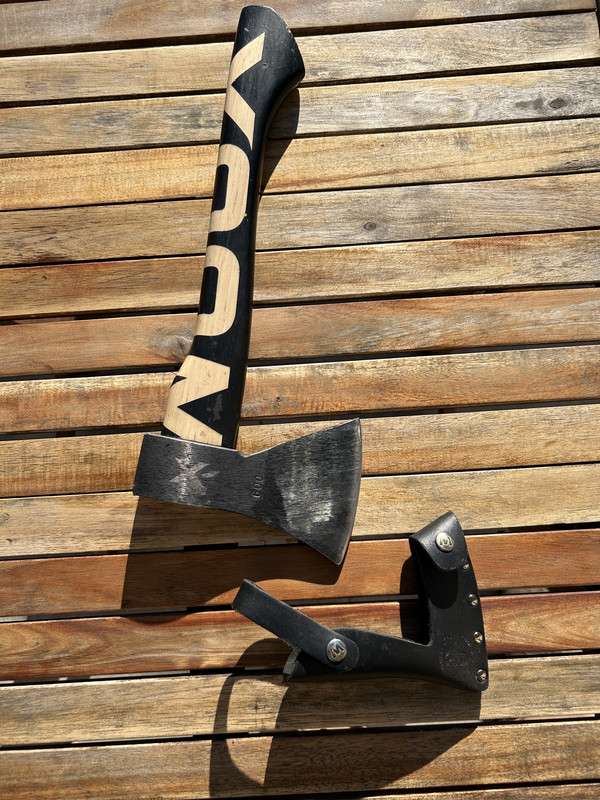
I’m new to this axe obsession… found this old axe and have been hand filing and sanding to clean it up. As mentioned previously, the only markings are a stamp reading “WESTON” along the poll.

Any help would be appreciated!

 
That’s a pretty head. Looks like it’s worth your time! Least valuable input first: The angles you show don’t let me see the Weston mark (on my phone…without my glasses) and also make the pattern a little tough to be sure about. Is it a Tassie? If so, makers who worked in the Australian market will be the ones to research. I’ve never seen it or heard of it.
Maybe more important is something I learned from the group right here. Depending on what you mean by “sanding”, you might consider stopping that.
My first restorations got sanded to absurdity because of the fancy YouTubers turning axes into mirrors.
Then someone here asked me something like: “which of the great old makers do you think polished axes to comb your hair in?” (The commenter was nicer and less sarcastic)
That black oxide you’re sanding away is very valuable, protective and bunches prettier than the silver. Save it!
 
Square shots from the side and top plus the mark will be the best way to get opinions on ID. The shots linked are at skewed angles and makes it almost impossible to read for clues on top of the heavily worn bit, pockmarked surface, and sanding that have all already obfuscated its identity. It's an uphill battle ID'ing pieces like this as it is without having to interpret the view angle and the way it visually compresses markings and form.
 
That’s a pretty head. Looks like it’s worth your time! Least valuable input first: The angles you show don’t let me see the Weston mark (on my phone…without my glasses) and also make the pattern a little tough to be sure about. Is it a Tassie? If so, makers who worked in the Australian market will be the ones to research. I’ve never seen it or heard of it.
Maybe more important is something I learned from the group right here. Depending on what you mean by “sanding”, you might consider stopping that.
My first restorations got sanded to absurdity because of the fancy YouTubers turning axes into mirrors.
Then someone here asked me something like: “which of the great old makers do you think polished axes to comb your hair in?” (The commenter was nicer and less sarcastic)
That black oxide you’re sanding away is very valuable, protective and bunches prettier than the silver. Save it!

Thank you!!!
 
While they were best known for broad axes and hatchets, the age, typeface, and placement makes me wonder if it's an Isaiah Blood. They were out of Ballston, NY
 
Interesting. I can’t find an Isaiah Blood example that fits the shape, but I’ll keep scouring.
 
They were only in operation as themselves for a fairly brief window and their tools in general are semi-rare. They were later absorbed into the American Axe & Tool Co. and the name continued to be used, mostly for grain cradle blades, bush hooks, and broad axes/hatchets. But they did make some "normal" axes. You just rarely find them in good shape. BUT it's also the only axe maker name that springs to mind that used that typeface and had a "'STON" prominently in their stamp other than the aforementioned "Charleston" Kelly axes which are not the correct period. So I wouldn't call it a conclusive ID, but certainly a possible one since the construction, overall form, and typeface of the mark all match the period that Blood was operating.
 
Thank you. I am flummoxed why I find this do damn interesting… but I surely do!

I’ll keep researching and very much appreciate your taking the time to help.
 
Back
Top