Plunge/Choil type preference.

Type of plunge/Choil you prefer

  • Top pic

    Votes: 0 0.0%
  • Bottom pic

    Votes: 0 0.0%

  • Total voters
    0
Joined
Dec 2, 2011
Messages
913
I don't make very many full tang knives, but have been thinking of making a few basic hunters. I see both styles from lots of different makers, and I see +/- of both. Safety being the biggest + on the lower sketch, and flow, in both looks and possibly in use, of the top pic. It might help my blood flow too.

Just thought it would be interesting to see what you all prefer, and maybe a short reason why. This is just a general question not picking a part my quick sketch. The lower pic could be with or without the mini Choil.

Thanks
Cody
B341FD56-4C60-42F5-9397-85ADCDAF470A-9061-000011C139D5441C_zps0c97c712.jpg
 
Last edited:
I like the first version. It has to be done right though! ...you need room and good indexing

Both choils can work very well when done correctly but I prefer the more snag free action of the first.

You can sharpen it all the way back or leave the grind thicker where the index finger meets the metal.


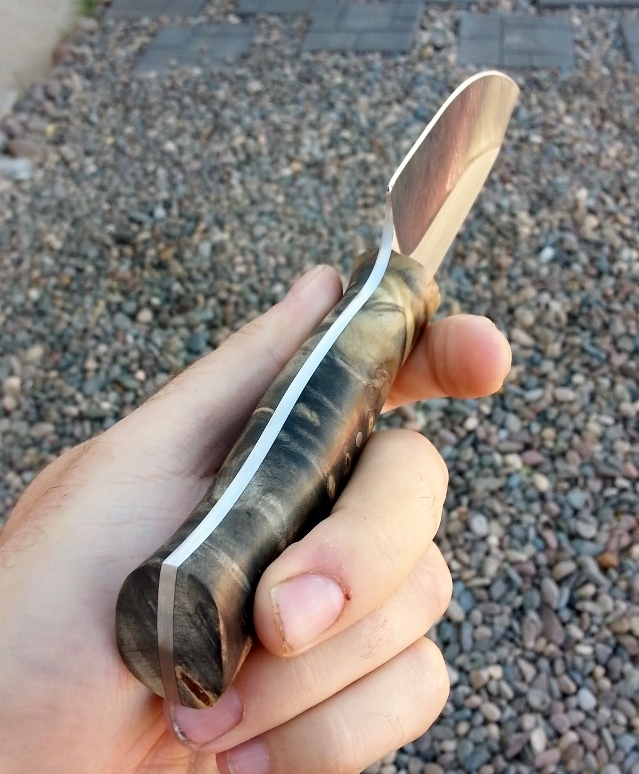
Here's one way to do it... the area where the index finger normally rests is thick and rounded for comfort. It is a single bevel grind by the way.

 
Last edited:
Bottom pic,I make some with the sharpening choil and some without. To me the top pic looks like a good way to get cut.

Stan
 
Bottom

For the top style to work for me the blade would have to be wider, like a chefs knife.

When designing a knife it is always good question to ask "Why" and have a good reason for it.
 
I am new at this, but I have done them as the top one. I tend to compound the curve to hold the finger in place a bit better. I always feel the Spanish notch is present to cover an error. I'm sure that isn't the case most of the time.
 
This is interesting! I see both sides. I like the look of the first one, but it does scare me a little. Like has been said earlier, it the first one can work, but has to be done right.

I believe that the little notch is a Choil, and not a Spanish notch, though that might be splitting hairs. I does get in the way sometimes, but does make it easier to sharpen. IMHO. We could have an over poll to see if the second pic, should it have a Choil or not. Bet that would be close also.
 
I hope you don't mind me chiming in here but as a knife user I prefer the top one. After the first few sharpenings the bottom design begins to look really bad to my eyes.
I like the top as well purely for aesthetic reasons. It just seems to flow better.
 
Cody,

For safety purposes, I usually put a .125" radius on that back corner. That way when you sharpen it, the edge start is moved slightly forward and around the corner from your finger.

Plus, the squared back as shown above can sometimes catch if cutting in reverse after a follow-through, depending on the geometry. I don't think the knife above would have any problem. Not really a right/wrong thing.

Edit: here's how I've been doing mine (this is one of my earlier knives, my plunge/edge thickness are better now) :

oyuAjbi.jpg


Edit2: I do the second style sometimes too, but without the notch. I'm not really sure why I do one and not the other. Just mood I guess.
 
Last edited:
It is a personal preference thing but I voted #2 as I once cut my finger on a style #1 while gutting and animal. #1 would be fine for other knives - kitchen knife comes to mind. I do like the look/flow of style 1.

Bruce
 
To remedy the catchiness of the sharpening notch (mine are rather large) ,I often sharpen the inside radius of the notch , so that the knife will cut its way out on the backstroke .
 
I like the drawing of "one" better but for safety I like the "2nd" one better.! By the time you get your hands bloody and the knife bloody and there is an ooops and whamo bamo there are stitches or worse.! Don't care how careful you are ~~ mistakes as we all know -- do happen at the wrong time.!** Enough said.
 
I like the drawing of "one" better but for safety I like the "2nd" one better.! By the time you get your hands bloody and the knife bloody and there is an ooops and whamo bamo there are stitches or worse.! Don't care how careful you are ~~ mistakes as we all know -- do happen at the wrong time.!** Enough said.

You are not kidding! When the knife is slick a I do not want my finger right up against a razor sharp edge.
 
When designing a knife it is always good question to ask "Why" and have a good reason for it.

I'm hoping for advice/comments on the functional benefits of the mini choil/sharpening notch.

If the bottom knife can be with or without the mini choil/sharpening notch, then it's function/purpose is separate from the safe handling issues raised?

What's the purpose of the mini choil/notch? If it has clear functional benefits then HOW can it best be implemented to achieve the defined functional objectives whilst minimising or avoiding potential negative consequences?

I had a look-a-round, and found the following potential benefits/purpose for the mini choil/spanish notch, all depending on how it is fashined:
1. Starting point for the edge and for sharpening, to make easier sharpening with reduced risk of damage to polished ricasso/guard/bolster/handle
2. Can give margin for forging/grinding error at the transition, can be used to disguise imperfections.
3. Drip point to reduce blood/liquid draining down the blade onto the handle.
4. Aesthetics or decoration (some notches are highly decorative).
5. Bushcraft activities such as ringbarking and stripping bark off willow etc., woodcarving or caning.
6. There are historic notions of functional rigging uses by sailors or stripping sinew
7. Blade catchers for fighting knives
8. Some contemprary applications suggested: ferro rod notch, sharpen bevel for use as a twine/cord cutter
9. Are there other benefits? Please comment?

Are the risks/disadvantages of the mini choil/notch limited to:
a. Increased risk of snagging "a great way to catch bits of cord and frustrate efficient cutting"
b. potential structural weak point
c. aesthetic disruption to the flow of curvature

Two options have been suggested already above to address the snagging issue:
- put a .125" radius on that back corner.
- sharpen the inside radius of the notch so that the knife will cut its way out on the backstroke

There are plenty of attractive and functional bushcraft/utility/hunting/neck knives made in both styles, and Ian's knife above is beauty. Both styles should consider safe handling and use in their design.

Personally I'm hoping to clearly understand the "good reasons" for including (or excluding) the mini choil/notch, and how it should be fashioned to achieve that purpose

Thanks,
Gus
Novice knifemaker, improving with every blade.

 
Last edited:
I like the second with out the sharpening choil. It leaves room for error when cutting things lol
 
Yes!
I agree that the top one looks better. I don't know that snagging because of a small notch like that is a real world issue, but a smooth line is really nice to see.
Feedback from users has made me go to using a notch on most of my knives that don't have a guard. The reason is, it gives your hand an extra unconscious message about where the sharp part is.
I don't necessarily think a notch is the ultimate design feature, it seems a little artificial, but it serves a purpose...here's a crappy cell phone photo of some almost done game knives:
https://www.dropbox.com/s/scltfttq3gvo5ei/2014-01-02 15.03.36.jpg

Kitchen knives are a different story, people stand upright at a properly sized counter and work with good light, so it's a very controlled environment compared to a general use knife...and folks still get a cut now and then.

When I was a teenager, a buddy stuck his knife in a tabletop (yes, we were tipsy) and ruined the tendon in his little finger when it slipped down. Made a very strong impression on me. I kind of hate knives that aren't designed with safety in mind, though some of them have really nice lines.
 
Last edited:
I like both but not in the same way. Besides the safety issue, I think that the two different design elements apply to two different kinds of knives. I tend to think of the first style as more rustic while the second style seems to me to be more refined. I like the little nub (sketch #2)to have some mass to it and define the ricasso area. Actually while designing I like to draw the same basic blade and handle but play around with the length of this area. I like the looks and the safety factor.

On the other hand, broad bladed skinning knives look best with the style of the first sketch. That extended ricasso area looks awkward with the broad blade. Safety factor is better too with the back of the blade to bump up against. I like how the makers of criollo knives (used by the gaucho) dealt with this design situation. Some belduque knives, which I assume is the origin of the criollo knife, have this feature too. While you are checking out some of those, look at the real "spanish notch" used on them. I think they are cool looking. By the way I think Willie71 was originally right on the nomenclature, the sharpening aid is the spanish notch and the part of the handle where one's index finger can go, especially when placed in the ricasso area, is the choil. At least that is what I have always thought, but I by no means consider my self an expert on such matters.
 
I prefer the look of the first pic for sure. That said, I've cut myself with a similar design.

As far as making, I've only made the bottom style. I'd like to try the first though. Anything I make is for me or a friend. Because of this I'm not worried about safety so much. For a customer though I dunno.

I always preferred the Spanish notch, that is until it was recommended that I try knives without. Now I prefer them without. I always thought the notch made it easier to sharpen, but I no longer think that.

Historically, with slipjoints, the notch was a sign of quality. On certain knives they look right.
 
Back
Top