If you look at a dozen different blades...you will see a half dozen different plunge cuts. I understand how to get the straight one..but not the quarter round plunge. This plunge has no true shoulder...it kinda just happens with no sharp definition. Is this done on a disc grinder rather than on a 2x72? How do others of you cut your plunge? It is an art all by itself. Thanks

-
The BladeForums.com 2024 Traditional Knife is available! Price is $250 ea (shipped within CONUS).
Order here: https://www.bladeforums.com/help/2024-traditional/
You are using an out of date browser. It may not display this or other websites correctly.
You should upgrade or use an alternative browser.
You should upgrade or use an alternative browser.
Plunge line geometry
- Thread starter John L
- Start date

- Joined
- Jan 5, 2005
- Messages
- 2,531
Hi John. I wondered the same thing when I started.That "quarter round" at the intersection of the horizontal and vertical lines of the grind is "sculpted".In other words rather than making a 90* corner , you lighten up on the pressure you are applying against the belt and kind of fuzz the quarter round in.I find it much easier to get the "quarter round" you are talking about on my 10" contact wheel rather than the flat platten.Some of the guys here are masters at "sculpting" with the flat platten.That is part of the learning curve.It is fairly easy to learn to flat grind or hollow grind a blade.Getting really good at it is what takes time  Just like anything else I guess.Hope this answered your question
Just like anything else I guess.Hope this answered your question

- Joined
- Nov 24, 2003
- Messages
- 2,357
A slack belt or rotary platen will create the rounded plunge cut and a convex grind.
John, all my grinding is flat and all of my plunges are sculpted. To get the 1/4 round appearance I run my belt slightly over the edge of the platen and work the plunge into the edge of the platen while running the belt at fairly slow speeds. I then move the tracking so the belt runs off the other side of the platen and do the other side of the blade. It takes quite a bit of practice, but you can get your plunges looking straight, but sculpted.
Note that I do not roll the belt until I am into the 220 grit range. I do some roughing with the edge of a 50 grit belt, much like David describes. The 220 belt is a J-Flex (real flexible), whereas the 50 grit is a stiff, X-weight belt. Once you have roughed the plunges, the J-Flex will roll right into the plunge and give you a beautiful finish once you get the hang of it.
Note that I do not roll the belt until I am into the 220 grit range. I do some roughing with the edge of a 50 grit belt, much like David describes. The 220 belt is a J-Flex (real flexible), whereas the 50 grit is a stiff, X-weight belt. Once you have roughed the plunges, the J-Flex will roll right into the plunge and give you a beautiful finish once you get the hang of it.
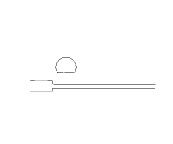
If you want it perfect, use a file guide, and a round file the diameter of the steel thickness, then grind and blend to it. You need edge lines to know when to stop filing below, and you need to stop about 3/32" from the horizonal grind line, or the spine , depending on your grind. I didn't always make early type knives. This method is nearly foolproof, as long as you are good at using a file. Try it on a piece of scrap, and you will see.

- Joined
- Jun 15, 2006
- Messages
- 108
Ive done a couple exactly how fox describes. Im as newb as it gets too and didnt find it awfully hard although I do have a fair bit of experience with belt grinders on wood. My rounded cuts came about coz I stuffed up the square ricasso! But if anyone asks its to eliminate stress risers. 
- Joined
- Jan 5, 2005
- Messages
- 2,531
David Wesner said:I find it much easier to get the "quarter round" you are talking about on my 10" contact wheel rather than the flat platten.
I should have been specific in that I find it easier to get the quarter round when I'm hollow grinding.When I am doing a flat or convex grind I struggle creating the quarter round look using the platten.
psycho78 said:I read in the Loveless book that you can take a big round file and grind a safe side on it, and run it along the plunge, hollowing out the plunge. This technique may not make the results you like, but I hope it helps anyway.
I have a feeling we're not all on the same page here.I did a little sketch to try and clarify exactly (I think
) what John L is asking about.Let me know John L if this is what you're asking about . I'm pretty good at :foot: .Anyway here is the sketch that shows the "quarter round"I'm talking about....well hard to explain...if a hard plunge is a straight line from edge of blade to spine..then I'm asking about a C shaped line from sharpened edge to spine. Not a hard inside corner but a smooth transformation from grind to ricasso.

Stacy E. Apelt - Bladesmith
ilmarinen - MODERATOR
Moderator
Knifemaker / Craftsman / Service Provider
- Joined
- Aug 20, 2004
- Messages
- 38,381
The "C" shaped ricasso/grind line is done on a disc grinder (or the side of a grinding wheel by Scagel ).

- Joined
- Jul 27, 2003
- Messages
- 5,689
I think you're talking about the grind going as this example shows. I hope he doesn't get mad at me, but this is an example of the grind as done by, who I consider, the King of the Fine Grind, Jim Siska. He will be giving grinding demos at the Ashokan knifemakers conference in a few weeks.
Note that it is a hollow grind.
I am successful at this by tracking the belt drastically off of the wheel letting it creat this "soft" radius.
Note that it is a hollow grind.
I am successful at this by tracking the belt drastically off of the wheel letting it creat this "soft" radius.

- Joined
- Jul 4, 2005
- Messages
- 135
The 'C' shape plunge/ricasso can also be forged in place when forming the bevels...then when it somes to grinding, the belt tracks into the bit that was forged to clean it up..
- Joined
- Jan 5, 2005
- Messages
- 2,531
I see said the blind man
- Joined
- Jun 15, 2006
- Messages
- 108
Yep, thats the style of mine but better. As said before; done by running belt over edge of platen. Vert useful for roughing out curves too. Best work like this that ive seen was done by a guy named 'bona' on these forums although I think his grind was hollow all the way. He might've used a wheel methinks. 