Poisonous Blades!?

Joined
Nov 4, 2007
Messages
246
I have always avoided using coated blades in food preparation. Even Dupont
admits that teflon can release toxic fumes when exposed to high enough temperatures.
I'm considering the purchase of an RC-4 or 5. But when I take it into the back country it will need to be used in food prep. Very briefly at times exposed to flames, but probably more relevantly, to acidic juices or boiling water.
(yes, because my knife is always right there on my belt , it often gets used as a spoon, and occasionally even a fork . . . you know how it is)

Any knowledge, or even just intuitive thoughts on this would be appreciated.

Thanks in advance, Mick.
(crust never sleeps!)
 
This comes up very frequently. Coatings, food poison from metals etc.

I'm sure youll be fine.

But get a knife with a satin blade if your worried about it... There are lots of good ones to choose from!
 
In my humble opinion, even if you scraped off every bit of coating, and ate it all in one sitting, you'd be just fine. Likewise, you could heat the knife to 600+ F (ruining the temper), collect and inhale every bit of vapour created, and again, you'd be fine.

Your risk of choking on the food, burning yourself, cutting an artery, etc., is much greater than the threat posed by any commercial knife coating.

Frank
 
I like uncoated stainless blades for food prep. It is more of a taste issue than anything else. Stainless is particularly resistant to acids in foods and avoids adding a metallic tang to my grub.
 
IIRC, Teflon has to be heated to 500* before it can cause damage.
Unless you are planning to blacken on your knife blade, which would ruin the heat treat, I wouldn't worry about it.
(Also, I would use a stainless blade for food prep. I normally like carboon, but I've found it lends a metallic twang to food that I don't really appreciate.)
 
I hear the same thing about oiling your blade. I think we have become far too worried about if we will live to be 90 or 90 and 1/2. Come on everyone you breath more harmful things in ambient air than you will get off your knife.
 
I don't see anything wrong with it :)

I see what you are saying, but I'm not too worried about it.


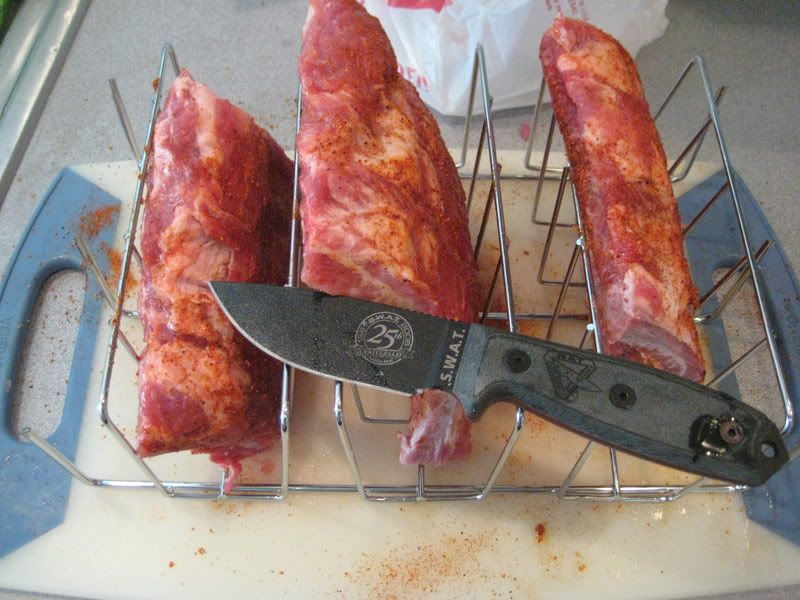
042.jpg
 
Could you move that knife, I'd like to get a better look at those ribs.

Thanks

MikeC
 
if it worries you buy a cheap stainless mora for camp kitchen chores they only cost 10bux and the dont weigh enough to really add any extra burden plus being super thin and sharp they really are awesome for kitchen work.
 
I despise the use of teflon in pots and pans, but for knives, I'm not worried. Knife blades tend to stay clear and smooth by their very nature while pots and pans (which are exposed to extreme heat) can flake into the food itself. Teflon is an extreme poison that may or may not be responsible for a number of health problems, but a knife's teflon doesn't normally flake, neither does the teflon accumulate. Just using a knife will keep it smooth and safe.
 
This post got me thinking. Clearly the coatings aren't dangerous, but what about an instant blueing product. I recently bought some to use on a knife I'm making. Should I avoid using it if I wanted to use the knife for occasional food prep. The product has many warnings about it being toxic, but it is supposed to be wiped and cleaned of the blade.
 
I despise the use of teflon in pots and pans, but for knives, I'm not worried. Knife blades tend to stay clear and smooth by their very nature while pots and pans (which are exposed to extreme heat) can flake into the food itself. Teflon is an extreme poison that may or may not be responsible for a number of health problems, but a knife's teflon doesn't normally flake, neither does the teflon accumulate. Just using a knife will keep it smooth and safe.

As long as you don't superheat Teflon (I think 500* is the mark) you should be safe. Don't blacken, sear, etc in it, and don't broil in it. Also, keep food when heat is applied to it.
Birds are particulary sensitive to poisonous gases- I believe this is why miners would take birds into the mines with them (if the bird kicked it, it was time to get out) They are also sensitive to Teflon gases. Again, this shouldn't be a problem if you don't get your pans really hot, but if you keep exotics around, it might be a good idea to play it safe and use non nonstick pans.

Also, newer Teeflon pans won't lose their coatings as easily. Older ones, just a thin, flat layer of Teflon as applied. Was very slick, but scratched off easily.
 
I wouldn't use a home-blued blade on food. It doesn't really offer good corrosion protection and you will get bad stuff in your food. You may even be able to see a residue on light colored meat. I like to use straight paraffin wax or mineral oil on carbon steel blades.
 
Back
Top