Possible Kabar mystery

Joined
Oct 9, 2015
Messages
2
I have a USMC marked Kabar 1219. So far not very mysterious.

BUT it does have 2 things that are at least somewhat unconventional. First, the handles are plastic. Second, the pommel is a screw on.

1)
The handle discs are the clear acrylic/plastic/plexiglass handles that seem pretty common on theatre handles. EXCEPT, there are red discs as well. Not a solid opaque red like you find on some Kabars, but a transparent red. They are thicker than the opaque red ones as well. Did the clear plastic come from aircraft windshields like is "common knowledge"? That always sounded like a sales pitch to me. Where would the red have come from?


2)
The second mystery is sort of bigger in my mind at the moment. My research tells me that there were no actual Kabar made screw on pommels, all screw ons were Camillus and those were only very early in the war. Kabar had peened or pinned. Of course, the knife is lacking the original pommel. The screw portion could have been welded on, I suppose, and it kinda looks like it in the picture, but I don't really think it looks welded in person. It also seems odd to do that as a theater fix. But then again, I could be mistaken, the only perfect people are moderators :D The screw portion also has a hole where a pin might go but the "new" pommel doesn't have holes for pins. I can do more pictures if requested.


8814b37f-0637-4110-9969-e295bf2ccf4a_zpseflwsifa.jpg
 
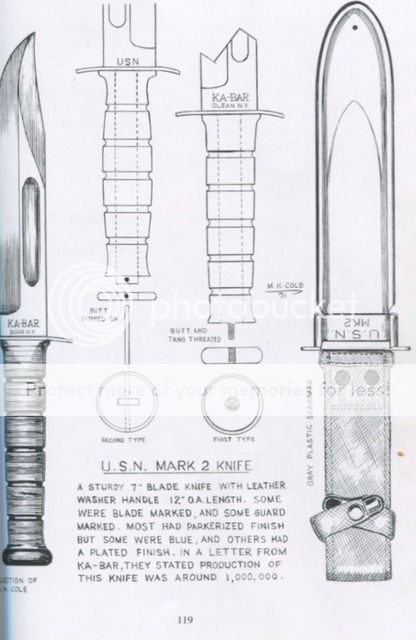
M. H. Cole referred to these KA-BAR marked 1219C2 knives as the (first version).

coles%20KaBar%201219C2%201_zpsfucaryou.jpg


One of the fundamental problems routinely associated with "theater knives" is trying to determine when and where the (theaterizing) occurred.
I've certainly seen other knives that have translucent red parts.
I think it would help with the discussion to have images of the hilt to see first hand.
 
M. H. Cole referred to these KA-BAR marked 1219C2 knives as the (first version).

coles%20KaBar%201219C2%201_zpsfucaryou.jpg


One of the fundamental problems routinely associated with "theater knives" is trying to determine when and where the (theaterizing) occurred.
I've certainly seen other knives that have translucent red parts.
I think it would help with the discussion to have images of the hilt to see first hand.

Nice reply Sac troop. Also, I'd like to see the knife as well. :thumbup:
 
Sorry for the delay in more pictures, but I think they will not really lend much to identifying the knife in question. In the "first version" knives, were the threaded pommels also pinned? The one I have has a hole where a pin would conceivably go.
Thanks for the image, it is helpful and neat.

I am aware that authenticating "theater" handles is pretty much impossible, and I would rather have an honest answer than an optimistic one. I was just wondering if anyone had any solid information on the windshield claim and I'm not just kind of curious to see if there was any source of clear red plastic. If you take one of the red discs off, it looks more orange-y or a really dark amber color.


The hilt is brass, and I would guess not original.


How the red looks from the side


Here is the Kabar marking with very faint Olean underneath.


Here is the USMC


Here is a top donw view of the hilt. Plain brass, no markings. I know Kabar has made some knives with brass hilts, but I don't think I've seen any military issue Kabar with brass a hilt.

 
The handle, hilt and guard have all been "reworked" at some time. You are right in that no 1219C2/USN-MK2 was ever made with either the guard or the hilt made of brass. Both were only made with steel. The first versions were made with 3/8" thick pommels and plain, unmarked steel guards. These pommels and tangs WERE NOT pinned. Only the thinner, 1/4" pommels, were pinned. The pins went all the way through the pommel and tang, so "WW2 Original" 1219C2s have a pin visible on both sides.... no blind pins (only go 3/4 of the way though) as found on current Kabar model #s 1211/1212/1213/1214

Camillus made the very first 1219C2s, which were delivered to the US Navy Supply System in February 1943. About 50,000. These first knives had 3/8" thick steel pommels. The bitter end of the tang was threaded, as was the pommel. This first version had split nuts acting as a snubbing nut to lock the pommel tight after it had been screwed on.

The first change order to the specs for the 1219C2 came out almost immediately. The change was to eliminate the split nut and simply peen the tang tight. The result left a ROUND peen stamp dead center on the pommel. KABAR never made a split nut version (nor did PAL or Robeson-Shuredge, the other 2 of the 4 WW2 1219C2 manufacturers).

It is PROBABLE, but not documented anywhere, that Kabar had already started making their first bactch of 1219C2s/USN-MK2s before the change order came through. If so, it would make it very likely that some of the knives would have had the tang end threaded already in preparation to assembling them under the split nut spec. All Kabar would have had to do on any they had already repaired (so that the knives would meet "new" standard was screw the pommel on and peen it over.

The various changes were made to improve the construction of the knives (keep the nuts from coming loose and/or the tang breaking at the last thread) OR save materials (3/8" o 1/4" pommel thickness) OR were made to speed up manufacturing by eliminating manufacturing steps, e.g., rounding and threading the tang, lining up the split nut and tightening with a wrench, etc.. The shifting of the stamp from both sides of the blade (company name on one side and "model" {USMC/USN} on the other) to the guard allowed for the info to be stamepd into the guard at the same time the guard was stamped out and eliminated the need to place the knife in the stamping machine, stamp it "KABAR", then turn it over and stick it in another stamper to stamp USN or USMC on it.
 
Now shifting to the plastic used for the handles. Realizing that a knife could be "theaterized" at any time between 1943 and 2015, I am going to limit the post here to JUST WW2 time frame modified knives.

One of the downsides to using leather for the handle disks and sheaths of the 1219C2/USN-MK2 (or anything else for that matter) was that the hot, wet, muddy, salty conditions of Pacific theater operations meant leather components quickly deteriorated/molded. Field expedient repairs were made with what ever materials were available.

Plastic was available from a variety of sources - aircraft canopies, instrument gauge covers, landing light covers, ALDIS lamp filters, vehicle tail light covers, etc....

A majority of disks you see on theater knives are clear mainly because you could get a lot of disks out of a single crashed/shot up airplane. Red, amber and green were less readily available for a simple reason - not as many items used the colors and also didn't get broken as easily to be available for scavenging. The most likely (but probably not the only) source of the colored plastic would have been signal light filters. Prtable signal lights were used for Morse code communications between aircraft and ship to aircraft when radio silence was imposed or radio transmitters and receivers were inoperable. ALDIS lamps, the primary hand-held signal lights of the Navy and Marine Corps came with green, red, and amber filters in various shades of translucency. The excess filters were just lying around and when a broken lamp was replaced, the new lamp came with a whole new set of filter, leaving the old set to be scavengeable.

I would think (my opinion only) that a knife with LOTS of color disks was probably repaired on a ship during a transit from one island offensive to the next, mainly due to plastic availability. Any knife with nice brass hilts and/or guards was made either on a ship in its machine shop or in a mobile machine shop under the control of a Seabees unit or a Marine vehicle maintenance unit due to the level of finish seen on those knives.

A theater knife can, unfortunately, be made at any time. I could make one this afternoon simply by taking apart an new and replacing the leather disks with plastic ones. Only through destructive testing of the plastic disks to determine the chemical composition of the plastics used for the modification cud you tell WHEN the plastic used was made, not when the knife was modified. i have pieces of old plastic out in a couple of sheds from the 1940s and later that I could used to make my mods "more period correct".

I would still like to see an overall shot of the knife, just to put everything into a single graphic.
 
I would still like to see an overall shot of the knife, just to put everything into a single graphic.

Same here. Thanks for the information all. I'm going to look into the first production 1219C2 Camillus knives issued in WWII. Interesting. It is so interesting to me to think that someone somewhere went through a theatre of war and worked on those knives by hand in-between duty and conflicts. What a piece of art with such a story; told or untold. Collecting trench art is an interesting hobby. Thanks for sharing.
 
Back
Top