Practical, not pretty, quicky knife sheath

Joined
Apr 3, 2006
Messages
1,465
These photos are not of a high standard sorry... I probably should have waited for daylight to take them.

On another thread I was asking for ideas to help solve my sheath problem. I wanted a sheath that would allow me to withdraw and insert my knife with just one hand if necessary.

I came up with a solution today. I quickly whittled a bit of wood to the shape of the knife... with the handle portion just a tad thinner than the thickness of the real knife's handle...but a bit wider at the same time.

I then got a bit of low density polythene water pipe. The size I used has a nominal size of three-quarters of an inch (plumbing standard), or 20mm as we call it here. I put it in a pot of boiling water for a short time until it became quite soft. I then pulled it from the pot and shoved in my wooden "knife". The plastic was soft enough to mold into shape around the wood. I ran cold water over it to cool it down, then pulled out the wood (which was difficult - I had to use a vice).

The next step was to trim it to size, and punch a hole through the end for the cord.

To fasten it to a belt one end is tied with a bit of cord. Rubber bands made by cutting "rings" off an old rubber glove hold the knife end of the sheath. I actually use a bit of thick cord more than a leather belt, but the principle is the same.

The sheath could also be fastened to a pack strap in a similar manner.

If you want a neck knife you can just hang it by a cord through the hole at the end of the sheath.

The knife can be put back into the sheath with one hand. If you are wearing it as a neck knife, you simply start the blade into the sheath, then lift the whole thing until it is at right angles to your body. You then simply push the knife in (carefully).

The knife is held securely. A bonus of this type of sheath is that you are using food grade plastic, and you can easily use a bottlebrush or something to clean it. I like my knives and sheaths to be clean seeing I prepare food with my knives.

Some designs of knife would be more suited than others to this type of sheath

The top picture shows a home-made machete I use when I go setting traps. I cut it from a big saw blade. The small knife was ground from a bit of heavy bandsaw blade.

PolysheathOnBelt.jpg

PolysheathCordBelt.jpg

PolysheathNeckKnife.jpg

I know that I've been writing a lot of posts lately. I am sort of on holiday right now, and I really enjoy sharing information on this forum. :)
 
Coote,

I love your knives. When steel meets flesh/nature steel usually wins.

That machete has the look of someone who knew what he wanted. I really like the shape. That blade would work just fine here as well.

Down here it is common to see knives tossed in packs with just a cork jammed on the end.

The pipe idea looks good. I can't get kydex here in Brazil. I'm going to have to look into what is available in other plastics. I had all sorts of plastic pipe left over from my house construction but its old and brittle now. You could probably make a decent "sheath" for a folder with that method as well. Mac
 
coote you just keep on sharing . If " To post or not to post " is the question ? Post away .

In fct you made a post of a white leather one piece no stitch sheath . If you could post a pic of the knife in and out of the sheath . I have a hrd time seeing how the blade is inserted/protected .
 
That looks like a slick solution.... you did good! Like Mac, I like the look of the machete. How long is the blade on it? From the height of the edge grind, it looks like it has a pretty thin edge.
 
Rok Jok: The machete blade is about 10.5 inches long.... and it is about 2mm, or 0.080 inch thick. I guess the blade was a bit thinner than I would have liked, but I just used the steel that I had.

I've never had much joy with machetes or slashers. Slashers might be called brush hooks in your part of the world. They are good for some things, but I have found that when I want to cut nasty, springy barbed vines I am not as successful as I would like to be.

I used to carry a small hatchet more than a machete when setting traps. I could chop stuff and use the back of it to hammer nails or pegs. However I don't generally use nails now, and I seldom need to cut a big peg. I have started to take the machete out a bit more lately. It is good when I want to cut finger sized bits of brush to help narrow down the width of a trail on which I want to set a snare. I avoid cutting our native trees, I generally am cutting the thorny pest plant gorse which was brought here by some well-meaning settlers. I have cut some bigger stuff with the machete too, and I am quite pleased with it. I carry it in a conveyor-belt sheath in my pack. If I need to drive a peg I try to find a suitable rock.

The top picture shows the machete, and the little knife and sheath that Kevin was asking about. I can't remember for sure what I made the blade out of on this wee tool. It was probably a bit of bandsaw blade. It was a "quick" job, but it has lasted quite well. The handle is stuffed into a slot in a bit of kanuka branch and is held there with two rivets made from heavy copper telephone wire. It is not a full tang knife. I think I may have originally intended it to be a grafting knife.... I am keen on growing fruit and I have a number of varieties of apples etc grafted on to trees in my yard.

The rest of the photos give more detail regarding the sheath and the method of holding the knife in it.
1. The knife has a hole through the handle.
2. The loop of cord tied around the sheath is passed through the hole in the handle. The loop has two tails formed by the knot. These go through the hole first.
3. The loop is then passed over the top of the knife with the tail ends sitting between the knife handle and the sheath.
4. The knife is released by pulling upwards on the tail ends of the knot on the loop. The size of the loop is fairly critical for security.
5. The knife can then be pulled from the sheath. The loop is pulled back through the hole as the knife is drawn.

The bottom photo shows the sheath pulled apart. It is easy to clean the inside of this sheath.
GraftingKnifeandMachete.jpg

LoopThroughHandle.jpg

LoopPassedOverHandle.jpg

SheathPulledApart.jpg


I don't know of a local source for Kydex either Mac. It seems like it is good stuff. I haven't experimented yet, but some of the plastic bottles and containers I've seen around here might be worth playing with as sheath material. Riveting or stitching could be the challenge. Maybe it would just have to be folded into the right shape then bound with tape or cloth or something. Good old leather looks nice and it is generally what we expect a sheath to be made out of.... but I think plastic is better in some ways. Knives with thin handles and no guards can be a heck of alot easier to make sheaths for than some other knives.
 
I have buddies on the forums who work with kydex a lot . Where is the best country for you to get it from ? If possible give me a second country as an alternative . Be aware , its expensive stuff .
 
Hmmm.... Kevin are you offering to help me get hold of some Kydex? That is a nice offer thanks. I don't need any at present, but I really would like to know more about it.... like how well it can be sewn or riveted etc. Perhaps you could point me in the right direction so I could find some reliable information on the stuff.

And then, being the frugal sort, I would probably just see if I could use similar manufacturing methods on whatever plastic I can scrounge locally. Actually I get quite a bit of satisfaction out of "making do" with non-standard materials.

But... if I did want Kydex, the question is where is the best country for me to get it from. Well... it doesn't really matter... it all boils down to cost and getting the payment to the supplier. Some folks don't ship overseas, some may not accept a NZ credit card. Any country other than NZ will involve some unpleasant freight costs :barf: .

So meanwhile please don't worry your pretty head over finding a source of Kydex for us disadvantaged colonials... but if you know of a source of reliable information on the stuff I would be grateful to learn some more about it.

You are obviously a good bloke. Much appreciated.

It is a bit silly really. Here I am still obsessing over new knives and sheaths when I already own enough to last several lifetimes. I'm a bit the same with ammunition.... and I'll bet there are others like me.
 
Good job Coote, I respect a man who can improvise.

Nothing like the satisfaction of doing somthing yourself.
 
Honestly synthetics would never be my first choice . Kydex is incredible stuff though . I have two form fitting sheaths . One for a becker necker and another for a spike knife . Both are secure enough to dangle upside down with the handle swinging in the breeze . It is a heat activated material . I hear of it being heated in an oven and hot wrapped around the blade . One of my buddies even stood on his to get a good pressure form fit . My necker just about snaps into place . Drilled and with special screws or rivets . black and slim . Not much of a bulge in a pocket .

The heat activation is important . I think its toughness is another one of its main attractions .

Someone from Brazil also expressed interest so I thought I would see how available it is outside the U:S: .
 
Thanks for the nice comments.

Dang Kevin... you never seem to be far from the computer. It's winter here and I am on holiday.... what's your excuse?

A few years ago I had a job where I had to sit in a guardhouse at the entrance of a large processing plant. At times there wasn't much to do. Fortunately I had worked in other parts of the plant and I was on good terms with the computer guys and a lot of other folks... and I had a log-in that got me on to the internet. That is when I really started to get acquainted with the good stuff out there on the 'net. It is just fantastic.

Interesting about that Kydex.... so you use heat to form it. I thought that maybe it was just a resilient sheet that you could cut out and rivet together. I must do some more research.

Incidentally, when I checked my snares this morning I had no pigs in five pig snares, but I got five possums from 22 possum snares. My new little knife with the low density polythene pipe sheath performed very well cutting away the flax fastenings and skinning and jointing three of the possums. It had lost its shaving edge at the end of the day's work, but it was still sharp enough to do more. Inevitably the edge runs up against bone when I am cutting the possums into portions for the freezer, and this doesn't help. I only select the best possums to eat.... so while I plucked the fur from all five, I only needed to skin the three tender-looking ones. It seems wasteful to throw possums away, but they are considered to be one of our main animals pests and we are encouraged to get rid of them.
 
Thanks once again Doc. I don't know whether you should be classified as help desk personnel or chief research librarian. I think I will go with the researcher classification for now.

Making a sheath out of Kydex doesn't appear to be all that difficult after looking at that site. It strikes me that one of the major advantages of this stuff is that you can make the sheath so snug that it grips the blade.... thus allowing a smaller sheath and no fastening domes etc. It doesn't have a lot of character to folks like me who have grown up drooling over nice bits of leather....but when I put emotion aside I would have to say that it seems better than leather.
 
Kydex is beter than leather in a few aspects. It won't rot nor rust your blade if you make a drain hole in the sheath.

I have never worked with it personally but I have watched a friend make a sheath with it. He used a beefed up hair dryer to heat it and then pressed it around the knife in a home made press covered with dense foam. Very easy to learn. Mac
 
If you saw my computer set-up you would understanf my easy access to the net . As is more common now I have Cable , Internet and could have telephone all combined . I have an articulated extendable monitor tray with a table for a keyboard . I don,t use it for a monitor just keyboard and mouse pad . (Oh yeah ...a few knives . L:O:L )THe keyboard extends over to my futon bed/couch and it is clear sailing from there .

My poor old computer is the weak link in this chain . I want to hook it up to a D:V:D:home theater I have . This will give me the ability to try and edit music that I like .

Oh there is one more weak link . Me . L:O:L I,m on the same level as my Pentium 2 . I need some upgrades to have U:S:B ports and a C:D:/D:V:D: burner . My present set-up can handle all this , just barely . I don,t have quite enough knowledge or cash to do it the old fashioned way .

Oh Yeah , as much as I like the little buggers > Could someone tell me why these little smiley @##$$%$ show up when I didn,t select them . It is always in place of a D . (Oh poop this D will proabably show up as a big smile . L:O:L
 
info@kleerdex.com

That is the E-mail for the parent company in the U:S: . Maybe they could help with a Brazil or N:Z: source . Apparently they make kydex up to half an inch thick . If you saw how impervious the 1/8th stuff is the thick stuff must be bullet-proof .
 
It is much more expensive to get involved in knife-making as opposed to kydex sheath making.

I would love to get into knifemaking but I'm a bit hard PRE$$ED to afford a belt grinder, steel, handle materials, etc. I looked into it while I was back in the States during 2004. The initial investment and learning curve are pretty steep.

By contrast learning to make decent kydex sheaths is much more cost effective. Heater, home made press, rivets, screws, etc. The techniques are not hard to master.

Make no mistake, I am an off-the-rack knife user. I also have a "sack o'moras" (12 at last count, some bought, most donated) just begging for decent kydex sheaths. Mac
 
Hey Pict . Don,t you have any birch trees around ? I,m working with birch bark for sheaths right now . Its supposed to form fit by heat as well . NOT !!!!!!
Personally I think its a lot of fun . At least I am getting something out of it .
 
Nice designs, Coote. That white sheath especially is ingenious.

Various plastics can be used for this sort of thing. The following two pictures show an axe guard made from a piece of plastic eavestrough (aka rain gutter). Probably PVC or vinyl.

Sheath1.jpg


Sheath2.jpg


I heated the plastic with a heat gun and folded it double over the edge, then molded it around the head and riveted it together with aluminum pop rivets. Not pretty, as you say, but it has held together for years.

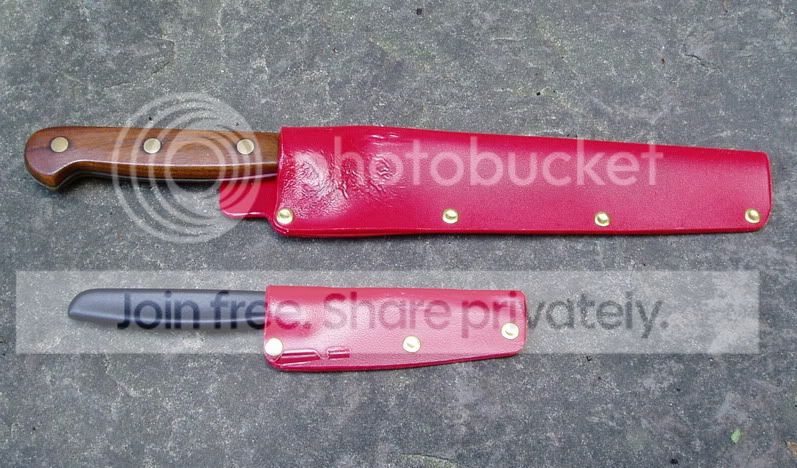
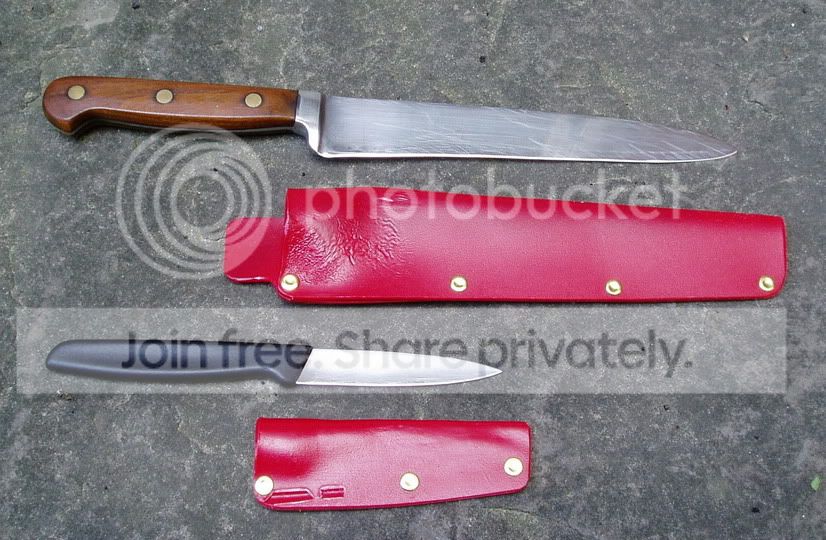
The next pictures show two knife sheaths I made to carry kitchen knives on canoe trips.

Sheath3.jpg


Sheath4.jpg


The plastic is from binder covers, meant to hold stacks of the old tractor-fed computer printouts. It's about 2mm thick, flexible but tough enough to be hard to cut with a knife (I use sheet metal shears).

I pinch the sheath just above the guard while it is still hot. Once it has cooled, the knives snap into place very securely. The marks on the large sheath come from pressing the hot plastic with a leather glove that I was using to protect my hand. The rivets in this case are two-piece brass rivets that you just hammer together. Both these sheaths have big enough gaps at bottom that they drain easily, but they are harder to clean than your design.

I'm sure Kydex is tougher, and probably can be formed more precisely, but for utilitarian sheaths like these the cheap stuff does fine. It would be interesting to build a proper press and see if one could do as good a job as with Kydex.

I seem to recall that Puma used something like your cord-loop retention method (maybe they still do) for their stag-handled hunting knives.

iSaur
 
Back
Top