
Pre HT Finish

Joined
Aug 28, 2009
Messages
7,951
I have finally started working on that kitchen knife for my mother and I have it profiled and was smoothing off the rough factory texture. I had originally just started sanding withthe thought of gong to my normal 400-600 grit pre HT finish. Then I got thinking, I am not grinding in the bevels till after HT, so just how finished do I need to take this before HT:confused:

I can't see the need to have a super fine pre HT finish if I am just going to grind it off when it gets back, but I could be wrong to and the steel need to be brought to a certain level of finish before HT, even if its going to be ground away.

Yes I am over thinking this:o but I figured it would be best to ask the people in the know before I put too much effort into a finish that will be ground off, or not put enough time into it and be left hurting in the end.

The knife in question is is made from 3/32" 154CM, has a blade length of 7" and an overall length of 11 3/4" and here is a quick scan of it. It is based on her favorite knife, but with some handle mods to fit her hand better.
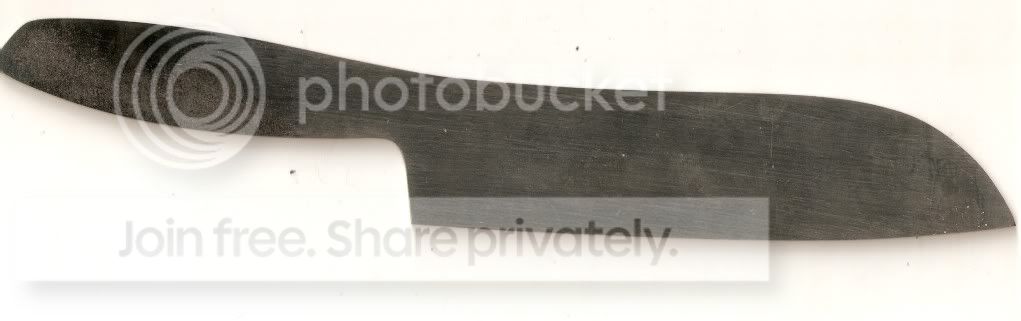
scan0044.jpg
 
Yes I am over thinking this:o...

No you're not, those are perfectly legitimate questions. The thing is, how much oxygen will your blade be exposed to during the austenizing cycle? That's what creates the nasty scale.

It really depends on your HT guy. If he's using a vaccuum furnace there will be next to zero scale even on "plain" carbon/oil-quenched steels, just a really thin layer of oxide color from tempering. You can go right to your desired finish and very close to final edge thickness. You'll have just a little touch-up work to do when it gets back. If he's using a normal kiln but wrapping the steel well, you still shouldn't have much scale. You'll just have to ask him :)
 
I send everything to Rob at Knifemaker.ca for HT, and going by what he has in the Evenheat manual he double wraps in high temperature, 309SS foil envelopes with some brown paper inside to eat up the oxygen. This knife wont be ground till after HT because Rob said that there is too much of a chance of warping if it is ground before hand. I will still send Rob an email to see what he suggests.
 
I just realized it's pretty thin stock, which makes sense for a kitchen knife. In that case yes a lot of makers grind post-HT to avoid warpage. Rob has a pretty good reputation, I'd go by whatever he suggests :thumbup:
 
I wouldn't be worried about warpage from 3/32 CPM154. It's an air cooled steel, meaning you should be plate quenching it, not oil quenching. Much less likely to warp between plates than dipped in oil. It can still warp, but nothing that can't be straightened during the tempering process.
 
I agree with grinding the bevel after HT, (if your are doing the HT yourself) I do a full flat grind so not much need to do a nice finish I will only go to 120. When you go to grind after HT, use new belts and a slow speed, the CPM 154 will laugh at used belts and heat pretty quickly. Better get your holes for the handle drilled!! If you want to save alot of trouble grind and finish to 400 grit and send out for HT, it will come back ready to finish. I dont do my kitchen HT anymore, they alway warp a little.
 
"I send everything to Rob at Knifemaker.ca for HT, and going by what he has in the Evenheat manual he double wraps in high temperature, 309SS foil envelopes with some brown paper inside to eat up the oxygen. This knife wont be ground till after HT because Rob said that there is too much of a chance of warping if it is ground before hand. I will still send Rob an email to see what he suggests."

If that is what he told you, you have the wrong heat treater for that steel. I used Paul Bos when I was working with stainless. He told me that I could put on the final finish, and grind them to the point of just needing to be sharpened. They always came back only needing a clean up by hand.
 
"I send everything to Rob at Knifemaker.ca for HT, and going by what he has in the Evenheat manual he double wraps in high temperature, 309SS foil envelopes with some brown paper inside to eat up the oxygen. This knife wont be ground till after HT because Rob said that there is too much of a chance of warping if it is ground before hand. I will still send Rob an email to see what he suggests."

If that is what he told you, you have the wrong heat treater for that steel. I used Paul Bos when I was working with stainless. He told me that I could put on the final finish, and grind them to the point of just needing to be sharpened. They always came back only needing a clean up by hand.

There is nothing wrong with Robs at knifemaker.ca (aka Ranger Original) HT, and the simple fact that Evenheat includes Robs process for stainless steels in their manuals put him in high standing in my books, and many others for that fact.
 
No you're not, those are perfectly legitimate questions. The thing is, how much oxygen will your blade be exposed to during the austenizing cycle? That's what creates the nasty scale.

It really depends on your HT guy. If he's using a vaccuum furnace there will be next to zero scale even on "plain" carbon/oil-quenched steels, just a really thin layer of oxide color from tempering. You can go right to your desired finish and very close to final edge thickness. You'll have just a little touch-up work to do when it gets back. If he's using a normal kiln but wrapping the steel well, you still shouldn't have much scale. You'll just have to ask him :)

This "scaling during heat treatment" thing confuses me. When I'm forging blades, the blade is WAY hotter than austenizing temp, and yes there is scaling to deal with. But at normalizing and heat treating temps, it seems that scaling just isn't a problem for me.

Now, bear in mind that I'm using primarily low-maintenance carbon steels that don't require long soak times. Perhaps time at temp is a critical part of this equation. But what I've found is that I just don't have scaly O1 or 1080 as long as I'm heat treating at the appropriate temperatures.

As a result (to get back to the original question), I tend to finish blades to 400-600 grit before I heat treat so there's less brute work left to do by the time the blade has been hardened. Of course that's more of a big deal for me because I do it all by hand with drawfiling and sanding with blocks. If I had a big grinder/shaper/sander, it might not be as much of an issue for me.
 
In answer to your question about HT finish for blades to be ground after HT.....
sand to a smooth finish with no large scratches. 220 grit will be fine enough. The entire surface will be sanded in the final steps, so all surface oxidation and such will be removed along with the 220 grit lines.

On thin slicer blades, if the steel is clean looking, I often just profile it and do the HT as it comes from the supplier. Then grind in all the bevels after HT. On .060 thin blade stock, you are not removing much steel at all to finish up the knife. Your .090 blade will be nearly as easy. Keep it cool and dip often. Fresh belts are required. Start with a 220 grit and then hit it with 400 grit. From there hand sand to whatever degree you wish, but I usually leave it at 400 for working blades, and just give it a light satin buff with a Scotch-brite belt. I've got a dozen .060" CPM-S35VN blades ready for HT right now.The surface is just as I received it from Aldo.
 
There is nothing wrong with Robs at knifemaker.ca (aka Ranger Original) HT, and the simple fact that Evenheat includes Robs process for stainless steels in their manuals put him in high standing in my books, and many others for that fact.

Suit yourself. It's your extra sweat, not mine.
 
I agree with grinding the bevel after HT, (if your are doing the HT yourself) I do a full flat grind so not much need to do a nice finish I will only go to 120. When you go to grind after HT, use new belts and a slow speed, the CPM 154 will laugh at used belts and heat pretty quickly. Better get your holes for the handle drilled!! If you want to save alot of trouble grind and finish to 400 grit and send out for HT, it will come back ready to finish. I dont do my kitchen HT anymore, they alway warp a little.

I am still trying to decide just how I am going to do the handle. I have a piece of black dyed maple burl that matches her counter tops perfectly, but she has stainless hardware, so I am trying to decide on whether or not to do a stainless bolster or just stick with the stainless pins. Until I decide on that I can't drill the holes, but they will be done before HT because there is no way I want to try and drill through hardened 154:eek:

In answer to your question about HT finish for blades to be ground after HT.....
sand to a smooth finish with no large scratches. 220 grit will be fine enough. The entire surface will be sanded in the final steps, so all surface oxidation and such will be removed along with the 220 grit lines.

On thin slicer blades, if the steel is clean looking, I often just profile it and do the HT as it comes from the supplier. Then grind in all the bevels after HT. On .060 thin blade stock, you are not removing much steel at all to finish up the knife. Your .090 blade will be nearly as easy. Keep it cool and dip often. Fresh belts are required. Start with a 220 grit and then hit it with 400 grit. From there hand sand to whatever degree you wish, but I usually leave it at 400 for working blades, and just give it a light satin buff with a Scotch-brite belt. I've got a dozen .060" CPM-S35VN blades ready for HT right now.The surface is just as I received it from Aldo.

Thank you Stacy, that is the sort of recommendation I was looking for, so that means that I have a bit more pre HT finishing to do. While not bad for a from the factory finish on the steel, I still ran it across a 60 grit belt.
 
The point is, you can grind before or after the HT on thinner blades. You can either spend more time straightening or grinding/sanding. It's one or the other. There is no right or wrong answer for this one, just religious preference. I've personally found that grinding after HT is a lot harder on the belts. It's also a lot harder on my elbow trying to hand sand hardened stainless.
 
Back
Top