Problem with Stitching Holes Not lining Up

Joined
Feb 7, 2005
Messages
1,086
I'm working on my first sheath and I'm having an issue. I'm not sure how to get my stitch holes, which are inside a stitch groove, to line up with the grove on the back of the sheath. The thonging chisle isn't long enough to punch through three layers of leather.
I tried with a practice sheath to punch holes with the chisle both front and back, but I couldn't get the holes to line up.
Thanks.
 
I normally predrilled my holes on the pedestal drill, it keeps the holes nice and straight, you may need to cut out a piece of wood to fit the belt loop though.
Richard
 
I set my front - drill my holes - THEN run my stitch groove on the back to have a stitch groove that always matches up. ;)

If you are careful - the spacing is the same - but you can tweak the back of the sheath a bit if you get off course.

TF
 
So, it's better to actually drill the holes out? Do you still mark the punch holes with the chisel, then drill the holes out?

I got the sheath body finished. I lined up all but two of the holes by hand with a sewing awl and stabbed my palm and thumb.:) There's supposed to be a little blood sacrifice with knife and sheath making, right?

I'm working on the ambi-strap right now. Well, actually, I'm done for today, with the strap clamped to the sheath and drying.

This is my first sheath, and it looks pretty good. I'm glad my skill level is starting out pretty good; but, it's mostly due to everyone else here who shares how they do what they do.

Thanks, Everyone.
 
I finish my edge, put in the stitch groove, then mark out the stitches with an over-stitch wheel and reinforce the dimple with a needle. I also put in my groove on the back as I've found it hard to put in with the holes there.
I used to use and awl, then a drill and then a dremel in a drill press set-up but I now use the dremel with the flexible shaft attachment and hold the sheath freehand.

I found that with a drill press I was always guessing about plumb and square but freehand I can start the hole then look at the back and as the drill starts to crown the leather I can see if it's coming out on the groove. Most of the time it's close enough.
If I get off line then I will stay off line for the nest couple stitch and walk them back to the groove line rather than have one hole very out of place.
With pratice, you can get repeatable angles and very even spacing.

I found this technique especially effective when dealing with large transitions in the skived welt where the mouth of the sheath can have a welt up to 5/8" or even more.
 
Most of the time it's close enough.

Stuart, I have high hopes for your blossoming ability, and the quality of your later work testifies to that fact. (the ability part)

I assume you meant by that quote above..Most of the time it's PERFECT, because it has to be perfect to be close enough. That's what you really meant, right?:D

Wulf, if you do not have a drill press then buy yourself a new stitching awl with a longer thin blade. One that will make it all the way through your leather. Then do as Stuart suggests and watch for the crown to appear on the back side. That tells you whether you are lined up or not. If you do have a drill press then use something like an old ice pick, cut off...very sharp and sized correctly for the size hole you want. Chuck it up and lube it every couple of strokes with parrafin wax or bee's wax and DO NOT turn the drill press on. Just punch the hole with your hand pressure. (That's much like a sewing machine does it). Be sure to be aware of square and plumb.

Paul
 
Thanks very much Paul.

Of course Paul is right. What I meant by close enough is that when I do waver a little I have devised a system where my back seams look "almost" perfect even with a small margin of error. The groove I cut in the back is often shallower than the front and serves more as a guide for the line. That way, if I deviate a little, and usually that is only to the edge of the groove, the tightening of the stitches and the final pass with the over-stitch wheel (and dampened leather in more "disasterous" mistakes :p) and it looks like it was a all intentional.

As a woodworker for a day job, the maxim is "covering up the mistakes to make them look like they weren't mistakes"... or something to that effect. :D

I cheat a little with the dremel trick but ideally the holes should not be drilled.
The removal of material usually looks okay but the punching of the holes ensures a better sewing job as the finishing will swell the holes back around the thread. Also, in hand sewing, if there is a mistake, then you can often re-punch the hole next to the error and the movement of leather will close the mistake.

The main reason I ended up with the dremel and drilling holes is that my style of sheaths often end with a large welt at the mouth of the sheath and with the compound angles created it's very hard to keep plumb, square and keep the proper spacing. Particularly under the pressure needed to punch through 3/4"-1" of leather.

I found the dremel and freehand took away many of these difficulties.

 
Last edited:
Try this method....http://www.wrtcleather.com/1-ckd/tutorials/_leatherstitch.html

I've been using it for 30+ years and I'll match the quality of my handsewing against anybody's (well except maybe Peter Main ;) ...... Paul knows who I'm talking about)

three important steps to sewing:
1) use quality leather such as Wickett & Craig or Herman Oak
2) Get a good quality awl, learn to sharpen it and then polish the blade mirror bright - or buy one from Bob Douglas, Peter Main, or one of the other top end makers - not cheap, but well worth the money
3) Wax your awl blade every fourth hole of so.....when doing saddle repair I can punch by hand with minimal effort through 3/4" when using a good polished blade and wax

The main reason I ended up with the dremel and drilling holes is that my style of sheaths often end with a large welt at the mouth of the sheath and with the compound angles created it's very hard to keep plumb, square and keep the proper spacing. Particularly under the pressure needed to punch through 3/4"-1" of leather.

Mr. Branson - Learn how to design the sheath to include wet molding around the thicker parts and you'll seldom if ever have more than three layers to deal with -
 
three important steps to sewing:
1) use quality leather such as Wickett & Craig or Herman Oak
2) Get a good quality awl, learn to sharpen it and then polish the blade mirror bright - or buy one from Bob Douglas, Peter Main, or one of the other top end makers - not cheap, but well worth the money
3) Wax your awl blade every fourth hole of so.....when doing saddle repair I can punch by hand with minimal effort through 3/4" when using a good polished blade and wax


Mr. Branson - Learn how to design the sheath to include wet molding around the thicker parts and you'll seldom if ever have more than three layers to deal with -


I will try that. Is your awl round or diamond shaped?

As far as design. Perhaps you're right. I'm sure with time I will revise my designs particularly if I ever get a machine.

Here's an example of how my welts can build up. I think this one is more than 3/4".
They actually look good. It's a balance between line and function. I have started skiving many of my welts so the edge is thinner and that will make sewing easier. In this case however I would have had to get much wider to get a thinner welt.

-Stuart

MapleLeaf_6.JPG
 
Last edited:
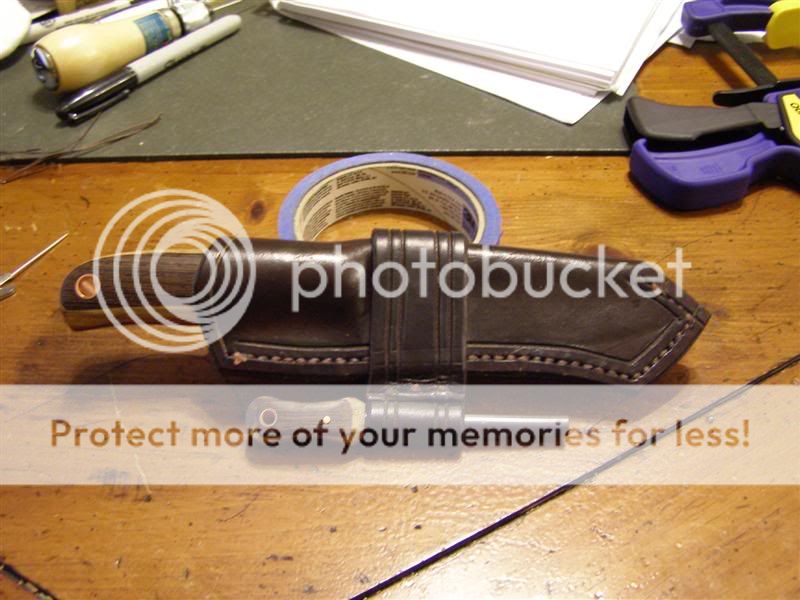
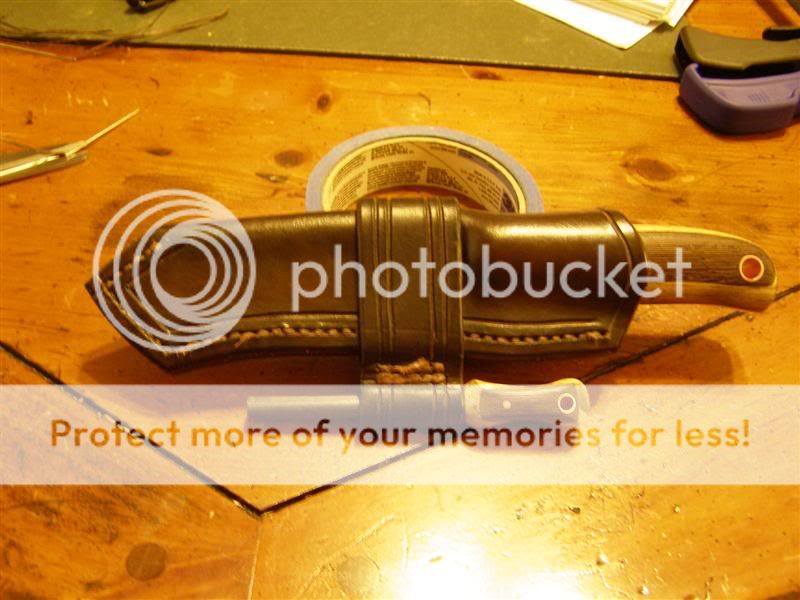
Thanks for the replies everyone. Here's a few pics of of my first knife, fire steel, and first sheath. I still need to make the belt loop strap.

P1010094Medium.jpg

P1010095Medium.jpg


I'm working on three more knives, so that's three more sheaths to make. Thanks for the tips.
 
nice job Wulf - I also like the 2 tone handles w/copper tubing for lanyard holes!
 
Back
Top